
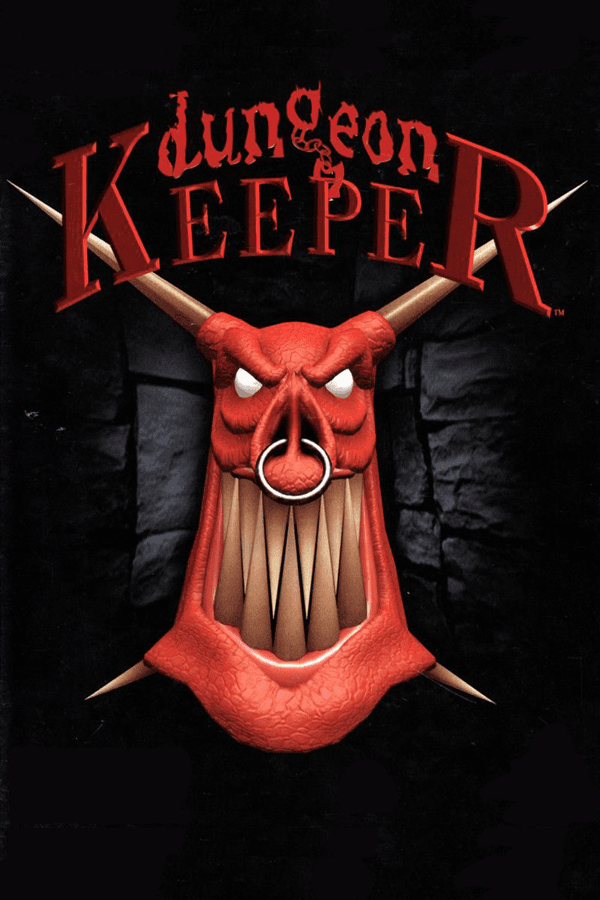

In Dungeon Keeper, you do not command noble armies saving the realm, but an unseen hand carving subterranean fortresses, slapping weak Imps, and crushing invasion forces under iron doors.
Most real-time strategy games task you with laying down timber supply lines and building neat villages under open skies. Bullfrog Productions, Ltd. flipped that setup on its head by burying the entire match inside damp, pitch-black rock. You mark dirt tiles for your red-skinned Imps to mine, unearthing veins of gold to fund your lair while leaving unyielding solid granite as natural defense walls.
Every level on the overworld map begins as a quiet, empty cavern surrounding your pulsating Dungeon Heart. In early campaign missions like Eversmile, the routine feels crisp and tidy. You carve out square rooms, paint down floor tiles to claim territory, and set up basic facilities to lure unholy denizens through your gateway. A basic setup requires four core rooms: a Lair for creatures to sleep, a Hatchery spawning squawking chickens for food, a Library where researchers uncover new spells, and a Training Room where minions spar to raise their stats.
The basic loop relies on managing competing room requirements against limited space. Expand your claimed ground into open dirt, build room walls near central corridors, and protect your Dungeon Heart at all costs. If that Heart breaks, the realm falls and your run ends immediately.
Attracting minions is only half the battle, keeping them happy enough not to tear your own dungeon apart is where the real management lies. Weak, early-game creatures like Flies and Beetles demand very little space, but they fall in seconds when a heavily armored Knight or Archer steps through your front gate. High-tier monsters bring severe operational headaches.
Bile Demons demand enormous Hatcheries, consume massive amounts of food, and produce noxious gas that angers nearby allies. Horned Reapers represent the ultimate melee force on your payroll, but they possess a lethal temper. Leave a Horned Reaper idle without a combat goal or isolate him in a cramped room, and he will go berserk, slaughtering your own Imps, Vampires, and Hellhounds before marching off to fight your own Dungeon Heart.
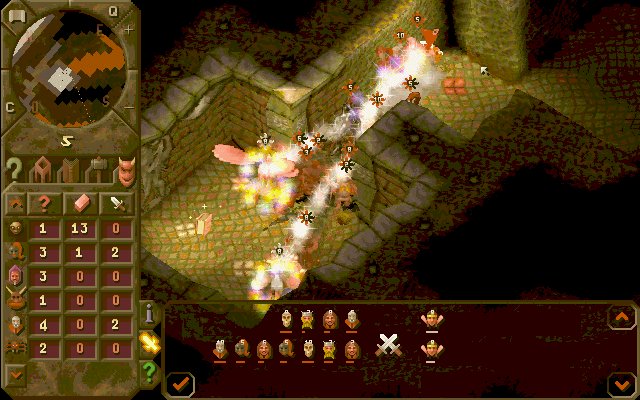
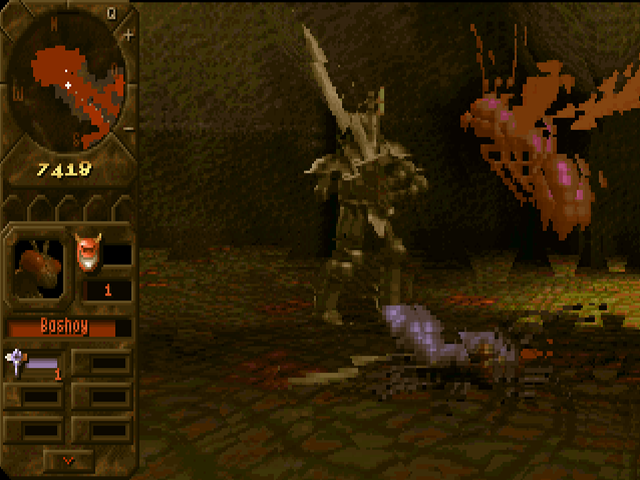
Directing these creatures relies on subtle manipulation rather than direct RTS clicks. You can pick minions up in hand and drop them into specific rooms, though dropping them directly into combat stuns them briefly on the floor. To speed up lazy researchers or sluggish diggers, you use the "Must Obey" spell to slap them across the room, boosting their task speed at the cost of a small slice of health. When you want direct control, casting the Possession spell drops the top-down perspective down to a first-person view, letting you walk through dirt corridors, attack heroes directly, and view your creation through custom visual filters like a Fly's segmented compound eyes.
Lead programmer Simon Carter built a hybrid engine that combined full 3D terrain blocks with flat 2D pixel sprites. The perspective allowed total camera rotation and real-time dynamic light sources. Torches cast flickering shadows across raw stone, while spells like "Sight of Evil" lit up distant unexplored caverns across the fog of war.
Audio design pulled equal weight in creating that oppressive, subterranean mood. Composer Russell Shaw utilized native hardware features of Creative Sound Blaster AWE32 and AWE64 sound cards, uploading custom dynamic SoundFont bank files directly into onboard card RAM. Instead of standard MIDI tracks, the sound card produced atmospheric dripping water, heavy footfalls, and distant moans that standard PC speakers could never render accurately.
The game came packed with weird secrets and blunt developer jokes. Holding Shift and typing developer codes like "FECKOFF" or "SKEKSIS" sent scrolling text bouncing across the display, including personal messages from the dev team. Playing the Electronic Arts, Inc. release on May 3 displayed a secret birthday greeting to Simon Carter, while playing during a real-world full moon unlocked a hidden bonus level on the campaign map. Regional censorship also left its mark: the German release had to replace the blood-soaked Torture Chamber animations with generic tent covers to pass local distribution checks.
For all its personality, the mid-to-late campaign design exposes major control flaws. When late-game heroic invasion waves send Tunnelers, Monks, Wizards, Fairies, and Knights through your walls, combat devolves into a messy cluster of overlapping pixel sprites. Trying to click and pick up a specific injured unit out of a twelve-creature brawl is almost impossible, and creatures frequently wander away from defensive flags due to weak pathfinding routines.
The artificial intelligence in later maps presents another wall. Enemy Keepers ignore key fog-of-war constraints, spawning infinite gold resources while sending Tunnelers on perfect, straight-line vectors toward your most vulnerable room walls. Before your Workrooms can manufacture Gas traps, Alarm traps, or reinforced doors to funnel enemies into kill zones, an aggressive enemy AI can rush your position and destroy your Dungeon Heart while your minions sit idly in the Hatchery.
Compared to other strategy / tactics releases from 1997 like Command & Conquer: Red Alert or Age of Empires, direct unit control here is deliberately indirect. When pathfinding glitches cause your Vampires to walk through lava pools instead of taking a safe bridge, the resulting loss feels like fighting the interface rather than the enemy invasion force.
Despite control quirks and late-campaign difficulty spikes, the core design holds up solid. The satisfaction of designing an efficient dungeon grid, collecting hidden "Resurrect Creature" boxes, and defending your lair against the final hero boss, the Avatar, delivers a tactical loop that very few strategy games have matched since.
The original balance leans heavily on micro-management, making late levels frustrating without modern source ports, but the early and mid-game campaigns remain absolute classics. Anyone interested in real-time management systems with real dark humor should play through the opening realms at least once.
You can play Dungeon Keeper free in your browser right now, with nothing to install and no setup required. New players often make the mistake of digging wide, massive open spaces immediately; keep your rock corridors narrow, place your Hatchery close to your Lair, and keep a tight leash on your Imps to survive your first heroic raid in this landmark classic Dungeon Keeper MS-DOS game.
In Dungeon Keeper, you do not command noble armies saving the realm, but an unseen hand carving subterranean fortresses, slapping weak Imps, and crushing invasion forces under iron doors.
Most real-time strategy games task you with laying down timber supply lines and building neat villages under open skies. Bullfrog Productions, Ltd. flipped that setup on its head by burying the entire match inside damp, pitch-black rock. You mark dirt tiles for your red-skinned Imps to mine, unearthing veins of gold to fund your lair while leaving unyielding solid granite as natural defense walls.
Every level on the overworld map begins as a quiet, empty cavern surrounding your pulsating Dungeon Heart. In early campaign missions like Eversmile, the routine feels crisp and tidy. You carve out square rooms, paint down floor tiles to claim territory, and set up basic facilities to lure unholy denizens through your gateway. A basic setup requires four core rooms: a Lair for creatures to sleep, a Hatchery spawning squawking chickens for food, a Library where researchers uncover new spells, and a Training Room where minions spar to raise their stats.
The basic loop relies on managing competing room requirements against limited space. Expand your claimed ground into open dirt, build room walls near central corridors, and protect your Dungeon Heart at all costs. If that Heart breaks, the realm falls and your run ends immediately.
Attracting minions is only half the battle, keeping them happy enough not to tear your own dungeon apart is where the real management lies. Weak, early-game creatures like Flies and Beetles demand very little space, but they fall in seconds when a heavily armored Knight or Archer steps through your front gate. High-tier monsters bring severe operational headaches.
Bile Demons demand enormous Hatcheries, consume massive amounts of food, and produce noxious gas that angers nearby allies. Horned Reapers represent the ultimate melee force on your payroll, but they possess a lethal temper. Leave a Horned Reaper idle without a combat goal or isolate him in a cramped room, and he will go berserk, slaughtering your own Imps, Vampires, and Hellhounds before marching off to fight your own Dungeon Heart.
Directing these creatures relies on subtle manipulation rather than direct RTS clicks. You can pick minions up in hand and drop them into specific rooms, though dropping them directly into combat stuns them briefly on the floor. To speed up lazy researchers or sluggish diggers, you use the "Must Obey" spell to slap them across the room, boosting their task speed at the cost of a small slice of health. When you want direct control, casting the Possession spell drops the top-down perspective down to a first-person view, letting you walk through dirt corridors, attack heroes directly, and view your creation through custom visual filters like a Fly's segmented compound eyes.
Lead programmer Simon Carter built a hybrid engine that combined full 3D terrain blocks with flat 2D pixel sprites. The perspective allowed total camera rotation and real-time dynamic light sources. Torches cast flickering shadows across raw stone, while spells like "Sight of Evil" lit up distant unexplored caverns across the fog of war.
Audio design pulled equal weight in creating that oppressive, subterranean mood. Composer Russell Shaw utilized native hardware features of Creative Sound Blaster AWE32 and AWE64 sound cards, uploading custom dynamic SoundFont bank files directly into onboard card RAM. Instead of standard MIDI tracks, the sound card produced atmospheric dripping water, heavy footfalls, and distant moans that standard PC speakers could never render accurately.
The game came packed with weird secrets and blunt developer jokes. Holding Shift and typing developer codes like "FECKOFF" or "SKEKSIS" sent scrolling text bouncing across the display, including personal messages from the dev team. Playing the Electronic Arts, Inc. release on May 3 displayed a secret birthday greeting to Simon Carter, while playing during a real-world full moon unlocked a hidden bonus level on the campaign map. Regional censorship also left its mark: the German release had to replace the blood-soaked Torture Chamber animations with generic tent covers to pass local distribution checks.
For all its personality, the mid-to-late campaign design exposes major control flaws. When late-game heroic invasion waves send Tunnelers, Monks, Wizards, Fairies, and Knights through your walls, combat devolves into a messy cluster of overlapping pixel sprites. Trying to click and pick up a specific injured unit out of a twelve-creature brawl is almost impossible, and creatures frequently wander away from defensive flags due to weak pathfinding routines.
The artificial intelligence in later maps presents another wall. Enemy Keepers ignore key fog-of-war constraints, spawning infinite gold resources while sending Tunnelers on perfect, straight-line vectors toward your most vulnerable room walls. Before your Workrooms can manufacture Gas traps, Alarm traps, or reinforced doors to funnel enemies into kill zones, an aggressive enemy AI can rush your position and destroy your Dungeon Heart while your minions sit idly in the Hatchery.
Compared to other strategy / tactics releases from 1997 like Command & Conquer: Red Alert or Age of Empires, direct unit control here is deliberately indirect. When pathfinding glitches cause your Vampires to walk through lava pools instead of taking a safe bridge, the resulting loss feels like fighting the interface rather than the enemy invasion force.
Despite control quirks and late-campaign difficulty spikes, the core design holds up solid. The satisfaction of designing an efficient dungeon grid, collecting hidden "Resurrect Creature" boxes, and defending your lair against the final hero boss, the Avatar, delivers a tactical loop that very few strategy games have matched since.
The original balance leans heavily on micro-management, making late levels frustrating without modern source ports, but the early and mid-game campaigns remain absolute classics. Anyone interested in real-time management systems with real dark humor should play through the opening realms at least once.
You can play Dungeon Keeper free in your browser right now, with nothing to install and no setup required. New players often make the mistake of digging wide, massive open spaces immediately; keep your rock corridors narrow, place your Hatchery close to your Lair, and keep a tight leash on your Imps to survive your first heroic raid in this landmark classic Dungeon Keeper MS-DOS game.
How Dungeon Keeper is played — the keys the game listens to, grouped by what they do.
Highlighted keys are mapped — hover or tap one to see what it does.
Control layout derived from provided research notes for Dungeon Keeper on MS-DOS.
Cheat codes, console commands and memory pokes for Dungeon Keeper — each one verified and attributed.
Sign in to submitHow Dungeon Keeper is played — the keys the game listens to, grouped by what they do.
Highlighted keys are mapped — hover or tap one to see what it does.
Control layout derived from provided research notes for Dungeon Keeper on MS-DOS.
Cheat codes, console commands and memory pokes for Dungeon Keeper — each one verified and attributed.
Sign in to submit