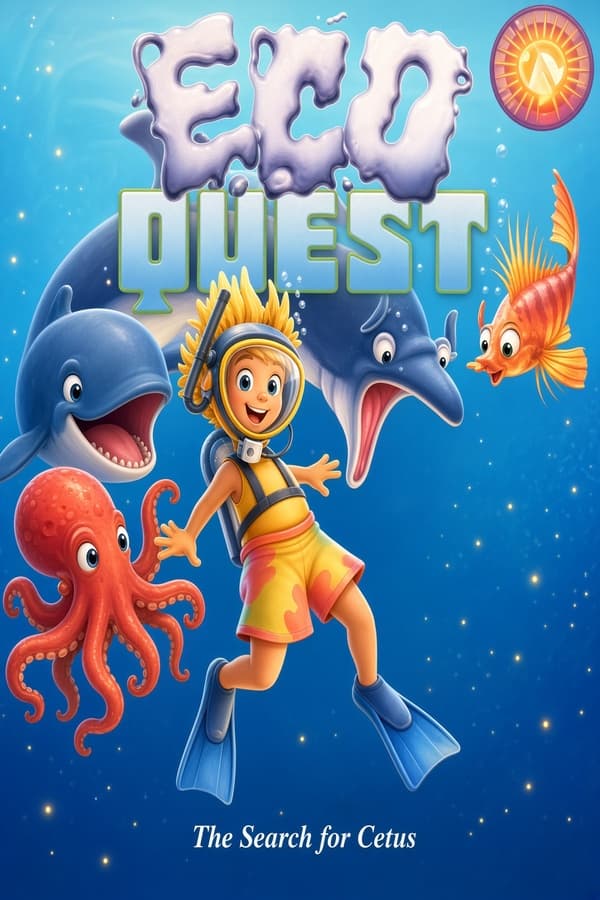
aka EcoQuest 1: The Search for Cetus
Playing EcoQuest I: The Search for Cetus takes you straight back to the golden age of point-and-click adventures, where saving the ocean meant combining obscure inventory items and obsessively collecting discarded trash.
By 1991, Sierra On-Line, Inc. had a reputation for cruelty. A wrong step in King's Quest could leave you dead without warning, or stuck hours later because you forgot to grab a tiny item in the opening screen. Designers Jane Jensen and Gano Haine took a completely different path when building this game. They wanted an environmental title that taught kids about ocean conservation without falling into hopeless preaching or forcing sudden game-over screens. The result was a world where you literally cannot die or get permanently stuck.
You play as Adam Greene, a young diver working with his marine biologist father. Before you even set foot in the ocean, the game hits you with an old-school copy protection puzzle inside the lab. You have to open a security door by punching in 9731, a code printed right in the physical manual. Once past the door, Adam rescues a stranded dolphin named Delphineus, who turns out to be a talking resident of an underwater kingdom called Eluria. The whale king Cetus has disappeared, and it falls to Adam to dive deep and restore order to the sea.
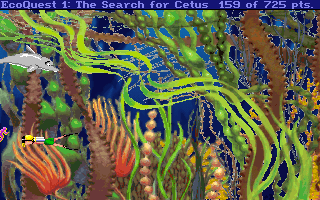
The interface is built on the mouse-driven SCI1 engine, utilizing Sierra's standard verb icons like Look, Talk, and Use. However, this release famously added a bright green recycling symbol to the action palette. Clicking this icon on floating debris, abandoned fishing nets, and oil slicks cleans up the water and grants extra points toward your final score of 725. It turns environmental cleanup into a core mechanic, rewarding thorough players for scouring every background for hidden garbage.
The campaign alternates between real-world environmental hazards and mythic underwater locations. You will find yourself solving puzzles in a murky kelp maze, navigating political intrigue among sentient marine life, and seeking wisdom from an ancient Oracle. The music shines through standard PC sound cards of the era, but plugging in a Roland MT-32 synth module reveals rich, atmospheric compositions by Chris Braymen that make the ocean depths feel surprisingly vast.
At the time of release, critics noted that this was largely a single-play experience. Once you knew the solutions to the ocean riddles, returning to the campaign offered little beyond squeezing out a few missed points on the recycling counter. Furthermore, the difficulty curve lands in an awkward middle ground. While the talking dolphin premise and eco-friendly messages aim squarely at younger players, several late-game inventory puzzles present a stiff challenge that can stop kids in their tracks while feeling slightly too juvenile for adult veterans of the genre.
Despite that tonal split, the production quality holds up well. The hand-drawn backgrounds carry tons of detail, from the sway of underwater flora to the grim, polluted ruins of neglected reefs. Following this release, Sierra put out a 1993 sequel, Lost Secret of the Rainforest, though Jensen moved on to write Gabriel Knight: Sins of the Fathers. The original stands alone in Sierra's catalog for how it pairs environmental awareness with classic adventure logic.

If you want to experience this early 90s adventure game, you can play EcoQuest I: The Search for Cetus free in your browser right now. The game was initially distributed on floppy disks in 1991 before getting a CD-ROM talkie re-release featuring full voice acting, though planned ports to the Amiga and Macintosh were cancelled before launch.
The absence of cheap player deaths makes this one of the most stress-free entries in Sierra's library. The environmental puzzles are logical, the art design looks great, and the recycling system gives every screen a fun secondary objective. You can launch this Sierra On-Line, Inc. title directly in your browser with no extra steps. Fire it up, keep your eye out for discarded plastic, and remember that code 9731 when you hit the lab door.
Playing EcoQuest I: The Search for Cetus takes you straight back to the golden age of point-and-click adventures, where saving the ocean meant combining obscure inventory items and obsessively collecting discarded trash.
By 1991, Sierra On-Line, Inc. had a reputation for cruelty. A wrong step in King's Quest could leave you dead without warning, or stuck hours later because you forgot to grab a tiny item in the opening screen. Designers Jane Jensen and Gano Haine took a completely different path when building this game. They wanted an environmental title that taught kids about ocean conservation without falling into hopeless preaching or forcing sudden game-over screens. The result was a world where you literally cannot die or get permanently stuck.
You play as Adam Greene, a young diver working with his marine biologist father. Before you even set foot in the ocean, the game hits you with an old-school copy protection puzzle inside the lab. You have to open a security door by punching in 9731, a code printed right in the physical manual. Once past the door, Adam rescues a stranded dolphin named Delphineus, who turns out to be a talking resident of an underwater kingdom called Eluria. The whale king Cetus has disappeared, and it falls to Adam to dive deep and restore order to the sea.

The interface is built on the mouse-driven SCI1 engine, utilizing Sierra's standard verb icons like Look, Talk, and Use. However, this release famously added a bright green recycling symbol to the action palette. Clicking this icon on floating debris, abandoned fishing nets, and oil slicks cleans up the water and grants extra points toward your final score of 725. It turns environmental cleanup into a core mechanic, rewarding thorough players for scouring every background for hidden garbage.
The campaign alternates between real-world environmental hazards and mythic underwater locations. You will find yourself solving puzzles in a murky kelp maze, navigating political intrigue among sentient marine life, and seeking wisdom from an ancient Oracle. The music shines through standard PC sound cards of the era, but plugging in a Roland MT-32 synth module reveals rich, atmospheric compositions by Chris Braymen that make the ocean depths feel surprisingly vast.
At the time of release, critics noted that this was largely a single-play experience. Once you knew the solutions to the ocean riddles, returning to the campaign offered little beyond squeezing out a few missed points on the recycling counter. Furthermore, the difficulty curve lands in an awkward middle ground. While the talking dolphin premise and eco-friendly messages aim squarely at younger players, several late-game inventory puzzles present a stiff challenge that can stop kids in their tracks while feeling slightly too juvenile for adult veterans of the genre.
Despite that tonal split, the production quality holds up well. The hand-drawn backgrounds carry tons of detail, from the sway of underwater flora to the grim, polluted ruins of neglected reefs. Following this release, Sierra put out a 1993 sequel, Lost Secret of the Rainforest, though Jensen moved on to write Gabriel Knight: Sins of the Fathers. The original stands alone in Sierra's catalog for how it pairs environmental awareness with classic adventure logic.

If you want to experience this early 90s adventure game, you can play EcoQuest I: The Search for Cetus free in your browser right now. The game was initially distributed on floppy disks in 1991 before getting a CD-ROM talkie re-release featuring full voice acting, though planned ports to the Amiga and Macintosh were cancelled before launch.
The absence of cheap player deaths makes this one of the most stress-free entries in Sierra's library. The environmental puzzles are logical, the art design looks great, and the recycling system gives every screen a fun secondary objective. You can launch this Sierra On-Line, Inc. title directly in your browser with no extra steps. Fire it up, keep your eye out for discarded plastic, and remember that code 9731 when you hit the lab door.
How EcoQuest I: The Search for Cetus is played — the keys the game listens to, grouped by what they do.
Highlighted keys are mapped — hover or tap one to see what it does.
Pressing the same direction key a second time stops character movement.
The on-screen keyboard and gamepad mapping the browser player uses on a phone, a tablet or a controller, as opposed to the real keys above. $PRO members make their own in the player and share them here; anyone can pick one to play with.
Cheat codes, console commands and memory pokes for EcoQuest I: The Search for Cetus — each one verified and attributed.
Sign in to submitHow EcoQuest I: The Search for Cetus is played — the keys the game listens to, grouped by what they do.
Highlighted keys are mapped — hover or tap one to see what it does.
Pressing the same direction key a second time stops character movement.
The on-screen keyboard and gamepad mapping the browser player uses on a phone, a tablet or a controller, as opposed to the real keys above. $PRO members make their own in the player and share them here; anyone can pick one to play with.
Cheat codes, console commands and memory pokes for EcoQuest I: The Search for Cetus — each one verified and attributed.
Sign in to submit