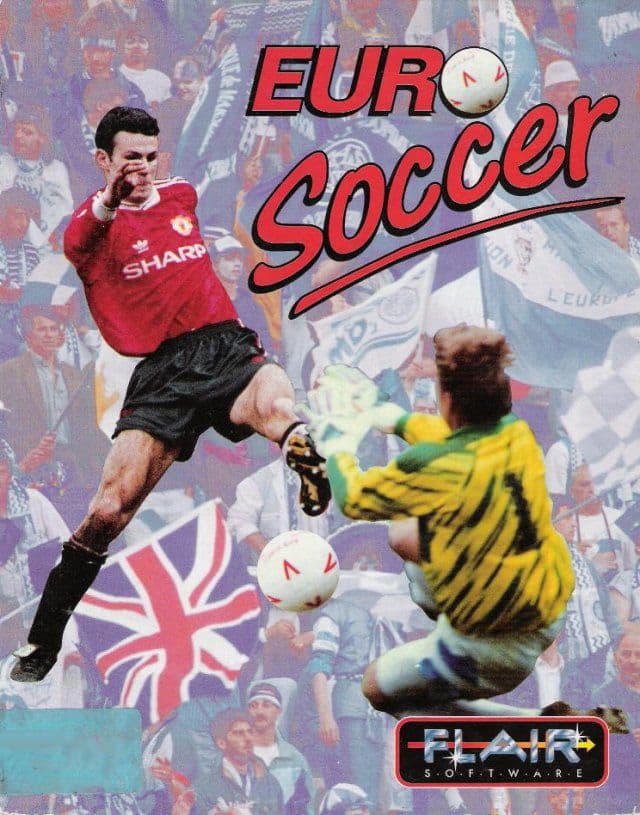
If you played Euro Soccer on MS-DOS in 1992, you probably remember booting up the executable, tapping the enter key to skip the manual word check, and immediately wondering where your winger had gone off-screen.
Big pitch graphics meet a curious tracking camera
Creative Edge Software went for an aggressive graphic scale in Euro Soccer. Instead of tiny stick figures running across a vast field, you get large, detailed player sprites. You can easily spot the kit details and the distinct player animations as team members jog, kick, and tackle across the grass. It looks impressive on paper, especially when running in full VGA color alongside an AdLib or Sound Blaster card playing the national anthems before kickoff.
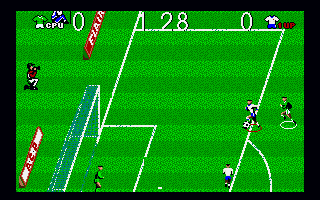
That visual choice comes with a severe structural compromise. Because the sprites occupy so much real estate, the diagonal-down pitch view feels cramped. The camera tracks the ball with a noticeable delay, frequently leaving the active player off-screen. You often find yourself controlling a teammate who is floating somewhere beyond the display edge, forcing you to guess your position relative to the ball.
Pitch friction and the stubborn control setup in Euro Soccer
Controlling your squad is where the game reveals its toughest edge. Programmer Sean Connolly built a system where the ball snaps directly to the feet of the active runner. Once you take possession, directional movement locks into eight strict vectors. Trying to pull off an arched pass or curve a shot around a defensive wall is virtually impossible, a point that contemporary magazine reviewers slammed hard upon release.
Executing advanced maneuvers feels like fighting the hardware input itself. Volleying a high cross requires precise timing that the sluggish controller response rarely rewards. Defensive play boils down to sliding directly into the path of an opponent before they trigger a straight-line shot. The computer goalkeeper operates entirely on auto-pilot, meaning you can only watch as the AI misjudges an incoming drive.
Tournament stakes with zero safety nets
The single-player mode places you straight into the Euro Cup tournament against heavyweights like AC Milan, Real Madrid, and Bayern München. You get basic match options to tweak before kicking off, including match lengths from two to eight minutes, dry or wet pitch conditions, and standard formations like 4-4-2 or 4-3-3.
- Friendly match mode for two local players using a keyboard and joystick combo.
- Single-player Euro Cup tournament mode featuring top European clubs.
- Toggleable weather conditions that alter pitch traction.
- Tactical formation selection covering classic 4-4-2, 4-3-3, and aggressive 4-2-4 spreads.
The core issue with tournament mode is the total lack of a save feature. If you want to take a club through the entire bracket, you have to complete the run in one sitting. A single slip in the semi-finals wipes out your entire session, sending you straight back to the main menu with nothing to show for it.
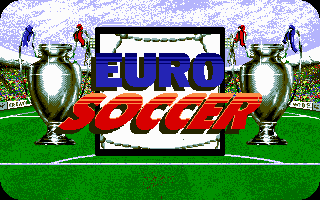
How the DOS release holds up today
Compared to other early nineties sports games, Euro Soccer prioritized visual punch over precise control input. Published by Flair Software Ltd., it delivered bold player models, but missed the responsiveness that made rival side-scrolling football titles thrive on home computers.
If you want to sample this piece of PC sports history, you can play Euro Soccer free in your browser right now. You can jump into a match immediately without digging up an old MS-DOS installation or tracking down missing manual pages. Pick your favourite European club, turn off the national anthems if the FM synthesis gets too loud, and see if you can manage the camera delay long enough to lift the cup.