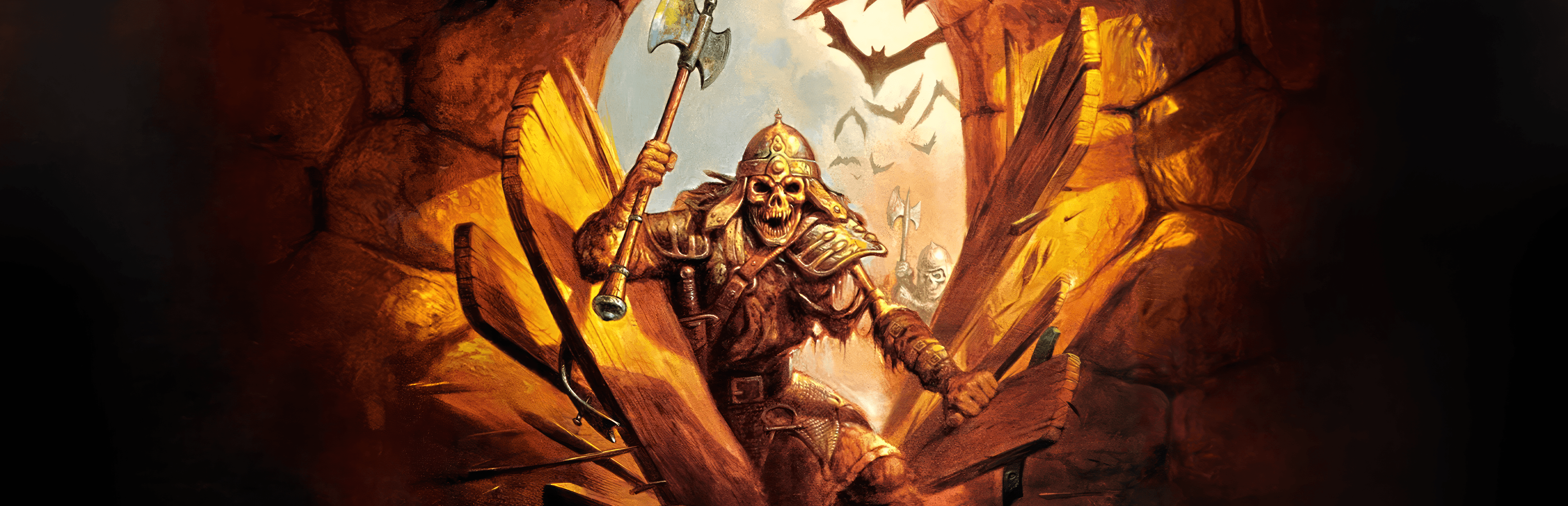
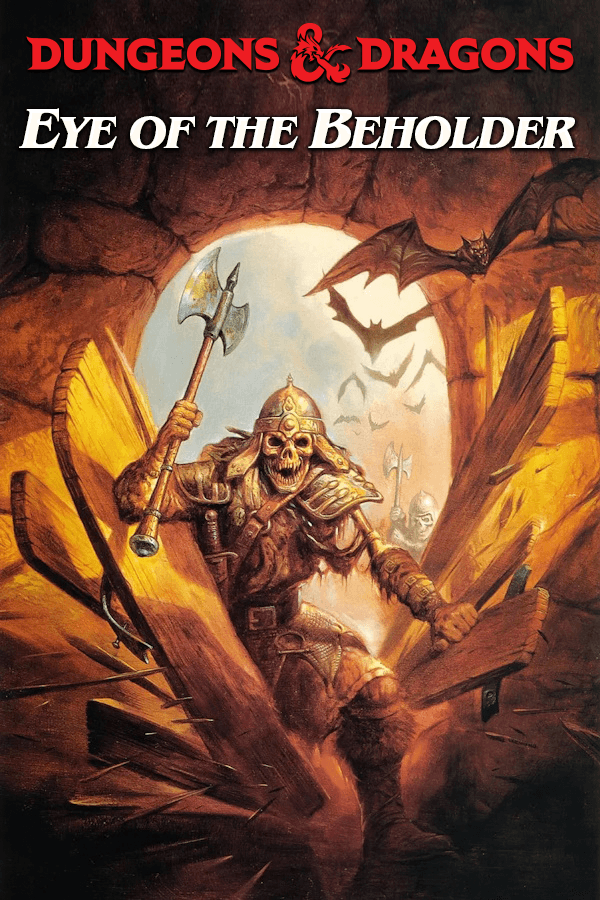

Trapped under the city of Waterdeep with a collapsed ceiling behind your party, Eye of the Beholder turns a standard D&D dungeon crawl into a tense real-time race against kobolds, spiders, and a deadly crime lord.
Before this dungeon hit PC monitors, computer role-playing games usually gave you time to deliberate. You sat at your keyboard, carefully planning every turn while monsters waited politely for their turn to strike. Westwood Associates flipped that formula by embracing the continuous flow of FTL's Dungeon Master, building a game where resting to memorise spells could easily invite a roaming patrol of skeletons into your camp.
The Lords of Waterdeep commission your party of four heroes to investigate a corruption beneath the city, but early on, a cave-in seals the entrance behind you. From that moment, your only path lies deeper into twelve levels of stone corridors. The game uses a first-person perspective locked to a 3D grid layout, forcing you to track spatial orientation purely by relative direction and step-by-step movement.
Building your initial group under the 2nd Edition Advanced Dungeons & Dragons rules determines your survival rate immediately. Bringing a front line of heavily armoured fighters backed by a cleric and a mage is standard, but you can also recruit up to two additional non-player characters deep inside the dungeon. Managing their inventory, spellbooks, and food rations happens live on screen through a point-and-click interface, forcing you to juggle weapons and spell icons while enemies actively strike back.
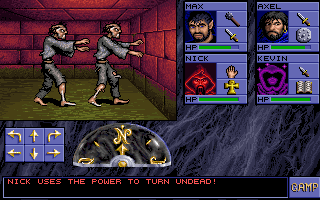
Descending through the three distinct zones of the dungeon, from the slimy Waterdeep Sewers down into the ancient Dwarven Ruins and finally the Drow and Xanathar Lair levels, brings increasingly cruel level design. The interface offers no in-game automap whatsoever. Players in 1991 had to keep a pad of graph paper next to their keyboard, drawing every corridor, door, and turning point by hand.
Without manual mapping, teleporter mazes will ruin your run. Certain pressure plates silently spin your party ninety degrees or move you back three spaces without changing the visual alignment of the wall in front of you. You might walk forward four paces, turn right, and realize you are back in a room you cleared twenty minutes ago without knowing how you got there.
Progress relies heavily on key management, secret wall buttons, and dwarven power objects needed to unlock hidden portals. A simple grid puzzle can block access to vital gear, while pit traps drop unsuspecting parties down into lower levels swarming with mantis warriors or kuo-toa before they are properly equipped to fight them.
Combat in this tile-based real-time environment demands fast fingers. Because party members attack based on weapon cool-downs, success depends on clicking attack icons in quick succession across your front rank, then reaching into your caster's spell list to launch magic missiles or fireballs from the back. The sound design plays a huge role here, as the harsh clack of the PC Speaker or the rich soundscapes of a Sound Blaster card alert you to footsteps before an enemy turns the corner.
The regular enemy roster presents steep challenges, especially when giant spiders inflict poison that drains party health fast unless your cleric has the right spells memorised. Yet nothing in the game generated as much discussion among players as the final boss fight against the beholder Xanathar. Fighting his massive health pool head-on often ends in complete party wipeouts within seconds.
Players quickly discovered two clever workarounds for the final fight. One method involves using the Wand of Silvias to weaken him, while another relies on baiting Xanathar backward into a specific wall trap where a spike mechanism eliminates him instantly. Navigating early areas also required keeping your original game box handy, as physical copy protection forced players to check symbols on a cardboard code wheel or look up specific manual lines to unlock key doors.
Published by Strategic Simulations, Inc., the game became a massive hit, reaching the top of sales charts shortly after launch and earning a 5 out of 5 star rating in Dragon Magazine. Contemporaries like Computer Gaming World praised its fluid mouse interface and atmospheric 3D grid layout, recognizing how significantly it refined the real-time RPG genre for PC screens.
Yet despite all the praise, one major flaw left a bitter taste for many players. Defeating Xanathar brings no epic cutscene or animated reward. Instead, the game delivers a quick block of text describing your victory before dropping you straight back to the DOS prompt. It felt abrupt and jarring after spending dozens of hours mapping twelve brutal levels on graph paper.
That sudden ending did not stop the title from founding a celebrated series. Westwood developed a direct sequel later in 1991, expanding on narrative depth before moving on to other projects, leaving SSI to finish the third chapter in-house years later.
The technical polish of the early dungeon levels, the crunch of real-time inventory management, and the genuine tension of stepping onto an unmarked floor tile make this tile-based adventure worth experiencing today. While the lack of an auto-map tests your patience and the abrupt ending is still frustrating, the raw design of its monster encounters and spell management holds up well.
You can play Eye of the Beholder free in your browser right now with no setup required. Launching the MS-DOS game directly in your browser lets you feel the exact panic of managing weapon cool-downs while poisoned by giant spiders, giving you the complete dungeon experience without hunting down vintage computer hardware.
Trapped under the city of Waterdeep with a collapsed ceiling behind your party, Eye of the Beholder turns a standard D&D dungeon crawl into a tense real-time race against kobolds, spiders, and a deadly crime lord.
Before this dungeon hit PC monitors, computer role-playing games usually gave you time to deliberate. You sat at your keyboard, carefully planning every turn while monsters waited politely for their turn to strike. Westwood Associates flipped that formula by embracing the continuous flow of FTL's Dungeon Master, building a game where resting to memorise spells could easily invite a roaming patrol of skeletons into your camp.
The Lords of Waterdeep commission your party of four heroes to investigate a corruption beneath the city, but early on, a cave-in seals the entrance behind you. From that moment, your only path lies deeper into twelve levels of stone corridors. The game uses a first-person perspective locked to a 3D grid layout, forcing you to track spatial orientation purely by relative direction and step-by-step movement.
Building your initial group under the 2nd Edition Advanced Dungeons & Dragons rules determines your survival rate immediately. Bringing a front line of heavily armoured fighters backed by a cleric and a mage is standard, but you can also recruit up to two additional non-player characters deep inside the dungeon. Managing their inventory, spellbooks, and food rations happens live on screen through a point-and-click interface, forcing you to juggle weapons and spell icons while enemies actively strike back.

Descending through the three distinct zones of the dungeon, from the slimy Waterdeep Sewers down into the ancient Dwarven Ruins and finally the Drow and Xanathar Lair levels, brings increasingly cruel level design. The interface offers no in-game automap whatsoever. Players in 1991 had to keep a pad of graph paper next to their keyboard, drawing every corridor, door, and turning point by hand.
Without manual mapping, teleporter mazes will ruin your run. Certain pressure plates silently spin your party ninety degrees or move you back three spaces without changing the visual alignment of the wall in front of you. You might walk forward four paces, turn right, and realize you are back in a room you cleared twenty minutes ago without knowing how you got there.
Progress relies heavily on key management, secret wall buttons, and dwarven power objects needed to unlock hidden portals. A simple grid puzzle can block access to vital gear, while pit traps drop unsuspecting parties down into lower levels swarming with mantis warriors or kuo-toa before they are properly equipped to fight them.
Combat in this tile-based real-time environment demands fast fingers. Because party members attack based on weapon cool-downs, success depends on clicking attack icons in quick succession across your front rank, then reaching into your caster's spell list to launch magic missiles or fireballs from the back. The sound design plays a huge role here, as the harsh clack of the PC Speaker or the rich soundscapes of a Sound Blaster card alert you to footsteps before an enemy turns the corner.
The regular enemy roster presents steep challenges, especially when giant spiders inflict poison that drains party health fast unless your cleric has the right spells memorised. Yet nothing in the game generated as much discussion among players as the final boss fight against the beholder Xanathar. Fighting his massive health pool head-on often ends in complete party wipeouts within seconds.
Players quickly discovered two clever workarounds for the final fight. One method involves using the Wand of Silvias to weaken him, while another relies on baiting Xanathar backward into a specific wall trap where a spike mechanism eliminates him instantly. Navigating early areas also required keeping your original game box handy, as physical copy protection forced players to check symbols on a cardboard code wheel or look up specific manual lines to unlock key doors.

Published by Strategic Simulations, Inc., the game became a massive hit, reaching the top of sales charts shortly after launch and earning a 5 out of 5 star rating in Dragon Magazine. Contemporaries like Computer Gaming World praised its fluid mouse interface and atmospheric 3D grid layout, recognizing how significantly it refined the real-time RPG genre for PC screens.
Yet despite all the praise, one major flaw left a bitter taste for many players. Defeating Xanathar brings no epic cutscene or animated reward. Instead, the game delivers a quick block of text describing your victory before dropping you straight back to the DOS prompt. It felt abrupt and jarring after spending dozens of hours mapping twelve brutal levels on graph paper.
That sudden ending did not stop the title from founding a celebrated series. Westwood developed a direct sequel later in 1991, expanding on narrative depth before moving on to other projects, leaving SSI to finish the third chapter in-house years later.
The technical polish of the early dungeon levels, the crunch of real-time inventory management, and the genuine tension of stepping onto an unmarked floor tile make this tile-based adventure worth experiencing today. While the lack of an auto-map tests your patience and the abrupt ending is still frustrating, the raw design of its monster encounters and spell management holds up well.
You can play Eye of the Beholder free in your browser right now with no setup required. Launching the MS-DOS game directly in your browser lets you feel the exact panic of managing weapon cool-downs while poisoned by giant spiders, giving you the complete dungeon experience without hunting down vintage computer hardware.
The on-screen keyboard and gamepad mapping the browser player uses on a phone, a tablet or a controller, as opposed to the real keys above. $PRO members make their own in the player and share them here; anyone can pick one to play with.
Cheat codes, console commands and memory pokes for Eye of the Beholder — each one verified and attributed.
Sign in to submitaka Official Advanced Dungeons & Dragons Computer Product : Eye of the Beholder – A LEGEND SERIES Fantasy Role-Playing Saga, · EOB · EotB
The on-screen keyboard and gamepad mapping the browser player uses on a phone, a tablet or a controller, as opposed to the real keys above. $PRO members make their own in the player and share them here; anyone can pick one to play with.
Cheat codes, console commands and memory pokes for Eye of the Beholder — each one verified and attributed.
Sign in to submit