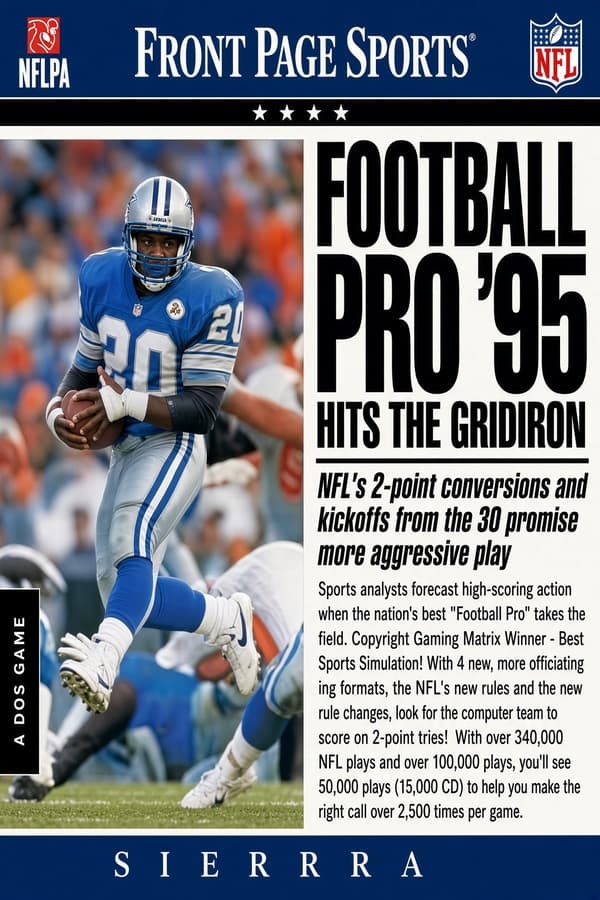
Front Page Sports: Football Pro '95 brought full-season career management, customizable playbooks, and 360-degree rotoscoped graphics to MS-DOS PCs. It gave simulation fans total control over tactics and rosters right when console sports titles were still focused on simple arcade action.
Most football games in the early nineties focused strictly on what happened between the white lines during a single afternoon. Dynamix took a completely different approach with their franchise. They built a multi-season career engine where players age, contract skills deteriorate, and veterans eventually retire.
You can take charge of any of the 28 official NFL teams with complete 1994 rosters and player ratings. Managing your franchise means balancing salaries, negotiating trades, and scouting rookie talent in annual college drafts. Watching your star quarterback drop in velocity after four hard seasons forces you to think about drafting his replacement long before he hangs up his helmet.
The statistical depth extends far beyond standard season totals. The simulation tracks individual player ratings alongside real stats to select Pro Bowl rosters at the end of each year. Online commissioner leagues quickly formed around this system, as players began trading roster files across bulletin board systems to run entire multi-season leagues together.
The defining strength of the series was always its play creation system. Instead of picking from a rigid set of preset formations, you can design every route and assignment on the field. You set the exact movement path for receivers, assign specific blocking schemes for linemen, and fine-tune defensive coverages down to the individual step.
The game shipped with 3,000 stock plays on floppy disk, while the CD-ROM edition expanded that database to 10,000 plays. You can adjust your playbook to counter over 2,500 distinct match situations. It turned game planning into a detailed exercise in tactical geometry where success depended on finding soft spots in a defense.
That level of tactical depth means you cannot simply rely on quick reflexes. If your offensive scheme is flawed, opponent defenses will quickly adapt to your habits. The computer AI analyzes your play calls over the course of a game, punishing callers who run the same dive play on third and short every time.
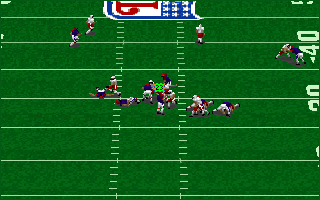
On the field, rotoscoped VGA animation gave player movement a distinct visual weight. Fullbacks hit running lanes with visible momentum, and receivers stretch for passes with fluid body mechanics. It felt far more realistic than the stiff sprites found in contemporary sports titles.
The Camera Angle Management System, known as CAMS, allowed players to inspect every down from any position. You can rotate the view 360 degrees, zoom in on the line of scrimmage, or raise the camera into the press box. It gave tactical managers a clear view of how their custom plays executed in real time.
The package also incorporated key NFL rule updates for the 1994 season. Players could run or pass for 2-point conversions after touchdowns, and kickoffs were moved back to the 30-yard line. Combined with crisp digitized sound effects on Sound Blaster cards, the presentation captured the feel of a real Sunday broadcast.
For all its depth, the simulation had clear flaws that frustrated players. Computer Gaming World praised the game planning tools as the best in the business, but noted that the computer AI occasionally suffered from erratic decision-making during critical late-game drives.
The menu interface could also feel overwhelming. Managing draft boards, player injuries, and playbook files required sorting through nested screens of raw data. The included documentation was thick and dense, offering little help for newcomers who did not already understand professional football strategy.
Handling on-field control with a keyboard or joystick could feel clunky compared to automated simulation modes. Many managers preferred to let the game engine simulate the action based on their playbooks rather than taking manual control of the quarterback.
If you want a football simulation that lets you tinker with front-office management and custom playbook designs, you will get dozens of hours out of its multi-season engine. For anyone digging into classic sports games from 1994, this was Dynamix and Sierra On-Line at their most detailed.
You can play Front Page Sports: Football Pro '95 online right now directly in your browser. There is nothing to install and no setup required. Simply launch this classic Front Page Sports: Football Pro '95 MS-DOS game, step into the head coach seat, and test your custom playbooks on the field.
Front Page Sports: Football Pro '95 brought full-season career management, customizable playbooks, and 360-degree rotoscoped graphics to MS-DOS PCs. It gave simulation fans total control over tactics and rosters right when console sports titles were still focused on simple arcade action.
Most football games in the early nineties focused strictly on what happened between the white lines during a single afternoon. Dynamix took a completely different approach with their franchise. They built a multi-season career engine where players age, contract skills deteriorate, and veterans eventually retire.
You can take charge of any of the 28 official NFL teams with complete 1994 rosters and player ratings. Managing your franchise means balancing salaries, negotiating trades, and scouting rookie talent in annual college drafts. Watching your star quarterback drop in velocity after four hard seasons forces you to think about drafting his replacement long before he hangs up his helmet.
The statistical depth extends far beyond standard season totals. The simulation tracks individual player ratings alongside real stats to select Pro Bowl rosters at the end of each year. Online commissioner leagues quickly formed around this system, as players began trading roster files across bulletin board systems to run entire multi-season leagues together.
The defining strength of the series was always its play creation system. Instead of picking from a rigid set of preset formations, you can design every route and assignment on the field. You set the exact movement path for receivers, assign specific blocking schemes for linemen, and fine-tune defensive coverages down to the individual step.
The game shipped with 3,000 stock plays on floppy disk, while the CD-ROM edition expanded that database to 10,000 plays. You can adjust your playbook to counter over 2,500 distinct match situations. It turned game planning into a detailed exercise in tactical geometry where success depended on finding soft spots in a defense.

That level of tactical depth means you cannot simply rely on quick reflexes. If your offensive scheme is flawed, opponent defenses will quickly adapt to your habits. The computer AI analyzes your play calls over the course of a game, punishing callers who run the same dive play on third and short every time.
On the field, rotoscoped VGA animation gave player movement a distinct visual weight. Fullbacks hit running lanes with visible momentum, and receivers stretch for passes with fluid body mechanics. It felt far more realistic than the stiff sprites found in contemporary sports titles.
The Camera Angle Management System, known as CAMS, allowed players to inspect every down from any position. You can rotate the view 360 degrees, zoom in on the line of scrimmage, or raise the camera into the press box. It gave tactical managers a clear view of how their custom plays executed in real time.

The package also incorporated key NFL rule updates for the 1994 season. Players could run or pass for 2-point conversions after touchdowns, and kickoffs were moved back to the 30-yard line. Combined with crisp digitized sound effects on Sound Blaster cards, the presentation captured the feel of a real Sunday broadcast.
For all its depth, the simulation had clear flaws that frustrated players. Computer Gaming World praised the game planning tools as the best in the business, but noted that the computer AI occasionally suffered from erratic decision-making during critical late-game drives.
The menu interface could also feel overwhelming. Managing draft boards, player injuries, and playbook files required sorting through nested screens of raw data. The included documentation was thick and dense, offering little help for newcomers who did not already understand professional football strategy.
Handling on-field control with a keyboard or joystick could feel clunky compared to automated simulation modes. Many managers preferred to let the game engine simulate the action based on their playbooks rather than taking manual control of the quarterback.
If you want a football simulation that lets you tinker with front-office management and custom playbook designs, you will get dozens of hours out of its multi-season engine. For anyone digging into classic sports games from 1994, this was Dynamix and Sierra On-Line at their most detailed.
You can play Front Page Sports: Football Pro '95 online right now directly in your browser. There is nothing to install and no setup required. Simply launch this classic Front Page Sports: Football Pro '95 MS-DOS game, step into the head coach seat, and test your custom playbooks on the field.
The on-screen keyboard and gamepad mapping the browser player uses on a phone, a tablet or a controller, as opposed to the real keys above. $PRO members make their own in the player and share them here; anyone can pick one to play with.
Cheat codes, console commands and memory pokes for Front Page Sports: Football Pro '95 — each one verified and attributed.
Sign in to submitThe on-screen keyboard and gamepad mapping the browser player uses on a phone, a tablet or a controller, as opposed to the real keys above. $PRO members make their own in the player and share them here; anyone can pick one to play with.
Cheat codes, console commands and memory pokes for Front Page Sports: Football Pro '95 — each one verified and attributed.
Sign in to submit