

Frontier: First Encounters promised a 1:1 scale simulation of the galaxy where you could drift through full-Newtonian space, trade standard commodities, or take dirty jobs for rival superpowers, but it landed in 1995 behind a wall of devastating bugs.
The simulation that dared to use real physics
Every system in Frontier: First Encounters hangs off one uncompromising design choice: David Braben and Chris Sawyer refused to use fake arcade flight. Space has no air resistance, so turning your ship around doesn’t change your direction; it just changes where your main thruster is pointing while you coast at thousands of kilometers a second toward a planet's gravity well.
You start in a basic ship with a few credits and total freedom. You can make a living shipping legal cargo, taking hit contracts from local bulletin boards, or turning pirate to strip helpless freighters. If you want to drop onto a planet to deliver military packages, you have to execute a real orbital entry. Come in too fast, and atmospheric friction will burn up your hull; come in too flat, and you skim back out into deep space.
How Frontier: First Encounters pushed MS-DOS hardware
While most PC space games in 1995 used sprite craft or flat-shaded polygons locked inside tiny skyboxes, this simulation rendered entire solar systems procedurally. The engine layered texture maps onto 3D fractal landscapes, letting you fly smoothly from deep space down to detailed planetary surfaces with mountain ranges and snow lines without hitting a single loading screen.
The audio side squeezed everything it could out of a Sound Blaster. Alongside an original score by David Lowe and the Quality Quartet, the game brought back the classic MIDI orchestral tracks from earlier entries in the series. Nineties PC players remember the exact feeling of swinging a massive freighter into an automated docking bay to the strains of Strauss's Blue Danube.
An unplayable release that ruined a launch
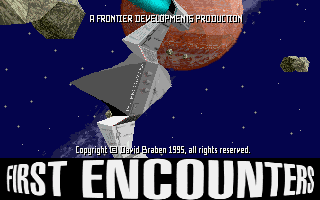
The original release of this 1995 MS-DOS game was famous for all the wrong reasons. GameTek, Inc. pushed the game onto store shelves before quality assurance was finished, unleashing a product full of game-breaking crashes. Early buyers found that jumping to specific star systems, firing lasers on unpatched installs, or simply looking at Mars would crash the system back to the DOS prompt.
The fallout was swift and brutal:
- UK retailers were flooded with returned boxes, causing initial top-charting sales to plummet instantly.
- Magazine reviews were sharply divided, with *PC Gamer* praising the sheer scale with an 87% score while *Computer Gaming World* slammed the launch state, noting North American players only got a stable build because early UK buyers acted as unpaid beta testers.
- David Braben engaged in a lengthy legal battle against publisher GameTek over breach of contract and the premature release, a dispute that dragged on until an out-of-court settlement in 1999 following GameTek's bankruptcy.
Interface friction and deep space dogfights
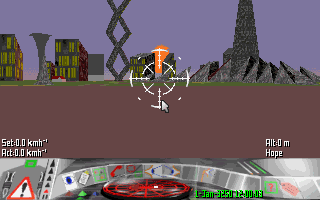
Even when running smoothly, the game fights you through its control panel. The user interface is an uncompromising maze of icons, sub-menus, and flight computers that can leave new players stranded in deep space without fuel. If you forget to buy fuel scoops or miscalculate a hyperspace jump, your journey ends quietly in the void.
Combat poses another hurdle. Because ships rotate on a dime while maintaining their forward momentum, dogfights tend to turn into tedious jousting matches where you flip, fire a burst of pulse laser, pass your target, and wait minutes to loop back around. Late-game behemoths like the Panther Clipper offer heavy fire-power, but bugs on larger hulls could cause your own turret fire to strike your ship's exterior. Yet when you land a contract to spy on the insectoid Thargoids or pilot the prototype Turner's Quest, the ambition behind the design shines through the roughness.
Fly the galaxy right now
What holds up today is the atmosphere. The sheer audacity of simulating an entire living galaxy with dynamic economies, competing empires, and real physics still makes modern space games look timid by comparison. The steep learning curve and punishing flight controls take patience, but once you learn how to read your vector lines, few experiences match successfully landing a haul of stolen gear on a distant moon.
You can play Frontier: First Encounters online, free in your browser right here. There is nothing to install and no setup required, so you can jump straight into the cockpit of your Cobra Mk III, set your hyperspace coordinates, and see if you have what it takes to survive the frontier.