
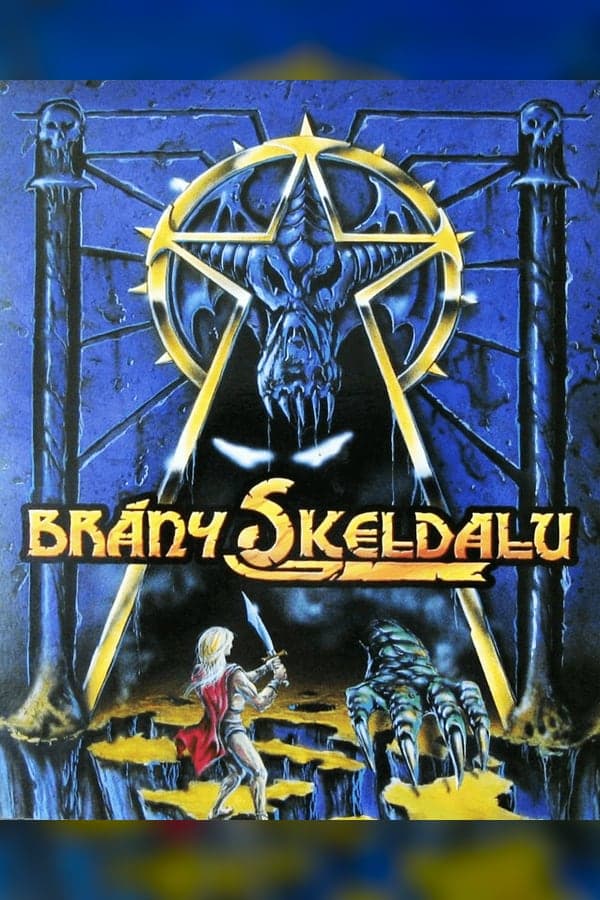
Building a grid-based dungeon crawler that moves in real-time until an enemy steps into view is the core idea behind Gates of Skeldal, a 1998 Czech RPG that pairs tactical turn-based combat with detailed map management.
By the late nineties, first-person dungeon crawlers were facing a sharp shift toward full 3D action. Ondřej Novák and Jindřich Rohlík at Napoleon Games took a different path, building a custom engine capable of displaying high-resolution 16-bit color palettes over a simulated 3D tile grid. The result gave the island of Rovenland a sharp, hand-drawn look that felt closer to an illustrated fantasy novel than the murky polygon walls appearing on PC displays in 1998.
You begin by drafting three heroes from four standard archetypes:
When walking through quiet corridors, movement across the map grid happens in real-time. The moment an enemy detects your party, the engine switches the encounter into a structured, turn-based battle mode. Position matters immensely here. If you get caught in a narrow hallway inside the Orc Caves, your back-line mages are safe, but your lead fighter takes every incoming swing. If an ambush happens in the open clearings of Ghost Canyon, enemies quickly circle around your flanks.
The backstory establishes that five rogue mages constructed the Skeldal tower in the south to tear open a doorway to the forbidden dimension of Zohar. The scholar Freghar attempts a summoning ritual to bring heroes to the island, but the effort kills him immediately, leaving your custom trio to pick up the pieces. To stand a chance against the tower, you must recruit three specific companions hidden across the realm: the warrior-thief Roland, the veteran mage Gralt, and Erik, the son of a local librarian. You eventually seek guidance from Nimeth, the ancient mentor who originally trained the five rogue mages.
Managing a full six-character party introduces the game's most impressive mechanical trick: group splitting. Many RPGs force your entire party to move as a single rigid block, but Gates of Skeldal lets you decouple characters and leave them standing on specific floor plates across different rooms. Solving complex dungeon layouts often requires sending one hero into a side chamber to hold down a wall lever while the rest of the team advances through a newly opened portcullis down the hall.
This freedom creates real tension during exploration. Leaving a lone thief isolated in a dark corridor while your main combat group searches for a missing key in the Magical Forest can turn catastrophic if roaming monsters spot the solitary hero. You end up managing two separate tactical situations on opposite sides of the map, constantly cycling between party splits to verify everyone stays alive.
The game earned a reputation for being uncompromisingly hard from the very first level. Early wilderness encounters hit exceptionally heavy, and players who fail to balance their initial character builds usually end up reloading early saves repeatedly. Unlike Western contemporaries that smoothed out early power curves, this title expects you to figure out combat spacing and spell conserve tactics immediately.
Cryptic puzzle design adds to that steep wall. Navigating mid-game zones like the White Tower involves deciphering maze layouts with minimal map feedback, where a single missed hidden button on a wall can stall progress for hours. Period reviews in regional gaming magazines like Score and Level awarded solid 7/10 ratings, praising the ambitious story and full Czech localization while criticizing technical bugs, cumbersome menu handling, and visual tech that looked retro next to contemporary hardware-accelerated 3D titles.
Yet for local players, those friction points mattered far less than the sheer depth on offer. Published by JRC Interactive, it became one of the most widely played home-grown computer games in its region during the late nineties, rivaling heavyweights like Diablo in local popularity. The package even shipped with a standalone map editor, allowing players to draft custom campaigns long after finishing the main storyline.
In 2008, the developers released the full source code under open-source licenses, ensuring that fans could maintain the engine modern operating systems tend to break. That community effort allowed the game to survive past the DOS era, eventually inspiring a direct narrative sequel, Pátý učedník, and a modern spiritual successor, 7 Mages. Playing the DOS original today reveals a tactical role-playing game that rewards careful party placement and methodical problem-solving over quick reflexes.
If you enjoy classic dungeon crawlers where party management requires actual spatial planning, this title offers an uncompromising adventure worth studying. Preserving catalog metadata, box layouts, and historical documentation for regional titles like this keeps the broader story of 1990s PC gaming complete. Take the time to read through the manual, plan your party composition before taking your first steps into Rovenland, and keep a notepad handy for mapping out its toughest mazes.
How Gates of Skeldal is played — the keys the game listens to, grouped by what they do.
Highlighted keys are mapped — hover or tap one to see what it does.
Key bindings can only be changed at game startup. Console requires editing skeldal.ini with DEBUG 6072296.
The on-screen keyboard and gamepad mapping the browser player uses on a phone, a tablet or a controller, as opposed to the real keys above. $PRO members make their own in the player and share them here; anyone can pick one to play with.
Cheat codes, console commands and memory pokes for Gates of Skeldal — each one verified and attributed.
Sign in to submitaka Brány Skeldalu
How Gates of Skeldal is played — the keys the game listens to, grouped by what they do.
Highlighted keys are mapped — hover or tap one to see what it does.
Key bindings can only be changed at game startup. Console requires editing skeldal.ini with DEBUG 6072296.
The on-screen keyboard and gamepad mapping the browser player uses on a phone, a tablet or a controller, as opposed to the real keys above. $PRO members make their own in the player and share them here; anyone can pick one to play with.
Cheat codes, console commands and memory pokes for Gates of Skeldal — each one verified and attributed.
Sign in to submit