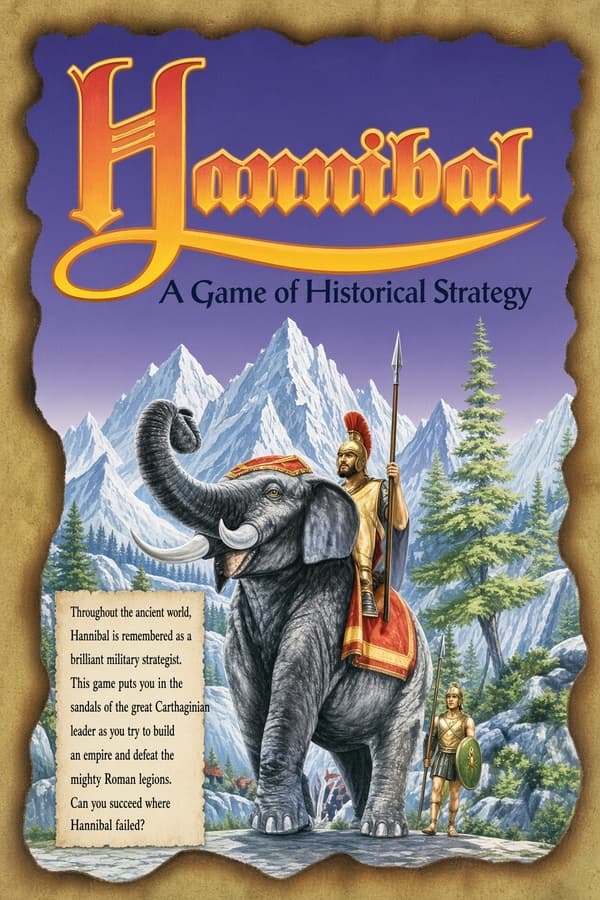
Hannibal
aka Hannibal: Master of the Beast
Taking command of Carthaginian armies across a map of 700 Mediterranean cities, Hannibal demands that you manage mines, recruit war elephants, and supply naval expeditions before sending forces into battle.
A grand scale that punishes you from the first turn
Most strategy titles from the early nineties give you a brief honeymoon period to set up your base, build a few farms, and figure out the user interface. Starbyte Software skipped that courtesy entirely. When you launch the campaign in Hannibal, Carthage is under immediate threat, and failing to shift adequate troops to defensive positions right away will end your war before you even cross the Pyrenees.
The top-down world map covers the Mediterranean theatre across Europe and North Africa, putting hundreds of settlements under your administrative control. Rather than breaking the Punic War into separate missions or scenario maps, the game commits to one massive campaign. You spend your early turns checking income from mines, adjusting taxation, and purchasing mercenaries to build out standing armies of infantry, cavalry, and elephants. Navigating this vast theater in a strategy game from 1994 requires constant attention to economic infrastructure so your frontline troops do not starve on the march.
The learning curve is steep because the game offers very little hand-holding. The printed manual was notoriously brief, leaving players to figure out how economic yields fed into troop recruitment through pure trial and error. If you jump into this Starbyte Software title expecting an easy march on Rome, your empire collapses under budget deficits before you ever see the Italian peninsula.
Micro-managing supply lines makes conquests drag
Moving a legion across land or water is a process of constant administrative anxiety. Troops move at a crawl, and sieges against fortified cities turn into extended waiting games where your reserves drain away with every passing turn. Long-distance sea voyages present an even harsher threat: if you fail to stock enough grain before setting sail, your fleet runs out of food mid-journey, turning an ambitious naval invasion into a tragic one-way trip.
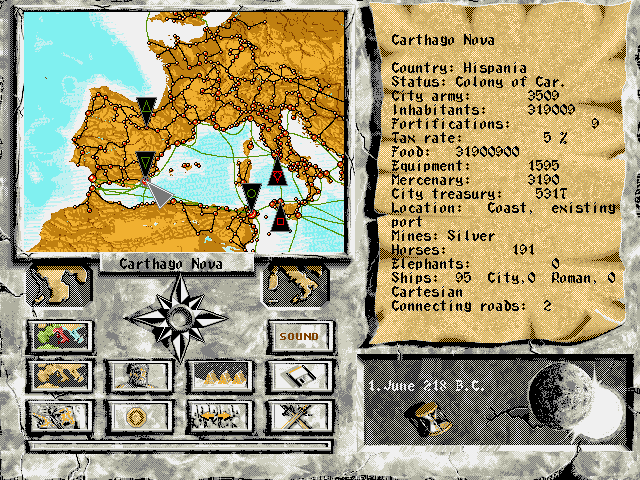
The operational layer requires you to balance several moving parts simultaneously:
- Extracting gold and raw materials from mines to fund long-term military spending.
- Buying mercenary contingents to replenish losses without draining local Carthaginian manpower.
- Assembling balanced forces featuring infantry, cavalry, heavy war elephants, and transport navies.
- Setting movement corridors across land routes while monitoring grain reserves for overseas transit.
Setting up the audio before launching into these logistics requires running HANSOUND.EXE from the installation folder to enable digital sound effects on PC setups. While German gaming magazines like PC Joker awarded the game 78 out of 100 for its graphical presentation and historical scope, American publications were far harsher. Computer Gaming World famously complained that players were forced to wear so many administrative hats that troop movement became virtually impossible, famously joking that Hannibal Lecter would prove a more entertaining houseguest than the game itself.
Tactical choices matter, but combat runs on autopilot
When two opposing armies finally clash on the map, the game shifts from grand strategy to a battle simulation screen. You do not get direct, real-time control over individual units once combat starts. Instead, designer Claude Cueni built the tactical phase around pre-battle command decisions. You set your initial line formations, choosing aggressive setups like a wedge to punch through enemy ranks or an encirclement to trap superior numbers, and you can issue orders for a retreat if the odds turn against you.
Once you confirm your choices, the combat engine takes over and resolves the fighting based on your army composition, morale, and chosen tactics. Programmed by Andreas Seebeck for DOS and published on two high-density floppies before receiving a CD-ROM release via MicroLeague, the engine handles the numbers quickly, but the lack of direct battlefield control disappointed players who wanted to micro-manage their elephant charges. I spent half my first playthrough trying to order specific cavalry units into a flank attack, only to realize the engine was strictly running a automated simulation based on my opening orders.
Why conquering Rome under Hannibal is a slow test of patience
The ambition behind this design deserves credit, even when the execution hits friction. Trying to conquer Rome across a single map containing over 700 interactive cities was a massive undertaking for a PC game in 1994. The visual detail on the map screen held up well compared to its contemporaries, but the pacing of movement and sieges creates long stretches where very little happens on screen.
If you enjoy complex historical simulations where logistics matter more than quick reflexes, the depth of the economic system provides a genuine challenge. However, players accustomed to faster turn resolution will find the travel times punishing. The gap between planning an invasion and actually marching your troops to the target city can feel endless, which is precisely why period reviewers were so divided on whether the historical detail was worth the sheer tedium of waiting for units to cross the terrain.
Step onto the map without the floppy swapping
This historical simulation gives a clear look at European strategy design. If you want to try this MS-DOS game today, you do not need to hunt down original floppy disks or wrestle with vintage hardware configurations. You can play Hannibal online right here in your browser with zero hassle.
Launching Hannibal free in your browser gives you instant access to the full grand campaign, complete with top-down map navigation and tactical battle setups. Jump straight into the commander's seat, review your mines in Africa, and see if you can handle the brutal supply lines long enough to cross the Alps and threaten Rome.