

Heroes
Rate this game
- Played
- A lot
Heroes takes the line-building foundation of classic snake arcade games, strips away instant death on wall collision, and turns the entire field into a high-speed survival match. Released in 1998 by RealTech and Olympus, this MS-DOS title trades cautious grid crawling for aggressive power-up hunting and fast reflexes.
Rethinking the classic snake mechanic
If you grew up playing standard line-building games, your muscle memory expects immediate failure the second your front bumper touches a boundary or your own tail. The main mechanical twist in Heroes is that hitting an obstacle does not end your run. Instead, your vehicle automatically bounces off walls and rival craft, instantly redirecting your path without costing a life.
That single adjustment changes how you read the board. Rather than planning cautious, right-angled routes through claustrophobic corridors, you spend every match sliding through narrow gaps at high speed while wrestling with the controls. The primary challenge comes from managing momentum and keeping track of your expanding tail while searching for open space before a competitor seals you off.
Because movement relies on the numeric keypad, steering requires a different rhythm than standard arrow-key arcade titles. Getting used to the key placement takes a few minutes, but once your fingers adjust, weaving around moving hazards feels precise and active.
Ninety-four levels of arena chaos in Heroes
The single-player campaign revolves around Quest mode, where the main objective is simple to grasp but tricky to execute. You navigate 94 distinct levels spread across 10 different visual environments, hunting down specific items while avoiding aggressive computer drivers. To complete a stage, you must collect ten purple trail power-ups to expand your tail to maximum length, which unlocks the purple exit node needed to clear the map.
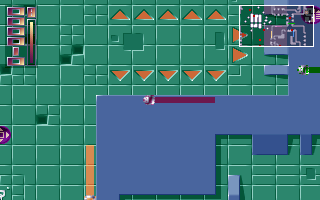
Things get crowded fast when computer opponents compete for the same items on the grid. If a rival grabs the pickup you need, your run stalls while you try to cut off their path and reclaim space. Along with Quest mode, four extra game modes vary the objective considerably:
- Quest: The primary campaign requiring ten trail extensions followed by a reach for the exit grid.
- Kill 'em All: A head-to-head elimination format focused purely on outmaneuvering rivals and forcing crashes.
- Death Match: Fast-paced survival rounds where staying alive longest scores the win.
- Time Cash: A timed scramble to gather high-value point bonuses before the match clock runs out.
- Color: A tactical territorial variant where controlling space and matching power-up colors dictates victory.
Having multiple game modes makes action games from this era surprisingly versatile. Whether you prefer hunting target power-ups or trapping rivals in tight corners, the layout and priorities shift with every round.
Power-ups that invert controls and melt your screen
Pickups scattered across the board do plenty besides lengthening your tail or boosting your score. Speed boosts launch your vehicle across the map before you can react, while slow-down items leave you crawling through traffic. Negative pickups intentionally invert your control scheme mid-turn, sending your craft straight into oncoming hazards when you least expect it.
One of the most memorable visual touches introduced by RealTech is a bonus item that triggers an active screen ripple effect. The entire display waves and warps while you try to navigate, turning basic line steering into a test of spatial awareness. It is a completely unnecessary graphical trick that exists because the developers knew how to push classic VGA hardware.
That demoscene flair appears throughout the presentation. Smooth color transitions and fluid particle trails make the grid look active for an MS-DOS freeware release from 1998.
Demoscene polish and Sound Blaster tracker audio
Before creating standalone games, the developers behind this title built projects in the demoscene. That background explains why the visual presentation punches above typical budget shareware of the late nineties. The engine maintains high frame rates even when half a dozen trails crisscross the arena at once.

The audio received equal care, featuring dedicated setup configurations for Sound Blaster cards and Gravis UltraSound hardware. Energetic tracker music keeps the pace moving during intense deathmatches, backed by sharp sound effects whenever vehicles collide. European players also received localized French language updates, showing strong post-release support for a free title.
The main drawback is that mastering the number pad layout has a minor learning curve if you are accustomed to standard arrow keys. Because steering requires rapid directional inputs, misreading your orientation happens easily during chaotic four-way battles.
Fire up the Heroes MS-DOS game in your browser
If you want a fast arcade distraction with solid demoscene presentation, this title delivers a great spin on classic mechanics. The auto-turn bounce rules eliminate the frustration of instant wall deaths, keeping the focus entirely on high-speed blocking and power-up collection. Published by RealTech VR and later released under an open-source GPL license, it holds up as a clever action hybrid.
You can play Heroes online free in your browser right here, with nothing to install or configure. Jump straight into Quest mode to see how many levels you can clear before the control-inversion pickups throw off your rhythm.
Players' controls
Touch and gamepad controls
The on-screen keyboard and gamepad mapping the browser player uses on a phone, a tablet or a controller, as opposed to the real keys above. $PRO members make their own in the player and share them here; anyone can pick one to play with.
Make your own touch controlsPRO
- 1Open the editorSign in below, then pick what to make. The game starts with the editor open over it.
- 2Place your keysAdd keys and drag them where your thumbs rest, or map a controller's buttons. Test plays the game with them; Save keeps them, and you play with them from then on.
- 3Share themShare them right after saving in the game, or name and share them here. Players vote, and the best become this game's controls for everyone.
Go PROSee how it worksSign in+20 XP for sharing · +50 XP if yours become the game's own
- The game's own controlsNone yet: played with a real keyboard only.In use
2 screenshots
From the archive
No reviews yet
Tell the community what you think of Heroes. Reviews are public and tied to your username.
No archived manuals for Heroes yet
No manuals archived for this title yet. Sign in to upload the first scan.
Cheat codes, console commands and memory pokes for Heroes — each one verified and attributed.
Sign in to submitNo cheats yet for this title
Know a working cheat, poke or trainer? Add it with the button above. Moderators check every entry before it goes live.
No archived soundtrack for Heroes yet
No soundtrack archived for this title yet. Sign in to upload the first rip.
No save states for Heroes yet
No save states for this title yet. Sign in to share one.
Discussions
Sign in to post- Threads0
- Total posts0
- Online now6
Community · Heroes
Who's contributing, and what's new
- Reviews0
- Threads0
- Uploadsapproved0
- Contributors0
Recent activity
Nothing here yet
Reviews, discussion threads and approved uploads appear here as members add them.