
If you ever wanted to play Raven Software's 1997 dark fantasy shooter on a classic platform without the original engine bugs, Hexen II: Hammer of Thyrion translates that heavy, mana-fueled action directly to MS-DOS. You chop through wave after wave of gargoyles and golems across four historical realms, leveling up your hero while hunting down cryptic switches.
By the time Raven Software returned to the Serpent Rider saga, the classic corridor shooter was changing fast. Linear corridors gave way to complex hub structures, and basic weapon pickup loops added character progression. This community-driven build by the uHexen2 Project Team takes the original Quake engine code and cleans it up, keeping the heavy, deliberate combat intact.
You start by selecting one of four distinct classes: Paladin, Crusader, Necromancer, or Assassin. Each class changes how you tackle encounters from the very first level. The Paladin operates as a close-quarters tank who thrives on melee attacks, while the Crusader plays a defensive game, eventually picking up healing spells. The Assassin gets stealthy critical strikes from behind, and the Necromancer leech vitality directly from killed enemies. Each class commands four unique weapons that consume green or blue mana, meaning you cannot play every class with the same twitch reflexes.
The campaign takes you across four hub worlds modeled on historical architecture: a European medieval realm named Blackmarsh, a Mesoamerican jungle complex, an ancient Greco-Roman temple grounds, and an Egyptian pyramid network. Instead of clearing a single map and moving on, you spend hours looping through interconnected stages to unlock massive gates and align ancient machinery.
The core structure relies on hub levels where actions in one stage trigger changes three maps away. You might flip a stone lever in a sunlit plaza, only to realize it opened a iron portcullis inside a subterranean tomb in a completely different area. Enemies do not respawn when you travel between connected stages, which turns completed zones into quiet backtracks as you hunt down missing quest items.
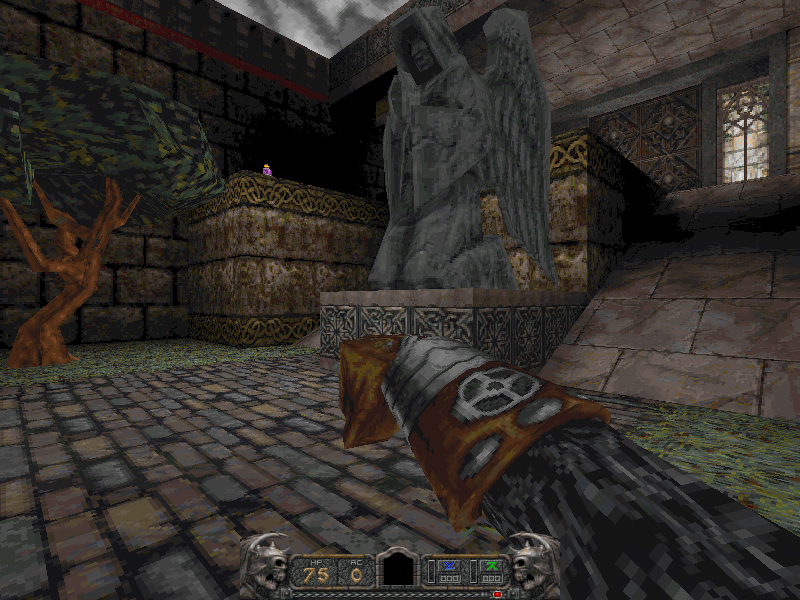
This layout creates the game's biggest hurdle: obtuse progression. If you miss a tiny wall switch tucked behind a pillar in the Greco-Roman hub, the entire game grinds to a halt. I spent nearly forty minutes wandering clean hallways in the Egyptian hub just trying to spot a brick texture that looked slightly misaligned. When you finally find the trigger, the payoff feels less like solving a puzzle and more like finding a dropped key in high grass.
The action mechanics hold up far better than the puzzle hunting. Monsters hit hard, from airborne gargoyles that dive from dark ceilings to stone golems that crush low-level characters in two hits. Medusas freeze you in place if you stare too long, forcing you to circle-strafe while firing blind around marble columns.
Character growth adds actual depth to the traditional first-person perspective. Defeating monsters yields experience points, which automatically raise your maximum health, mana pool, and base combat stats. Reaching higher levels unlocks new character-specific passive traits, giving your hero a noticeable spike in power as you near the final showdown with Eidolon and his Four Horsemen of the Apocalypse.
Inventory management sits right alongside your firepower. You collect relics like the Tome of Power, which temporarily modifies your current weapon into a devastating secondary attack mode. The Disc of Repulsion pushes incoming projectiles back toward enemies, but smart players also drop it beneath their feet to execute high-velocity tricks similar to a classic rocket jump.
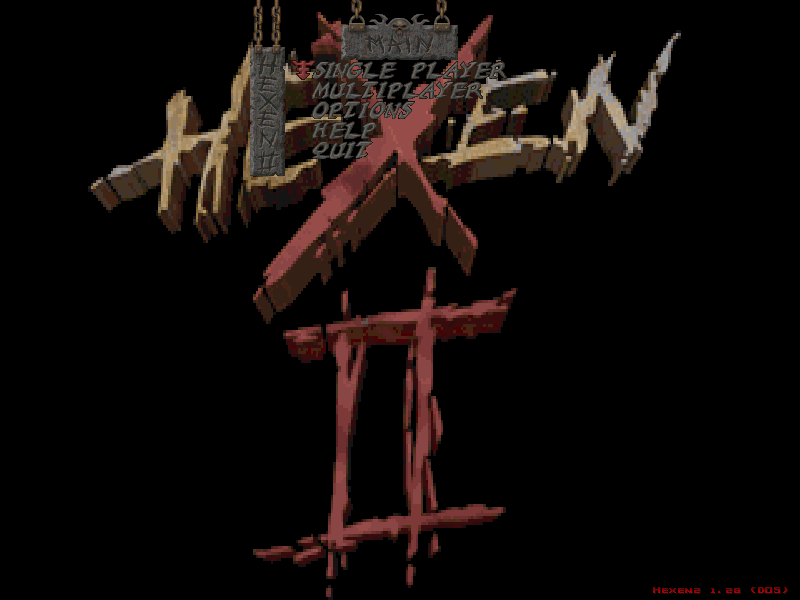
The engine enhancements in this 2006 project fix numerous code quirks that plagued earlier releases. While original multiplayer sessions often suffered from character placement bugs that left loaded players stuck inside geometry, this updated C and SDL codebase runs clean. Sound card options are equally robust, supporting original MIDI tracks alongside digital audio formats.
For 2006 open-source software, this engine rewrite runs fast, cleans up the original controls, and brings back full console command access, though crank the difficulty up and it locks out the cheat menu entirely. The four historical eras still look distinct on screen, swapping out the architecture and the enemy sets every time you jump to a new region.
Yet the core flaws of the 1997 design remain fully exposed. Certain late-game enemies are notoriously tanky, soaking up vast amounts of mana while offering little tactical variation. If you do not enjoy methodically sweeping cleared maps for obscure keyholes, the middle hubs will test your patience long before you reach Eidolon.
Here is what you need to know before jumping in:
If you want to experience this dark fantasy shooter today, you do not need to hunt down vintage PC setups or fiddle with complex source code compilations. You can play Hexen II: Hammer of Thyrion online right in your web browser, giving you immediate access to all four character classes and the complete campaign with zero installation hassles.
Launch the game right here, pick the Paladin for heavy melee swing feedback or the Assassin for fast sneaking, and test your circle-strafing against the gargoyles of Blackmarsh straight away.
If you ever wanted to play Raven Software's 1997 dark fantasy shooter on a classic platform without the original engine bugs, Hexen II: Hammer of Thyrion translates that heavy, mana-fueled action directly to MS-DOS. You chop through wave after wave of gargoyles and golems across four historical realms, leveling up your hero while hunting down cryptic switches.
By the time Raven Software returned to the Serpent Rider saga, the classic corridor shooter was changing fast. Linear corridors gave way to complex hub structures, and basic weapon pickup loops added character progression. This community-driven build by the uHexen2 Project Team takes the original Quake engine code and cleans it up, keeping the heavy, deliberate combat intact.
You start by selecting one of four distinct classes: Paladin, Crusader, Necromancer, or Assassin. Each class changes how you tackle encounters from the very first level. The Paladin operates as a close-quarters tank who thrives on melee attacks, while the Crusader plays a defensive game, eventually picking up healing spells. The Assassin gets stealthy critical strikes from behind, and the Necromancer leech vitality directly from killed enemies. Each class commands four unique weapons that consume green or blue mana, meaning you cannot play every class with the same twitch reflexes.
The campaign takes you across four hub worlds modeled on historical architecture: a European medieval realm named Blackmarsh, a Mesoamerican jungle complex, an ancient Greco-Roman temple grounds, and an Egyptian pyramid network. Instead of clearing a single map and moving on, you spend hours looping through interconnected stages to unlock massive gates and align ancient machinery.
The core structure relies on hub levels where actions in one stage trigger changes three maps away. You might flip a stone lever in a sunlit plaza, only to realize it opened a iron portcullis inside a subterranean tomb in a completely different area. Enemies do not respawn when you travel between connected stages, which turns completed zones into quiet backtracks as you hunt down missing quest items.
This layout creates the game's biggest hurdle: obtuse progression. If you miss a tiny wall switch tucked behind a pillar in the Greco-Roman hub, the entire game grinds to a halt. I spent nearly forty minutes wandering clean hallways in the Egyptian hub just trying to spot a brick texture that looked slightly misaligned. When you finally find the trigger, the payoff feels less like solving a puzzle and more like finding a dropped key in high grass.
The action mechanics hold up far better than the puzzle hunting. Monsters hit hard, from airborne gargoyles that dive from dark ceilings to stone golems that crush low-level characters in two hits. Medusas freeze you in place if you stare too long, forcing you to circle-strafe while firing blind around marble columns.
Character growth adds actual depth to the traditional first-person perspective. Defeating monsters yields experience points, which automatically raise your maximum health, mana pool, and base combat stats. Reaching higher levels unlocks new character-specific passive traits, giving your hero a noticeable spike in power as you near the final showdown with Eidolon and his Four Horsemen of the Apocalypse.
Inventory management sits right alongside your firepower. You collect relics like the Tome of Power, which temporarily modifies your current weapon into a devastating secondary attack mode. The Disc of Repulsion pushes incoming projectiles back toward enemies, but smart players also drop it beneath their feet to execute high-velocity tricks similar to a classic rocket jump.
The engine enhancements in this 2006 project fix numerous code quirks that plagued earlier releases. While original multiplayer sessions often suffered from character placement bugs that left loaded players stuck inside geometry, this updated C and SDL codebase runs clean. Sound card options are equally robust, supporting original MIDI tracks alongside digital audio formats.
For 2006 open-source software, this engine rewrite runs fast, cleans up the original controls, and brings back full console command access, though crank the difficulty up and it locks out the cheat menu entirely. The four historical eras still look distinct on screen, swapping out the architecture and the enemy sets every time you jump to a new region.
Yet the core flaws of the 1997 design remain fully exposed. Certain late-game enemies are notoriously tanky, soaking up vast amounts of mana while offering little tactical variation. If you do not enjoy methodically sweeping cleared maps for obscure keyholes, the middle hubs will test your patience long before you reach Eidolon.
Here is what you need to know before jumping in:
If you want to experience this dark fantasy shooter today, you do not need to hunt down vintage PC setups or fiddle with complex source code compilations. You can play Hexen II: Hammer of Thyrion online right in your web browser, giving you immediate access to all four character classes and the complete campaign with zero installation hassles.
Launch the game right here, pick the Paladin for heavy melee swing feedback or the Assassin for fast sneaking, and test your circle-strafing against the gargoyles of Blackmarsh straight away.
aka uHexen2 · Hexen II DOS port
How Hexen II: Hammer of Thyrion is played — the keys the game listens to, grouped by what they do.
Highlighted keys are mapped — hover or tap one to see what it does.
Set up for modern play: W A S D move, the mouse turns and aims, left click fires. The arrow keys still turn. Ctrl and Alt are left free because the browser uses them (Ctrl + W closes the tab).
The on-screen keyboard and gamepad mapping the browser player uses on a phone, a tablet or a controller, as opposed to the real keys above. $PRO members make their own in the player and share them here; anyone can pick one to play with.
Cheat codes, console commands and memory pokes for Hexen II: Hammer of Thyrion — each one verified and attributed.
Sign in to submitHow Hexen II: Hammer of Thyrion is played — the keys the game listens to, grouped by what they do.
Highlighted keys are mapped — hover or tap one to see what it does.
Set up for modern play: W A S D move, the mouse turns and aims, left click fires. The arrow keys still turn. Ctrl and Alt are left free because the browser uses them (Ctrl + W closes the tab).
The on-screen keyboard and gamepad mapping the browser player uses on a phone, a tablet or a controller, as opposed to the real keys above. $PRO members make their own in the player and share them here; anyone can pick one to play with.
Cheat codes, console commands and memory pokes for Hexen II: Hammer of Thyrion — each one verified and attributed.
Sign in to submit