
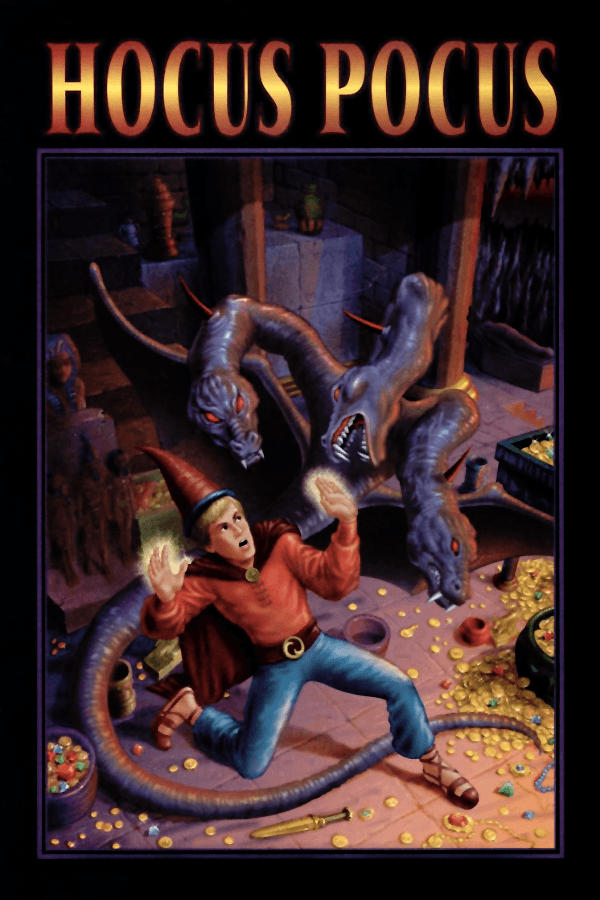

Hocus Pocus
Rate this game
Shooting lightning bolts from your fingertips while hunting down glowing crystal balls, Hocus Pocus delivers pure side-scrolling action from Apogee's 1994 era. The young wizard's quest to win Popopa's hand and join the Council of Wizards trades deep spell systems for fast arcade maze crawling.
Zapping monsters and navigating mazes in 256 colors
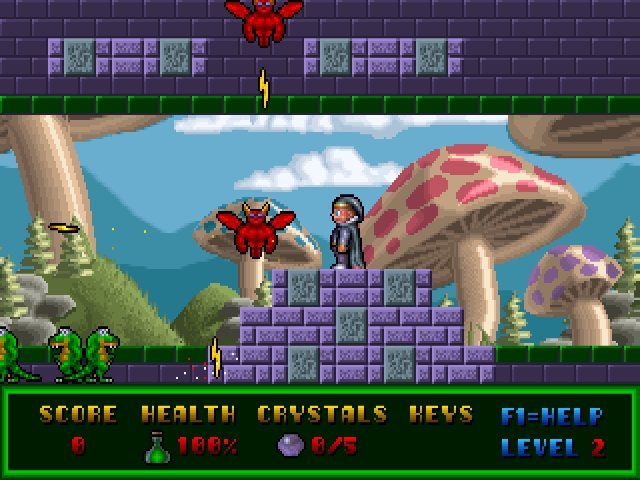
The moment you step into the first level, the game skips lengthy tutorial steps and hands you instant magical firepower. Firing infinite lightning bolts from your hands, you blast past floating imps and red skeletons while searching for the green crystal balls required to open each stage exit. Developed by Moonlite Software, the controls respond immediately when firing, turning corridors into shooting galleries.
Movement builds on a simple grid structure backed by smooth 360-degree VGA scrolling and multiple parallax background layers. Every level is a maze loaded with secret chambers hidden behind breakable or fake walls. Hologram images of the archmage Terexin pop up in quiet corners, offering cryptic advice or poking fun at your progress.
Power-up potions dictate how you clear each area. Picking up a white potion grants rapid-fire magic, while grey and red potions upgrade your standard shot into a destructive fireball laser. Yellow potions boost your jump height to reach high platforms, and green vials restore lost health. Scattered treasure items like rubies, crowns, and gold goblets boost your score as you hunt for the silver and gold keys needed to open locked doors.
Where Moonlite Software hit the mark and where it fell short
Tom Hall penned the backstory, wrapping a playful fantasy narrative around a straightforward action game. The game did not try to hide its cheat codes either. Apogee printed codes right inside the official instruction manual, letting players type FEELGOOD for full health or BLAKE to spawn keys whenever they got stuck.
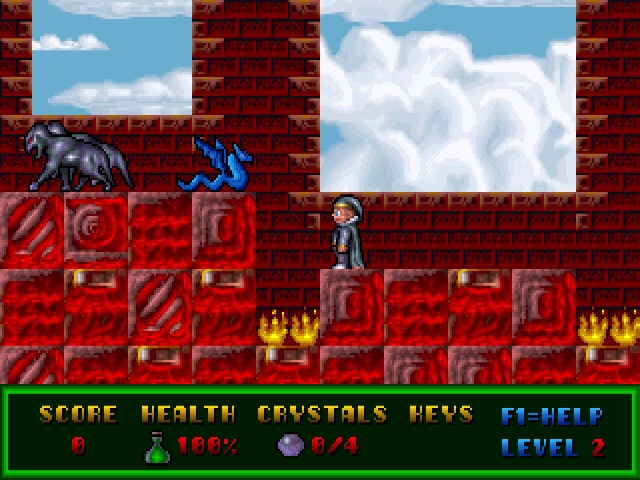
The core level design suffers from rigid spatial limits. Because every wall, floor, and ledge relies strictly on square tiles, you will never find a single ramp, slope, or ladder across all 36 levels. Each stage feels like a re-skinned dungeon vault, changing background palettes rather than introducing new structural ideas.
Jump physics introduce their own frustration. The keyboard controls carry floaty momentum that often glides you straight into spikes or enemy projectiles when landing on small platforms. Occasionally, moving platforms fail to load correctly on screen, forcing you to wait or adjust your timing blind.
Four episodes of escalating difficulty and cruel jump traps
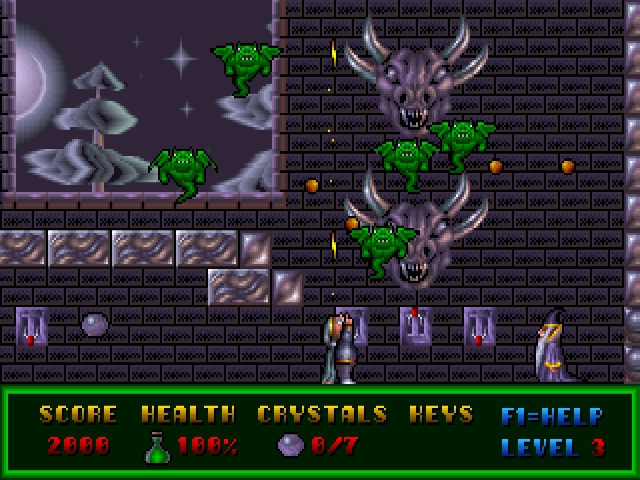
The adventure splits into four distinct nine-level episodes: "Time Tripping", "Shattered World", "Lair of the Dark Wizard", and "The Final Court". Monsters evolve steadily across these worlds, bringing in mummies, ghosts, armored knights, and fire-breathing crocodiles. Boss encounters cap off each episode, featuring the Seven Mad Monks of MellonWah, hostile tree monsters, and massive dragons.
Difficulty spikes hit hard in the final episode. While early levels shower you with healing items, the fourth episode grows stingy with green potions. Mistakes that cost only a fraction of your health early on suddenly turn into run-ending blunders during late-game stages.
Level geometry also sets mean traps with high-jump potions. If you drink a yellow potion and jump up to a high ledge before clearing the lower room, the effect can run out while you are up top. Without that super-jump active, you might find yourself stuck in a pit with no way to jump back out to collect missing crystals.
Standing in the shadow of major releases from 1994
When this 1994 release arrived on store shelves, gaming magazines gave it positive scores. French outlet Génération 4 awarded it 88 percent, while PC Zone gave it 4 out of 5 stars, praising the colorful graphics and smooth scrolling. Music composed for Sound Blaster, General MIDI, and Gravis Ultrasound sound cards gave every world an upbeat soundtrack.
Commercial sales lagged behind expectations despite the initial shareware release of Episode 1. Launching alongside behemoths like Doom II and Jazz Jackrabbit left little room for a tile-based platform shooter. It built a loyal following over time, even inspiring an indie rock band to take its name from the Seven Mad Monks of MellonWah boss encounter.
I still come back to it for quick twenty-minute runs when I want clean arcade platforming without complicated inventory management. The level tiles repeat themselves endlessly, but the responsive magic shooting retains its satisfy punch.
Fire up this classic Hocus Pocus MS-DOS game straight in your browser
If you enjoy classic Apogee shareware titles, this magic maze crawler deserves a spot in your rotation. The square tile geometry shows its age, but collecting treasure while blasting through waves of mummies and dragons remains surprisingly fun. Skip the hassle of tracking down sound drivers or tweaking memory settings on modern hardware.
You can play Hocus Pocus free in your browser right now with zero installation. Jump straight into the first episode, grab your lightning powers, and see if you can clear the mazes to join the Council of Wizards.
How Hocus Pocus is played — the keys the game listens to, grouped by what they do.
- Movement
- Action
- Interface
Highlighted keys are mapped — hover or tap one to see what it does.
Keyboard controls can be redefined in-game under the 'Change game options' menu. Setup program options are saved to HOCUS.SAV.
Players' controls
Touch and gamepad controls
The on-screen keyboard and gamepad mapping the browser player uses on a phone, a tablet or a controller, as opposed to the real keys above. $PRO members make their own in the player and share them here; anyone can pick one to play with.
Make your own touch controlsPRO
- 1Open the editorSign in below, then pick what to make. The game starts with the editor open over it.
- 2Place your keysAdd keys and drag them where your thumbs rest, or map a controller's buttons. Test plays the game with them; Save keeps them, and you play with them from then on.
- 3Share themShare them right after saving in the game, or name and share them here. Players vote, and the best become this game's controls for everyone.
Go PROSee how it worksSign in+20 XP for sharing · +50 XP if yours become the game's own
- The game's own controlsKeyboardGamepadWhat every player starts with.In use
6 screenshots
From the archive
No gameplay video yet
No gameplay video for Hocus Pocus yet. Sign in to add one.
No reviews yet
Tell the community what you think of Hocus Pocus. Reviews are public and tied to your username.
No archived manuals for Hocus Pocus yet
No manuals archived for this title yet. Sign in to upload the first scan.
Cheat codes, console commands and memory pokes for Hocus Pocus — each one verified and attributed.
Sign in to submitNo cheats yet for this title
Know a working cheat, poke or trainer? Add it with the button above. Moderators check every entry before it goes live.
No archived soundtrack for Hocus Pocus yet
No soundtrack archived for this title yet. Sign in to upload the first rip.
No save states for Hocus Pocus yet
No save states for this title yet. Sign in to share one.
Discussions
Sign in to post- Threads0
- Total posts0
- Online now6
Community · Hocus Pocus
Who's contributing, and what's new
- Reviews0
- Threads0
- Uploadsapproved0
- Contributors0
Recent activity
Nothing here yet
Reviews, discussion threads and approved uploads appear here as members add them.