
Screenshot×56d ago
aka Horké léto aneb Majer v akci · Hot Summer
The 1998 Czech MS-DOS game Horké léto opens with a teenager named Honza Majer explaining that guys call him Rambo while girls call him an asshole, right before his lazy afternoon in the jungle is ruined by cannibals kidnapping his family. Armed with nothing but basic point-and-click inventory logic, you spend the entire ordeal fixing your own mistakes across a sun-drenched Pacific island.
The intro sequence sets the exact tone you deal with for the duration of the story. While Honza's father, a botany professor, drags the rest of the family through tropical woods to inspect local flora, Honza ducks into the bushes to shirk his chores. That brief bit of slacking saves his life when local islanders capture his family, leaving the teenager as their only hope for rescue.
What made this setup land with players in 1998 was the audio recording. Comedian and impersonator Zdeněk Izer provided almost every male voice in the cast, giving each character on the island a distinct vocal personality. It stood out as the first Czech title to feature professional full voice acting, which turned a simple budget production into an immediate commercial success in its home country.
William Foldes handled the sound design and musical score, giving the 640x480 presentation an upbeat tropical background. Even when you spend time pixel-hunting across static screens, Izer's delivery keeps the comedy moving forward. You hear his range in every conversation, whether Honza is arguing with locals or talking to himself while testing random objects from his inventory.
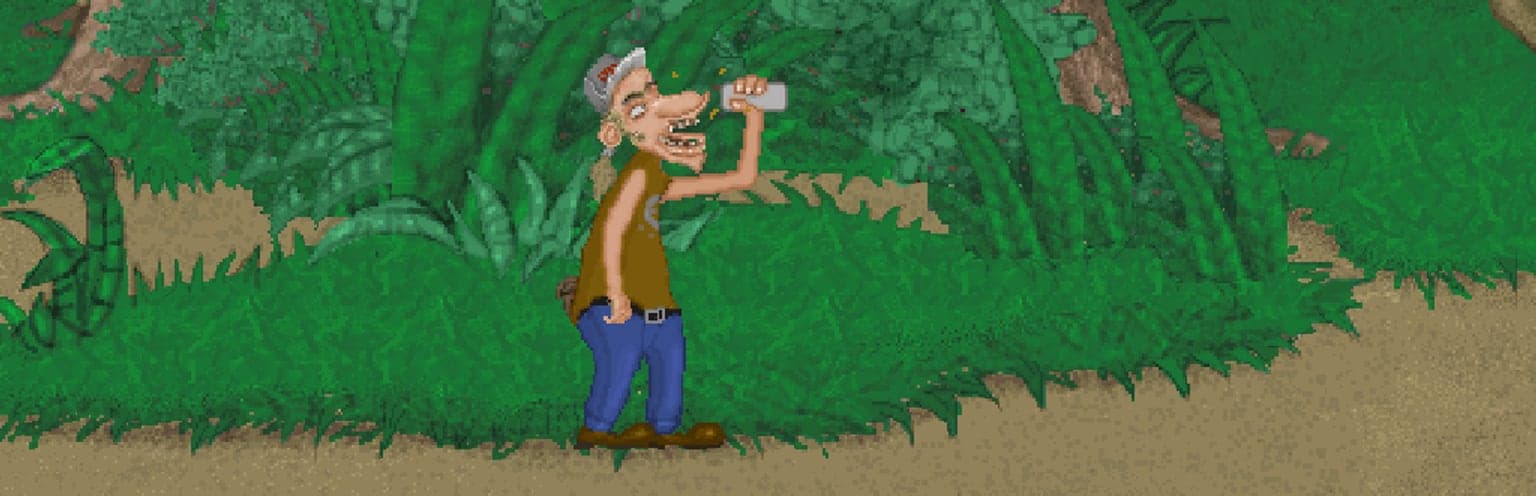
The core Horké léto gameplay spans forty-three distinct rendered screens, moving Honza through sandy shorelines, thick jungles, and hidden clearings. Designed by Marek Píša and Viktor Bocan, the adventure relies on traditional point-and-select interaction where you collect items, talk to characters, and combine objects to clear obstacles.
To make progress in this JRC Interactive release, you spend most of your time scrutinizing backgrounds for inventory items. Finding a usable object often depends on clicking every interactive hotspot on a screen, as some essential items sit half-buried in the environment artwork. Combine a few mismatched items together, talk to an eccentric island resident, and another path opens up deeper into the forest.
The puzzle design follows standard nineties inventory logic. When progress stalls, the usual approach involves opening your inventory bag and systematically clicking every tool against every object on screen. Here is what you end up doing during a standard playthrough:
Developer Maxon shipped the game in SVGA mode, presenting digital art created by Marek Píša. Despite running on standard PC hardware from the late nineties, the bright visuals gave the island setting a clean look that separated it from darker western titles of the same period.
Czech gaming magazines Level and Score both awarded the title a 70% rating upon release. Critics praised the vocal delivery and colorful presentation, though the blunt humor and linear puzzle paths divided reviewer opinion. Despite mixed critical responses regarding puzzle structure, it became the top-selling Czech release of 1998.
I find that the comedic script holds up far better than the mechanical pacing. While dialogue scenes move fast, searching forty-three screens for tiny clickable spots without a built-in hint system can bring progress to a standstill. If you miss a small item hidden against a tree trunk early on, you spend twenty minutes backtracking across the entire map.
Playing through this classic Horké léto MS-DOS game today shows how much early Czech studios relied on voice talent to paper over straightforward gameplay loops. The title does not try to reinvent adventure mechanics, opting instead for quick dialogue exchanges and simple inventory gates.
Compared to complex adventure games of the same era like The Secret of Monkey Island, Maxon kept the mechanical scope manageable for a small team. The interface remains lightweight, letting players focus on inventory interaction without managing complicated verb wheels or nested menus. Everything happens directly through cursor feedback.
The game's initial sales success spawned a franchise, leading to Horké léto 2 in 1999 from Centauri Production and Žhavé léto 3 ½ in 2006. Later mobile ports documented on Wikipedia brought Honza Majer to iOS through Bohemia Interactive, but the original DOS release holds a specific place in developer history as the project that proved full Czech dubbing could sell thousands of copies.
By 2003, gaming writer Petr Ticháček noted that the core community around the title had shrunk significantly as players moved on to full 3D releases. Because early CD-ROM releases from small central European studios rarely received wide international distribution, finding preserved documentation for nineties PC games from the region requires active maintenance.
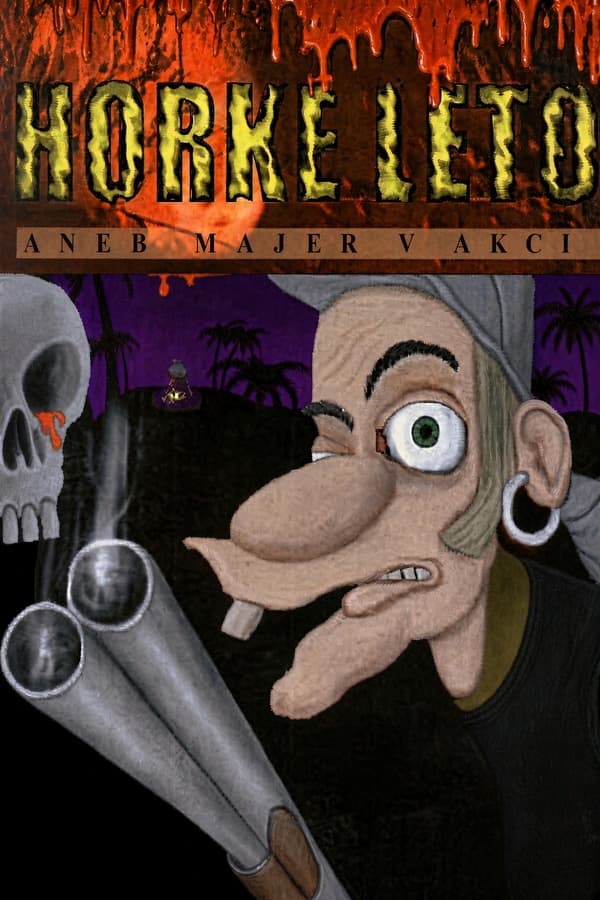
Digital preservation efforts do essential work by keeping original binaries, scanned manuals, and audio tracks cataloged for modern players. Without dedicated metadata tracking and box art preservation, early milestones in non-English software development would quietly disappear from public record.
If you enjoy late-nineties comedy adventures and want to see how localized voice acting launched a regional PC industry, this island misadventure is worth examining. Keep a walkthrough handy for the pixel hunts, grab your inventory items, and enjoy one of the most eccentric voice performances in vintage MS-DOS gaming.
How Horké léto is played — the keys the game listens to, grouped by what they do.
Highlighted keys are mapped — hover or tap one to see what it does.
The on-screen keyboard and gamepad mapping the browser player uses on a phone, a tablet or a controller, as opposed to the real keys above. $PRO members make their own in the player and share them here; anyone can pick one to play with.
AndyCheat codes, console commands and memory pokes for Horké léto — each one verified and attributed.
Sign in to submitThe 1998 Czech MS-DOS game Horké léto opens with a teenager named Honza Majer explaining that guys call him Rambo while girls call him an asshole, right before his lazy afternoon in the jungle is ruined by cannibals kidnapping his family. Armed with nothing but basic point-and-click inventory logic, you spend the entire ordeal fixing your own mistakes across a sun-drenched Pacific island.
The intro sequence sets the exact tone you deal with for the duration of the story. While Honza's father, a botany professor, drags the rest of the family through tropical woods to inspect local flora, Honza ducks into the bushes to shirk his chores. That brief bit of slacking saves his life when local islanders capture his family, leaving the teenager as their only hope for rescue.
What made this setup land with players in 1998 was the audio recording. Comedian and impersonator Zdeněk Izer provided almost every male voice in the cast, giving each character on the island a distinct vocal personality. It stood out as the first Czech title to feature professional full voice acting, which turned a simple budget production into an immediate commercial success in its home country.
William Foldes handled the sound design and musical score, giving the 640x480 presentation an upbeat tropical background. Even when you spend time pixel-hunting across static screens, Izer's delivery keeps the comedy moving forward. You hear his range in every conversation, whether Honza is arguing with locals or talking to himself while testing random objects from his inventory.
The core Horké léto gameplay spans forty-three distinct rendered screens, moving Honza through sandy shorelines, thick jungles, and hidden clearings. Designed by Marek Píša and Viktor Bocan, the adventure relies on traditional point-and-select interaction where you collect items, talk to characters, and combine objects to clear obstacles.
To make progress in this JRC Interactive release, you spend most of your time scrutinizing backgrounds for inventory items. Finding a usable object often depends on clicking every interactive hotspot on a screen, as some essential items sit half-buried in the environment artwork. Combine a few mismatched items together, talk to an eccentric island resident, and another path opens up deeper into the forest.
The puzzle design follows standard nineties inventory logic. When progress stalls, the usual approach involves opening your inventory bag and systematically clicking every tool against every object on screen. Here is what you end up doing during a standard playthrough:
Developer Maxon shipped the game in SVGA mode, presenting digital art created by Marek Píša. Despite running on standard PC hardware from the late nineties, the bright visuals gave the island setting a clean look that separated it from darker western titles of the same period.
Czech gaming magazines Level and Score both awarded the title a 70% rating upon release. Critics praised the vocal delivery and colorful presentation, though the blunt humor and linear puzzle paths divided reviewer opinion. Despite mixed critical responses regarding puzzle structure, it became the top-selling Czech release of 1998.
I find that the comedic script holds up far better than the mechanical pacing. While dialogue scenes move fast, searching forty-three screens for tiny clickable spots without a built-in hint system can bring progress to a standstill. If you miss a small item hidden against a tree trunk early on, you spend twenty minutes backtracking across the entire map.
Playing through this classic Horké léto MS-DOS game today shows how much early Czech studios relied on voice talent to paper over straightforward gameplay loops. The title does not try to reinvent adventure mechanics, opting instead for quick dialogue exchanges and simple inventory gates.
Compared to complex adventure games of the same era like The Secret of Monkey Island, Maxon kept the mechanical scope manageable for a small team. The interface remains lightweight, letting players focus on inventory interaction without managing complicated verb wheels or nested menus. Everything happens directly through cursor feedback.
The game's initial sales success spawned a franchise, leading to Horké léto 2 in 1999 from Centauri Production and Žhavé léto 3 ½ in 2006. Later mobile ports documented on Wikipedia brought Honza Majer to iOS through Bohemia Interactive, but the original DOS release holds a specific place in developer history as the project that proved full Czech dubbing could sell thousands of copies.
By 2003, gaming writer Petr Ticháček noted that the core community around the title had shrunk significantly as players moved on to full 3D releases. Because early CD-ROM releases from small central European studios rarely received wide international distribution, finding preserved documentation for nineties PC games from the region requires active maintenance.
Digital preservation efforts do essential work by keeping original binaries, scanned manuals, and audio tracks cataloged for modern players. Without dedicated metadata tracking and box art preservation, early milestones in non-English software development would quietly disappear from public record.
If you enjoy late-nineties comedy adventures and want to see how localized voice acting launched a regional PC industry, this island misadventure is worth examining. Keep a walkthrough handy for the pixel hunts, grab your inventory items, and enjoy one of the most eccentric voice performances in vintage MS-DOS gaming.
How Horké léto is played — the keys the game listens to, grouped by what they do.
Highlighted keys are mapped — hover or tap one to see what it does.
The on-screen keyboard and gamepad mapping the browser player uses on a phone, a tablet or a controller, as opposed to the real keys above. $PRO members make their own in the player and share them here; anyone can pick one to play with.
AndyCheat codes, console commands and memory pokes for Horké léto — each one verified and attributed.
Sign in to submit