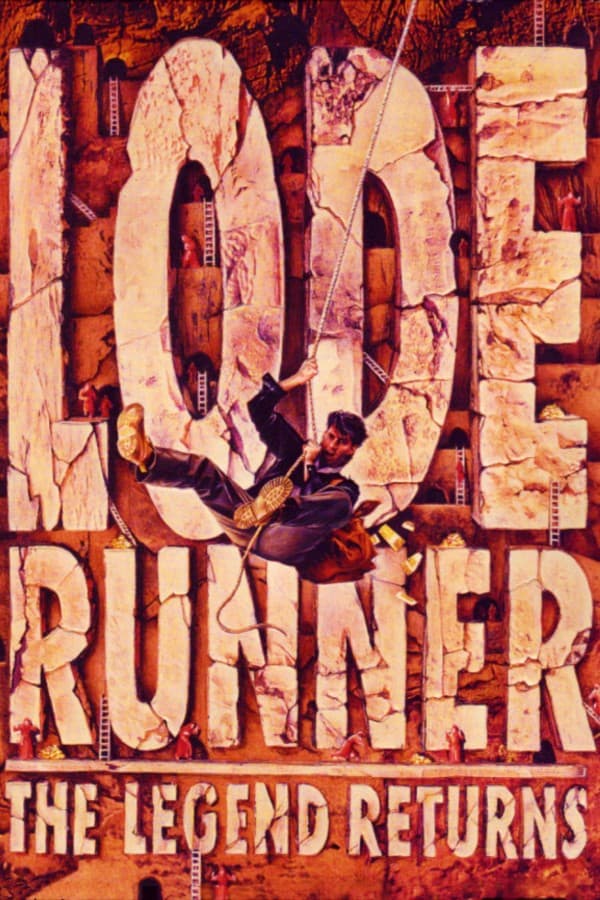

Lode Runner: The Legend Returns
aka LR'94 · ロードランナー レジェンド リターンズ
Rate this game
Rating 5.0
- Rating
- 5.0/ 5
- Played
- Rarely
When Lode Runner: The Legend Returns hit PCs, it took a quiet 1983 arcade puzzle game and rebuilt it into a slick, frantic trap-laying puzzle game of timing and spite.
Trapping Mad Monks in the DOS classic Lode Runner: The Legend Returns
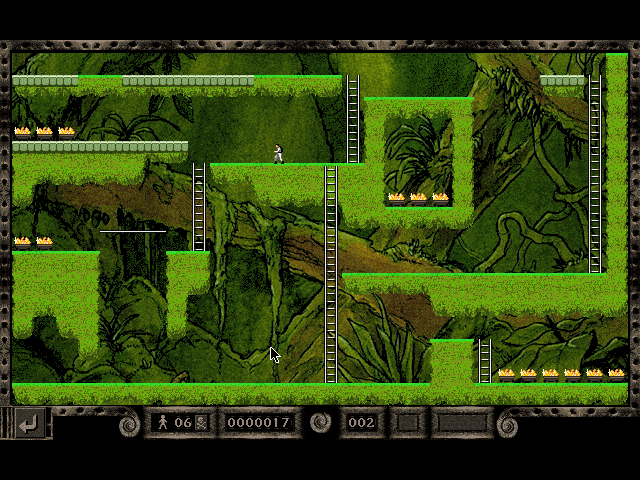
You play as Jake Peril in his grey jumpsuit, dropping into screen-sized puzzle grids with a simple objective: grab every chest of gold on the screen and sprint through the exit door before the local wildlife catches you. That local wildlife consists of red-robed skeletal creatures called Mad Monks that chase you across ladders and hand-over-hand bars without stopping. You have no weapon to kill them outright, only a hand-held blaster that digs temporary holes in the dirt to your left or right. Drop a Monk into a fresh hole, scramble over his head while he is stuck, and keep running before the floor fills back in and crushes him into a fresh spawn at the top of the map.
The movement feels tight and immediate, which is crucial because the action operates on strict frame timing. If you dig a hole a fraction of a second too early, the Monk walks right over it; dig too late, and he snaps onto your ladder and eats you instantly. The sound design amplifies every mistake, contrasting the sharp zip of your digger with the ominous crunch of a Monk grabbing your hero. Running the game on a Sound Blaster Pro or a Roland MT-32 gave the soundtrack by Matt Berardo and Brian Salter a rich synth punch, but the real acoustic cue was always the frantic scraping sound of digging through turf under pressure.
Ten hazardous worlds and a bucket of goo
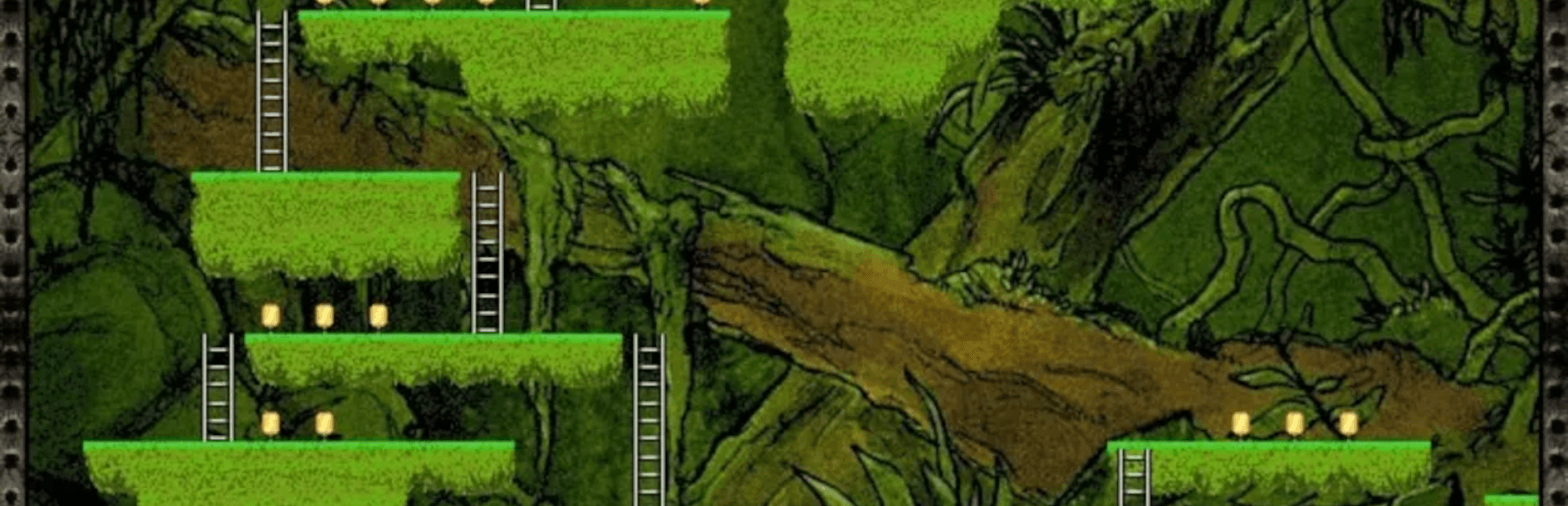
Developer Presage Software, Inc. expanded the original game's basic brick templates into 150 single-player levels spanning ten distinct environment tilesets. You start in the lush greens of the Moss Caverns before pushing through Fungus Delvings, the ancient stone of the Lost City of Ur, the slippery floor hazards of Winter's Dungeon, and the searing lava pits of Inferno's Playground. Each region introduces distinct floor logic. Bedrock cannot be dug through with your standard laser, requiring you to find special single-use tools like jackhammers, while trapdoor turf looks solid right up until you walk across it and fall through to the floor below.
To navigate these elaborate death traps, designer Jake Hoelter handed players an arsenal of single-use power-ups beyond the standard digging laser:
- Small and Big Bombs: Small charges blast away adjacent tiles, while big bombs permanently vaporize destructible blocks without letting them regenerate.
- Jackhammers and Pickaxes: Jackhammers chew through impassable bedrock beneath your feet, and pickaxes dislodge loose rocks from the ceiling to drop on approaching enemies.
- Snare Traps and Goo Buckets: Snares hold a chasing Monk in place, while buckets of goo coat the floor to slow down anything walking through it.
- Paralyzing Sprays: Gas canisters freeze nearby Monks in their tracks when you are backed into a dead end.
The trickiest levels turn these tools into strict logic puzzles. In world eight, the Shadowlands, the game cuts the ambient light entirely, leaving only a small circular spotlight centered on your character. Navigating pitch-black ladders while hunting gold chests and listening for the footfalls of off-screen Monks turns an already tense action game into pure nerves.
High difficulty and unpredictable Monk behavior
Published by Sierra On-Line, Inc. during a strong year for 1994 action games, contemporary gaming magazines praised its strategic depth. Computer Gaming World gave it four out of five stars, calling it a rare thinking person's arcade game, while French magazine Joystick scored it at 85%. Yet for all the critical praise, modern players often slam into a brick wall when the difficulty spikes in the mid-game worlds like Skeleton's Keep and Meltdown Metropolis.
Part of that frustration comes down to the Mad Monk pathfinding programmed by lead engineer Beth Daggert. Monks often appear plain foolish, getting stuck on single ladders or clustering uselessly in corners, but their simple pathfinding turns terrifying when three of them converge on a bottleneck. Because a trapped Monk drops any gold chest he was carrying, you frequently have to trick an enemy into a hole, steal his loot, and jump off his skull before the hole closes. One misplaced dig in a tight sequence leaves you completely stranded with no option but to reset the stage.
Building custom levels in Lode Runner: The Legend Returns
If the built-in campaign wears out your patience, the included level editor provides an endless supply of fresh punishment. The construction kit allows you to paint terrain, drop power-ups, set custom background music, and toggle day or night flags across custom stages. Designing custom levels was quick and easy on a standard 1994 VGA monitor, allowing players to build claustrophobic death traps or puzzle-focused stages to swap with friends via floppy disk.
The package also features 30 unique two-player cooperative levels. Player one controls Jake in gray, while player two takes control of Wes Reckless in blue. Co-op changes the entire dynamic of the game: you can dig traps to save your partner from a pursuing Monk, or accidentally blast away the ladder your teammate was using to escape, causing instant chaos. Playing two-player mode is still one of the fastest ways to test a friendship.
Why this platformer still demands your attention
While later ports added 3D polygons, the clean hand-drawn 2D graphics and fixed single-screen perspective of this DOS release hold up far better than its sequels. The enemy artificial intelligence is unpredictable and brutal, and the sudden difficulty spikes in later worlds will test anyone's tolerance for trial-and-error puzzle solving. The core loop of digging a hole, stealing gold, and escaping by the skin of your teeth works just as well today as it did three decades ago.
You can play Lode Runner: The Legend Returns online directly in your web browser with no download or technical setup required. Grab a keyboard, load up the first stage of Moss Caverns, and see how many gold chests you can snag before the Mad Monks corner you.
How Lode Runner: The Legend Returns is played — the keys the game listens to, grouped by what they do.
- Movement
- Action
- Interface
Highlighted keys are mapped — hover or tap one to see what it does.
Controls can also be reconfigured via the in-game Options menu. Joystick and mouse controls are supported in addition to keyboard.
Players' controls
Touch and gamepad controls
The on-screen keyboard and gamepad mapping the browser player uses on a phone, a tablet or a controller, as opposed to the real keys above. $PRO members make their own in the player and share them here; anyone can pick one to play with.
Make your own touch controlsPRO
- 1Open the editorSign in below, then pick what to make. The game starts with the editor open over it.
- 2Place your keysAdd keys and drag them where your thumbs rest, or map a controller's buttons. Test plays the game with them; Save keeps them, and you play with them from then on.
- 3Share themShare them right after saving in the game, or name and share them here. Players vote, and the best become this game's controls for everyone.
Go PROSee how it worksSign in+20 XP for sharing · +50 XP if yours become the game's own
- The game's own controlsKeyboardGamepadWhat every player starts with.In use
2 screenshots
From the archive
No gameplay video yet
No gameplay video for Lode Runner: The Legend Returns yet. Sign in to add one.
No reviews yet
Tell the community what you think of Lode Runner: The Legend Returns. Reviews are public and tied to your username.
No archived manuals for Lode Runner: The Legend Returns yet
No manuals archived for this title yet. Sign in to upload the first scan.
Cheat codes, console commands and memory pokes for Lode Runner: The Legend Returns — each one verified and attributed.
Sign in to submitNo cheats yet for this title
Know a working cheat, poke or trainer? Add it with the button above. Moderators check every entry before it goes live.
No archived soundtrack for Lode Runner: The Legend Returns yet
No soundtrack archived for this title yet. Sign in to upload the first rip.
No save states for Lode Runner: The Legend Returns yet
No save states for this title yet. Sign in to share one.
Discussions
Sign in to post- Threads0
- Total posts0
- Online now6
Community · Lode Runner: The Legend Returns
Who's contributing, and what's new
- Reviews0
- Threads0
- Uploadsapproved0
- Contributors0
Recent activity
Nothing here yet
Reviews, discussion threads and approved uploads appear here as members add them.