


In Lure of the Temptress, you spend half your time saving a medieval village from brutal orc invaders and the other half begging an automated blacksmith to move out of the doorway.
Most adventure games in 1992 treated non-player characters as static set dressing. They stood in one room, waiting for you to walk up and trigger their single line of dialog. Revolution Software tried something radically different for their debut title by building the proprietary Virtual Theatre engine. Instead of sitting around, every NPC in the game follows an automated internal routine, wandering through the streets of Turnvale to work, drink, or chat with neighbors entirely on their own schedule.
It was a massive conceptual leap, but in practice, it turns every quest into an exercise in high-stakes hide-and-seek. If you need a specific character to take a key item or answer a crucial question, you cannot just walk into their shop and find them. You have to comb through Turnvale's alleys, cross your fingers, and hope they didn’t decide to stroll across town while your back was turned.
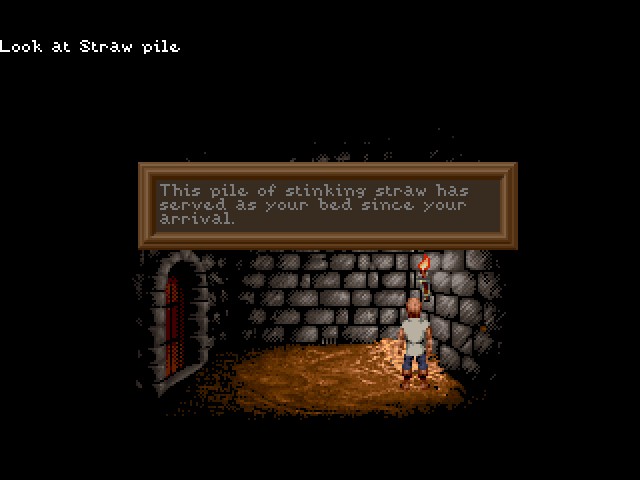
You play as Diermot, a young peasant who lands in a prison cell after a disastrous battle against the Skorl, an invading army of heavy-set warrior creatures. Your immediate goal is to escape the dungeon, link up with the local resistance, and eventually overthrow the evil sorceress Selena. The game handles basic inventory puzzles cleanly enough: you use a torch to start a cell fire, trade a metal bar for a gem, and swap that gem for a flask. You even get simple real-time combat where you swing a sword and block attacks from Skorl guards or subterranean monsters.
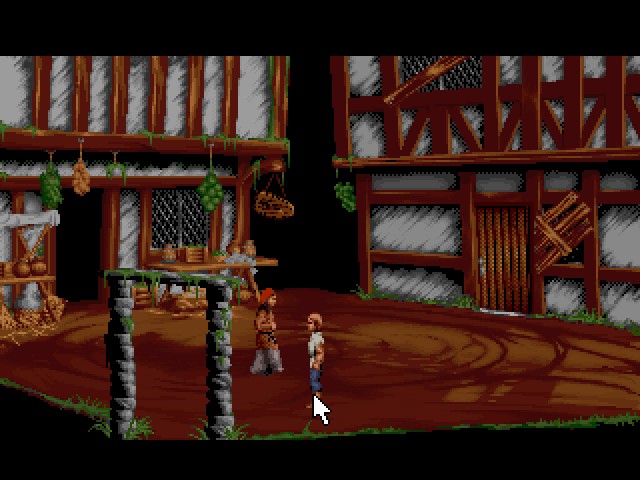
The trouble comes from how the engine handles space and multi-character mechanics. You recruit a sidekick named Ratpouch early on, and you can issue him multi-part instruction strings like telling him to unlock a door or lure a guard away. But the character collision and pathfinding are notoriously clumsy. Because the engine refuses to let characters pass through one another, a single villager standing in a narrow doorway causes Diermot to pathfind by running in frantic circles around the room rather than stepping past them. Followers like Ratpouch regularly get stuck behind geometry or fail to load into the next screen entirely, leaving you wandering alone until you go back to fetch them.

Despite the pathfinding headaches, Lure of the Temptress delivered a distinct voice. Reviewers in 1992 praised its dry British humor, snappy text, and atmospheric detailed visuals. While critics noted the game was relatively short at around four to five hours, it punched above its weight commercially and hit the top of the UK PC charts despite heavy competition from Sierra and LucasArts.
For PC audio enthusiasts, the sound design holds a special detail. Music composer Richard Joseph wrote sound effects tailored to the Roland CM-32L sound module. If you try running the game through a standard MT-32, certain specific sound effects do not render properly because they rely on the extra sound memory built into the CM-32L board.
Early Amiga owners had to contend with a game-breaking bug near the end that permanently locked players inside the Castle Gate Room, but the PC version shows Revolution Software working out the design ideas they would later refine into Broken Sword. The game plays fast, doesn't overstay its welcome, and features clever multi-character puzzle setups if you have the patience for its erratic schedules.
You can play Lure of the Temptress free in your browser right now, with nothing to install and no complex setup required. If you want to check out this classic 1992 release from publisher Virgin Interactive Entertainment, launch the game above, burn down your dungeon door with the torch, and remember to keep a very close eye on where Ratpouch is standing before you try walking through a narrow doorway.
In Lure of the Temptress, you spend half your time saving a medieval village from brutal orc invaders and the other half begging an automated blacksmith to move out of the doorway.
Most adventure games in 1992 treated non-player characters as static set dressing. They stood in one room, waiting for you to walk up and trigger their single line of dialog. Revolution Software tried something radically different for their debut title by building the proprietary Virtual Theatre engine. Instead of sitting around, every NPC in the game follows an automated internal routine, wandering through the streets of Turnvale to work, drink, or chat with neighbors entirely on their own schedule.
It was a massive conceptual leap, but in practice, it turns every quest into an exercise in high-stakes hide-and-seek. If you need a specific character to take a key item or answer a crucial question, you cannot just walk into their shop and find them. You have to comb through Turnvale's alleys, cross your fingers, and hope they didn’t decide to stroll across town while your back was turned.

You play as Diermot, a young peasant who lands in a prison cell after a disastrous battle against the Skorl, an invading army of heavy-set warrior creatures. Your immediate goal is to escape the dungeon, link up with the local resistance, and eventually overthrow the evil sorceress Selena. The game handles basic inventory puzzles cleanly enough: you use a torch to start a cell fire, trade a metal bar for a gem, and swap that gem for a flask. You even get simple real-time combat where you swing a sword and block attacks from Skorl guards or subterranean monsters.
The trouble comes from how the engine handles space and multi-character mechanics. You recruit a sidekick named Ratpouch early on, and you can issue him multi-part instruction strings like telling him to unlock a door or lure a guard away. But the character collision and pathfinding are notoriously clumsy. Because the engine refuses to let characters pass through one another, a single villager standing in a narrow doorway causes Diermot to pathfind by running in frantic circles around the room rather than stepping past them. Followers like Ratpouch regularly get stuck behind geometry or fail to load into the next screen entirely, leaving you wandering alone until you go back to fetch them.

Despite the pathfinding headaches, Lure of the Temptress delivered a distinct voice. Reviewers in 1992 praised its dry British humor, snappy text, and atmospheric detailed visuals. While critics noted the game was relatively short at around four to five hours, it punched above its weight commercially and hit the top of the UK PC charts despite heavy competition from Sierra and LucasArts.
For PC audio enthusiasts, the sound design holds a special detail. Music composer Richard Joseph wrote sound effects tailored to the Roland CM-32L sound module. If you try running the game through a standard MT-32, certain specific sound effects do not render properly because they rely on the extra sound memory built into the CM-32L board.

Early Amiga owners had to contend with a game-breaking bug near the end that permanently locked players inside the Castle Gate Room, but the PC version shows Revolution Software working out the design ideas they would later refine into Broken Sword. The game plays fast, doesn't overstay its welcome, and features clever multi-character puzzle setups if you have the patience for its erratic schedules.
You can play Lure of the Temptress free in your browser right now, with nothing to install and no complex setup required. If you want to check out this classic 1992 release from publisher Virgin Interactive Entertainment, launch the game above, burn down your dungeon door with the torch, and remember to keep a very close eye on where Ratpouch is standing before you try walking through a narrow doorway.
How Lure of the Temptress is played — the keys the game listens to, grouped by what they do.
Highlighted keys are mapped — hover or tap one to see what it does.
The on-screen keyboard and gamepad mapping the browser player uses on a phone, a tablet or a controller, as opposed to the real keys above. $PRO members make their own in the player and share them here; anyone can pick one to play with.
Cheat codes, console commands and memory pokes for Lure of the Temptress — each one verified and attributed.
Sign in to submitHow Lure of the Temptress is played — the keys the game listens to, grouped by what they do.
Highlighted keys are mapped — hover or tap one to see what it does.
The on-screen keyboard and gamepad mapping the browser player uses on a phone, a tablet or a controller, as opposed to the real keys above. $PRO members make their own in the player and share them here; anyone can pick one to play with.
Cheat codes, console commands and memory pokes for Lure of the Temptress — each one verified and attributed.
Sign in to submit