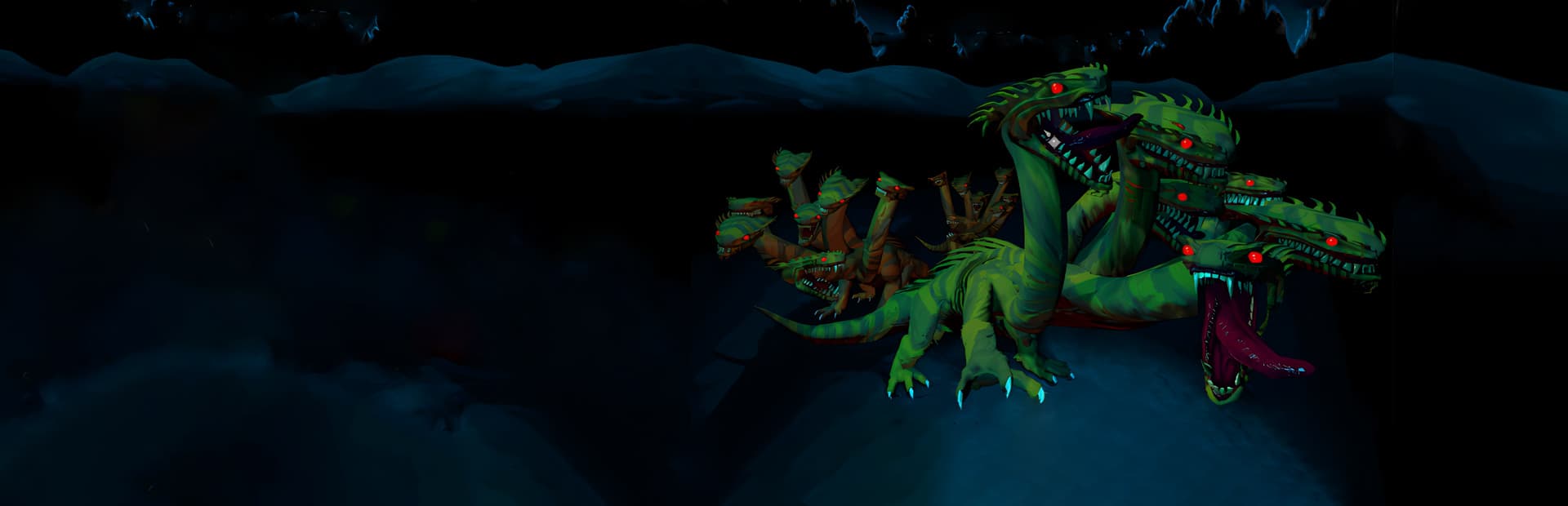
Laying down a ridge of molten rock with a single spell while banking around a dragon is where Magic Carpet 2: The Netherworlds hits its stride, refining Bullfrog's wild experiment into something faster and far more direct.
The core loop of Magic Carpet 2: The Netherworlds turns landscape management into combat strategy. Guided by your dead master Kafkar, your job as an apprentice wizard is to reclaim the living realm from the demon lord Vissiluth and his seven servant wizards. You float above the terrain on a carpet, blast wild creatures, and claim the raw energy left behind when they disintegrate. Every kill drops glowing balls of mana that drift across the dirt. You cast a possession spell to tag that energy with your color, which summons a hot air balloon from your home base. That balloon slowly hauls the glowing spheres back to your castle, expanding its towers and unlocking higher tiers of destructive magic.
That delivery pipeline makes defense just as important as offensive firepower. If rival wizards spot your balloon floating across open ground, they will destroy it and tag the loose mana for themselves. If they find your castle, they can level its stone walls with targeted spells while your back is turned. Upgrading your castle tier grants access to heavy spells like meteor showers and lightning bolts, but larger bases also draw more aggression from local fauna like giant worms, spiders, and dragons. Managing your mana income while fighting off floating demon spawns creates a constant pull between pushing forward into unknown territory and rushing back to guard your local stockpile.
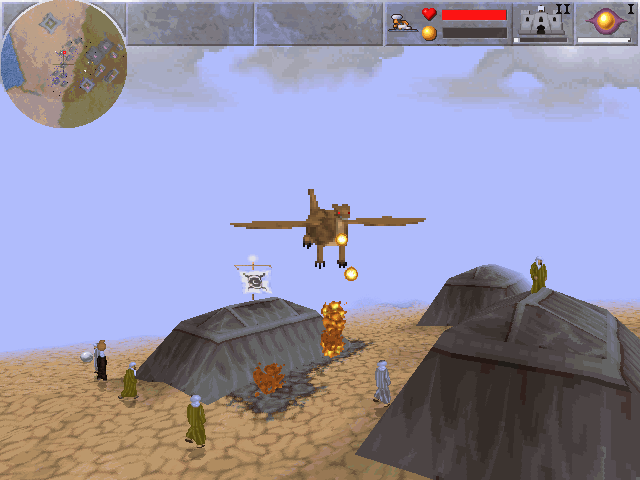
Terrain deformation adds real tactical depth to every firefight. When you raise a volcano or fracture the earth with an earthquake spell, the 3D landscape physically warps under your carpet. Raising a wall of earth stops incoming fireballs mid-flight, while carving an abyss splits armies of ground-bound trolls so you can pick them off individually. The game tracks spell experience, meaning the fireballs and tornadoes you throw early in the campaign grow vastly larger and more lethal as you clear out local threats.
Not every addition to this follow-up works in its favor. Designer Peter Molyneux and lead programmer Alan Wright pushed the proprietary 3D engine into cramped underground cavern levels, switching up the wide-open skies for winding tunnels and narrow rock ledges. While these pitch-black environments create intense close-quarters duels against giant spiders, they highlight the awkward nature of the flight controls. Because flying lacks the full pitch range of a dedicated flight simulator, navigating vertical shafts in pitch-dark tunnels often results in hitting rock walls while trying to aim downward at a troll hidden in a crevice.
The save system compounds the problem inside these underground zones. Unlike outdoor missions where open ground gives you room to retreat, subterranean maps force you down narrow corridors where missing a secret entrance or taking a wrong turn leads straight into an ambush. Dying near the end of a long tunnel run sends you back to the level start, which turns certain cavern missions into tedious memory tests. French gaming press noted at launch that these underground sections quickly became the most frustrating bottleneck in an otherwise fluid campaign.
Oddly enough, outside of those cave bottlenecks, open-air missions in this 1995 action game feel substantially easier than those in the original release. Longtime players who survived the ruthless AI of the first game often find Vissiluth's lackeys passive by comparison. Enemy wizards rarely launch coordinated counter-attacks against your castle, letting you accumulate massive mana hoards early in a mission without facing real pressure.
Released as an exclusive 1995 Bullfrog Productions title for Electronic Arts, the project salvaged a massive amount of artwork, cut concepts, and abandoned spells originally drafted for the first game. Artist Eoin Rogan and composer Russell Shaw filled out the dark, Middle Eastern fantasy aesthetic with distinct ambient audio and night-time lighting maps that gave each world a darker tone. Unlike its predecessor, this sequel never received ports to home consoles like the Sony PlayStation or Sega Saturn, remaining entirely tailored to PC hardware.
That PC focus meant serious hardware demands. Getting smooth framerates out of the software renderer required at least a 486/33 MHz processor with 8 MB of RAM running MS-DOS 5.0. The manual famously advised running SMARTDRV.EXE 2048 before launching, or high-quality audio tracks from Russell Shaw's soundtrack and custom voice lines would stutter during chaotic fights. When everything ran correctly on a Sound Blaster card, hearing distant enemy wizards cast gravity wells made the open skies feel huge.
The campaign wraps up with one of the most memorable visual payoffs on DOS. When you finally track down Vissiluth in his lair and deplete his health bar, the entire landscape ruptures in a scripted victory sequence. A massive volcano erupts in the center of the map, showering the sky with multi-colored streams of liquid mana that rain down across the newly reclaimed realm.
Very few shooters have ever matched this level of environmental freedom. Dropping a mountain range on top of a rival wizard's town while dodging giant worms feels great. While the campaign curve is gentler and the subterranean flight controls can irritate, fast aerial combat and real-time terrain destruction carry you right past those flaws. If you enjoyed mid-nineties action design on PC, you need to play it.
You can play Magic Carpet 2: The Netherworlds online right now, fully playable as a original Magic Carpet 2: The Netherworlds MS-DOS game inside your browser window. New players often try to play it like a standard flight sim, but the trick is treating your carpet like a strafing hovercraft rather than an airplane. Fire up Magic Carpet 2: The Netherworlds free in your browser, keep your carpet moving sideways during wizard duels, and claim your first mana sphere today.
Laying down a ridge of molten rock with a single spell while banking around a dragon is where Magic Carpet 2: The Netherworlds hits its stride, refining Bullfrog's wild experiment into something faster and far more direct.
The core loop of Magic Carpet 2: The Netherworlds turns landscape management into combat strategy. Guided by your dead master Kafkar, your job as an apprentice wizard is to reclaim the living realm from the demon lord Vissiluth and his seven servant wizards. You float above the terrain on a carpet, blast wild creatures, and claim the raw energy left behind when they disintegrate. Every kill drops glowing balls of mana that drift across the dirt. You cast a possession spell to tag that energy with your color, which summons a hot air balloon from your home base. That balloon slowly hauls the glowing spheres back to your castle, expanding its towers and unlocking higher tiers of destructive magic.
That delivery pipeline makes defense just as important as offensive firepower. If rival wizards spot your balloon floating across open ground, they will destroy it and tag the loose mana for themselves. If they find your castle, they can level its stone walls with targeted spells while your back is turned. Upgrading your castle tier grants access to heavy spells like meteor showers and lightning bolts, but larger bases also draw more aggression from local fauna like giant worms, spiders, and dragons. Managing your mana income while fighting off floating demon spawns creates a constant pull between pushing forward into unknown territory and rushing back to guard your local stockpile.
Terrain deformation adds real tactical depth to every firefight. When you raise a volcano or fracture the earth with an earthquake spell, the 3D landscape physically warps under your carpet. Raising a wall of earth stops incoming fireballs mid-flight, while carving an abyss splits armies of ground-bound trolls so you can pick them off individually. The game tracks spell experience, meaning the fireballs and tornadoes you throw early in the campaign grow vastly larger and more lethal as you clear out local threats.
Not every addition to this follow-up works in its favor. Designer Peter Molyneux and lead programmer Alan Wright pushed the proprietary 3D engine into cramped underground cavern levels, switching up the wide-open skies for winding tunnels and narrow rock ledges. While these pitch-black environments create intense close-quarters duels against giant spiders, they highlight the awkward nature of the flight controls. Because flying lacks the full pitch range of a dedicated flight simulator, navigating vertical shafts in pitch-dark tunnels often results in hitting rock walls while trying to aim downward at a troll hidden in a crevice.
The save system compounds the problem inside these underground zones. Unlike outdoor missions where open ground gives you room to retreat, subterranean maps force you down narrow corridors where missing a secret entrance or taking a wrong turn leads straight into an ambush. Dying near the end of a long tunnel run sends you back to the level start, which turns certain cavern missions into tedious memory tests. French gaming press noted at launch that these underground sections quickly became the most frustrating bottleneck in an otherwise fluid campaign.
Oddly enough, outside of those cave bottlenecks, open-air missions in this 1995 action game feel substantially easier than those in the original release. Longtime players who survived the ruthless AI of the first game often find Vissiluth's lackeys passive by comparison. Enemy wizards rarely launch coordinated counter-attacks against your castle, letting you accumulate massive mana hoards early in a mission without facing real pressure.
Released as an exclusive 1995 Bullfrog Productions title for Electronic Arts, the project salvaged a massive amount of artwork, cut concepts, and abandoned spells originally drafted for the first game. Artist Eoin Rogan and composer Russell Shaw filled out the dark, Middle Eastern fantasy aesthetic with distinct ambient audio and night-time lighting maps that gave each world a darker tone. Unlike its predecessor, this sequel never received ports to home consoles like the Sony PlayStation or Sega Saturn, remaining entirely tailored to PC hardware.
That PC focus meant serious hardware demands. Getting smooth framerates out of the software renderer required at least a 486/33 MHz processor with 8 MB of RAM running MS-DOS 5.0. The manual famously advised running SMARTDRV.EXE 2048 before launching, or high-quality audio tracks from Russell Shaw's soundtrack and custom voice lines would stutter during chaotic fights. When everything ran correctly on a Sound Blaster card, hearing distant enemy wizards cast gravity wells made the open skies feel huge.
The campaign wraps up with one of the most memorable visual payoffs on DOS. When you finally track down Vissiluth in his lair and deplete his health bar, the entire landscape ruptures in a scripted victory sequence. A massive volcano erupts in the center of the map, showering the sky with multi-colored streams of liquid mana that rain down across the newly reclaimed realm.
Very few shooters have ever matched this level of environmental freedom. Dropping a mountain range on top of a rival wizard's town while dodging giant worms feels great. While the campaign curve is gentler and the subterranean flight controls can irritate, fast aerial combat and real-time terrain destruction carry you right past those flaws. If you enjoyed mid-nineties action design on PC, you need to play it.
You can play Magic Carpet 2: The Netherworlds online right now, fully playable as a original Magic Carpet 2: The Netherworlds MS-DOS game inside your browser window. New players often try to play it like a standard flight sim, but the trick is treating your carpet like a strafing hovercraft rather than an airplane. Fire up Magic Carpet 2: The Netherworlds free in your browser, keep your carpet moving sideways during wizard duels, and claim your first mana sphere today.
How Magic Carpet 2: The Netherworlds is played — the keys the game listens to, grouped by what they do.
Highlighted keys are mapped — hover or tap one to see what it does.
Controls can be customized from the Stone Tablet screen by selecting 'Configure Keyboard'. NWSETUP is used to configure sound and music.
The on-screen keyboard and gamepad mapping the browser player uses on a phone, a tablet or a controller, as opposed to the real keys above. $PRO members make their own in the player and share them here; anyone can pick one to play with.
Cheat codes, console commands and memory pokes for Magic Carpet 2: The Netherworlds — each one verified and attributed.
Sign in to submitaka Magic Carpet 2 · Magic Carpet 2: Niederwelten
How Magic Carpet 2: The Netherworlds is played — the keys the game listens to, grouped by what they do.
Highlighted keys are mapped — hover or tap one to see what it does.
Controls can be customized from the Stone Tablet screen by selecting 'Configure Keyboard'. NWSETUP is used to configure sound and music.
The on-screen keyboard and gamepad mapping the browser player uses on a phone, a tablet or a controller, as opposed to the real keys above. $PRO members make their own in the player and share them here; anyone can pick one to play with.
Cheat codes, console commands and memory pokes for Magic Carpet 2: The Netherworlds — each one verified and attributed.
Sign in to submit