

When you send a sweater through a time-traveling toilet so a shivering hamster in the future can wear it, you realize Maniac Mansion: Day of the Tentacle built a brand of puzzle design that nobody else ever matched.
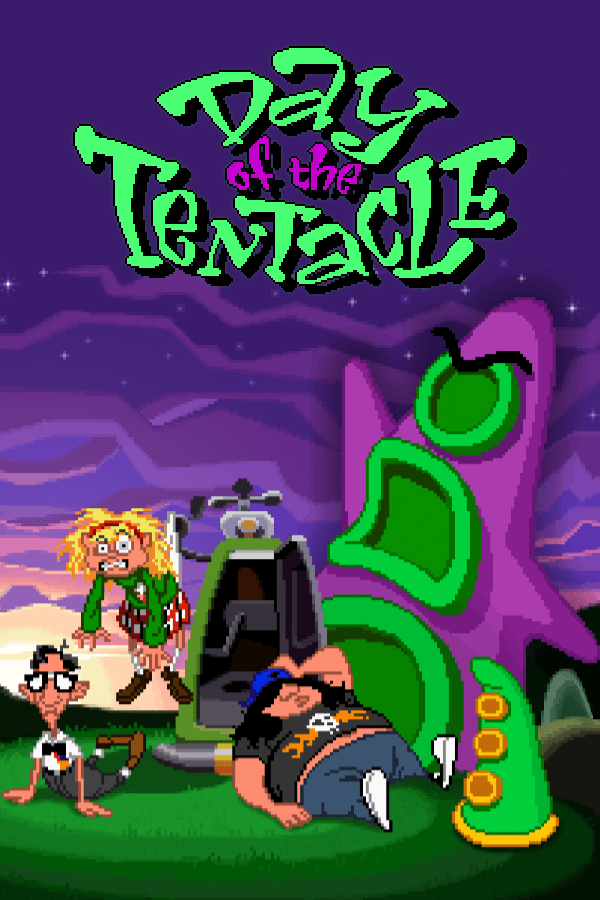
The core setup separates its three leads across half a millennium. After Purple Tentacle drinks toxic runoff from Dr. Fred Edison's Sludge-o-matic, he grows a pair of stubby flipper arms and decides to conquer the world. Dr. Fred tries to solve the problem by building three makeshift time machines out of porta-potties, called Chron-o-Johns. The experiment goes wrong immediately: Hoagie the laid-back rock roadie gets dumped 200 years in the past alongside George Washington and Thomas Jefferson, deranged medical student Laverne lands 200 years in a future ruled by tyrant tentacles, and high-strung nerd Bernard Bernoulli remains stuck in the present mansion motel.
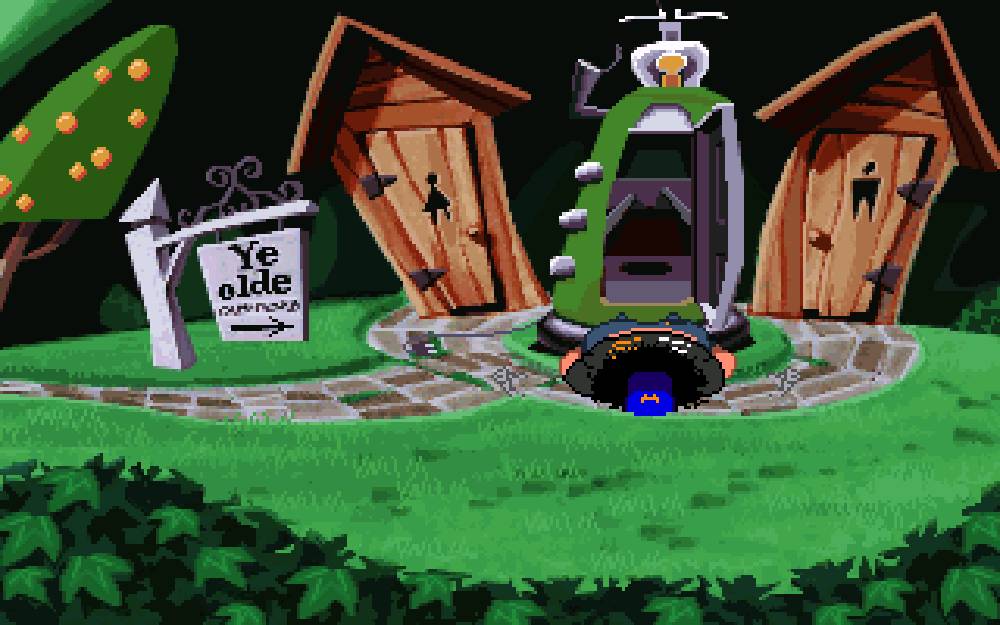
Because the three timelines share the exact same location, actions in the past reshape the world for the characters downstream. If you need a tree removed in Laverne's time, you have Hoagie convince George Washington to chop it down in 1776, or paint its cherries red so it gets mistaken for a kumquat tree. Inventory item transfer happens directly through the toilets: flushing an item down a Chron-o-John sends it directly to another character's inventory across centuries. This triangular cross-time inventory system forced LucasArts to dump standard linear adventure structure for something far looser and more flexible.

The top-down perspective from old adventure interfaces gave way here to low, dynamic camera angles that emphasize the stretched, tilted walls inspired by classic American animated shorts. You interact with the world via nine standard SCUMM verbs laid out across the bottom third of the screen. Scrolling through inventories across three distinct periods means managing three times the typical item pool, but the game avoids clutter by keeping items relevant to specific local paradoxes. If you find a battery blueprint in the past, you pass it forward so Dr. Fred can complete it in the present, then charge it up in the future.
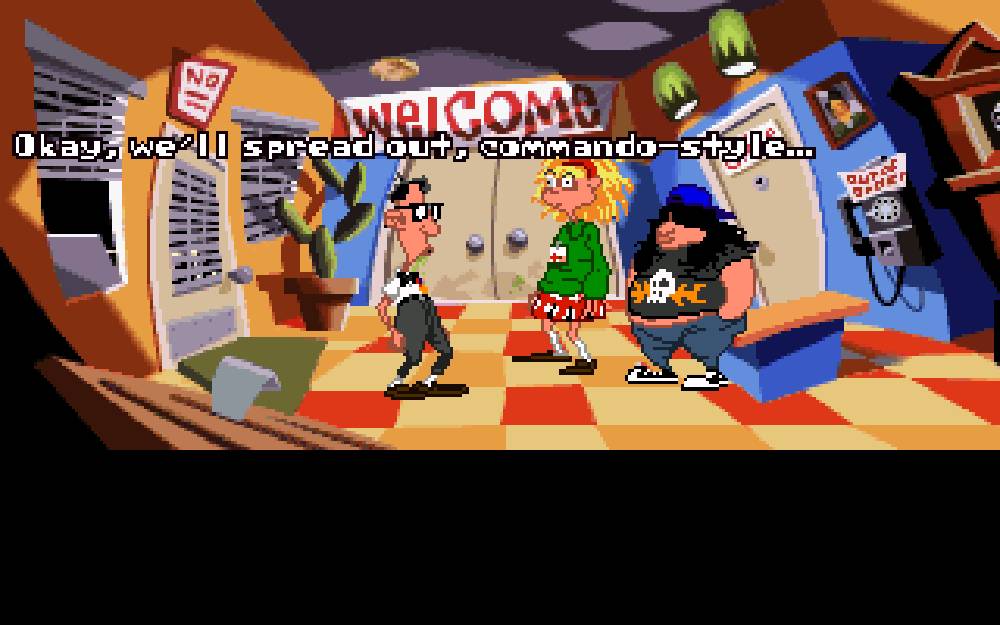
Design leads Dave Grossman and Tim Schafer took over project direction for their first time, building on scenario drafts provided by Maniac Mansion creators Ron Gilbert and Gary Winnick. They chose a bright visual style influenced by classic Chuck Jones cartoons, filling rooms with curved furniture, crooked doorframes, and exaggerated sight gags. Rather than treating animated comedy as a sequence of passive cutscenes, the humor sits entirely inside the mechanics. You solve problems by executing slapstick logic that would make sense in a Monday morning broadcast cartoon.
The writing relies heavily on rapid-fire banter and voice work that set a new benchmark for PC games in 1993. When reviewed in September 1993, Computer Gaming World noted that the voice performances
"would have done the late Mel Blanc proud."The CD-ROM talkie release packed full voice audio for every line in the script, making the floppy disk edition feel like a stripped-down alternative. The floppy set came on seven 3.5-inch diskettes and enforced a physical copy protection system where players matched Dr. Fred's Super Battery recipe patent numbers, beaker shapes, and crouton positions using a paper code wheel.
For players who explored every corner of the present-day motel, the developers hid a complete surprise inside Bernard's timeline. By clicking on the computer terminal inside Weird Ed Edison's room, you can boot up and play the entirety of the original 1987 Maniac Mansion within the game itself. It is one of the earliest examples of an entire commercial release nested as a playable easter egg inside a sequel.
The original 1987 title was infamous for punishing players who made minor errors early in a run. You could lock yourself out of a solution, trap characters in rooms, or accidentally kill off your party members hours before realizing the save file was rendered useless. For this 1993 release, running on the eighth iteration of the internal SCUMM engine, LucasArts threw out character death and unwinnable states entirely. Every mistake is temporary, and every dead end just means you missed a cross-time interaction elsewhere.
Removing fatal failures changed how players approached lateral puzzles. Instead of saving before every action out of paranoia, you are encouraged to experiment with bizarre inventory combinations. Trying to freeze a hamster in a ice machine in the present so Laverne can thaw it out 200 years later sounds absurd on paper, but the internal consistency of the game's rules makes you search for those exact leaps in logic. The difficulty stays high because you are managing three separate inventories across three distinct periods, but you never have to restart from scratch because of an unread line in the documentation.
Sound support was equally comprehensive for MS-DOS setups of the period. The game included native support for:
While the overall puzzle logic stands up exceptionally well, the sheer volume of cross-time backtracking can drag during the middle act. Once all three characters have access to their respective Chron-o-Johns, you will spend considerable time opening the inventory menu, selecting an item, flushing it, switching characters, walking to the porta-potty, retrieving the item, and testing it across town. If you miss a subtle clue, like altering a flag design to change a costume in the future, you will end up blindly sending items across centuries just to see what sticks. Compared to streamlined contemporary point-and-click titles produced by LucasArts, the trial-and-error element can still stall your progress.
Even with that friction, it shows the genre at its best, right when PC graphics were transitioning from simple VGA sprites to full cartoon production values. The humor lands, the character voices carry the scenario, and the time-manipulation puzzles feel rewarding when all the pieces snap into place. Anyone who wants to experience nineties interactive comedy at its most creative should give it a run.
You can play Maniac Mansion: Day of the Tentacle online right now, free in your browser, with nothing to install and no setup required. Load up the DOS version of Maniac Mansion: Day of the Tentacle free in your browser to test the kumquat tree puzzle yourself, or just log onto Weird Ed's computer to play the original 1987 classic without leaving the intro area.
When you send a sweater through a time-traveling toilet so a shivering hamster in the future can wear it, you realize Maniac Mansion: Day of the Tentacle built a brand of puzzle design that nobody else ever matched.
The core setup separates its three leads across half a millennium. After Purple Tentacle drinks toxic runoff from Dr. Fred Edison's Sludge-o-matic, he grows a pair of stubby flipper arms and decides to conquer the world. Dr. Fred tries to solve the problem by building three makeshift time machines out of porta-potties, called Chron-o-Johns. The experiment goes wrong immediately: Hoagie the laid-back rock roadie gets dumped 200 years in the past alongside George Washington and Thomas Jefferson, deranged medical student Laverne lands 200 years in a future ruled by tyrant tentacles, and high-strung nerd Bernard Bernoulli remains stuck in the present mansion motel.
Because the three timelines share the exact same location, actions in the past reshape the world for the characters downstream. If you need a tree removed in Laverne's time, you have Hoagie convince George Washington to chop it down in 1776, or paint its cherries red so it gets mistaken for a kumquat tree. Inventory item transfer happens directly through the toilets: flushing an item down a Chron-o-John sends it directly to another character's inventory across centuries. This triangular cross-time inventory system forced LucasArts to dump standard linear adventure structure for something far looser and more flexible.
The top-down perspective from old adventure interfaces gave way here to low, dynamic camera angles that emphasize the stretched, tilted walls inspired by classic American animated shorts. You interact with the world via nine standard SCUMM verbs laid out across the bottom third of the screen. Scrolling through inventories across three distinct periods means managing three times the typical item pool, but the game avoids clutter by keeping items relevant to specific local paradoxes. If you find a battery blueprint in the past, you pass it forward so Dr. Fred can complete it in the present, then charge it up in the future.
Design leads Dave Grossman and Tim Schafer took over project direction for their first time, building on scenario drafts provided by Maniac Mansion creators Ron Gilbert and Gary Winnick. They chose a bright visual style influenced by classic Chuck Jones cartoons, filling rooms with curved furniture, crooked doorframes, and exaggerated sight gags. Rather than treating animated comedy as a sequence of passive cutscenes, the humor sits entirely inside the mechanics. You solve problems by executing slapstick logic that would make sense in a Monday morning broadcast cartoon.
The writing relies heavily on rapid-fire banter and voice work that set a new benchmark for PC games in 1993. When reviewed in September 1993, Computer Gaming World noted that the voice performances
"would have done the late Mel Blanc proud."The CD-ROM talkie release packed full voice audio for every line in the script, making the floppy disk edition feel like a stripped-down alternative. The floppy set came on seven 3.5-inch diskettes and enforced a physical copy protection system where players matched Dr. Fred's Super Battery recipe patent numbers, beaker shapes, and crouton positions using a paper code wheel.
For players who explored every corner of the present-day motel, the developers hid a complete surprise inside Bernard's timeline. By clicking on the computer terminal inside Weird Ed Edison's room, you can boot up and play the entirety of the original 1987 Maniac Mansion within the game itself. It is one of the earliest examples of an entire commercial release nested as a playable easter egg inside a sequel.
The original 1987 title was infamous for punishing players who made minor errors early in a run. You could lock yourself out of a solution, trap characters in rooms, or accidentally kill off your party members hours before realizing the save file was rendered useless. For this 1993 release, running on the eighth iteration of the internal SCUMM engine, LucasArts threw out character death and unwinnable states entirely. Every mistake is temporary, and every dead end just means you missed a cross-time interaction elsewhere.
Removing fatal failures changed how players approached lateral puzzles. Instead of saving before every action out of paranoia, you are encouraged to experiment with bizarre inventory combinations. Trying to freeze a hamster in a ice machine in the present so Laverne can thaw it out 200 years later sounds absurd on paper, but the internal consistency of the game's rules makes you search for those exact leaps in logic. The difficulty stays high because you are managing three separate inventories across three distinct periods, but you never have to restart from scratch because of an unread line in the documentation.
Sound support was equally comprehensive for MS-DOS setups of the period. The game included native support for:
While the overall puzzle logic stands up exceptionally well, the sheer volume of cross-time backtracking can drag during the middle act. Once all three characters have access to their respective Chron-o-Johns, you will spend considerable time opening the inventory menu, selecting an item, flushing it, switching characters, walking to the porta-potty, retrieving the item, and testing it across town. If you miss a subtle clue, like altering a flag design to change a costume in the future, you will end up blindly sending items across centuries just to see what sticks. Compared to streamlined contemporary point-and-click titles produced by LucasArts, the trial-and-error element can still stall your progress.
Even with that friction, it shows the genre at its best, right when PC graphics were transitioning from simple VGA sprites to full cartoon production values. The humor lands, the character voices carry the scenario, and the time-manipulation puzzles feel rewarding when all the pieces snap into place. Anyone who wants to experience nineties interactive comedy at its most creative should give it a run.
You can play Maniac Mansion: Day of the Tentacle online right now, free in your browser, with nothing to install and no setup required. Load up the DOS version of Maniac Mansion: Day of the Tentacle free in your browser to test the kumquat tree puzzle yourself, or just log onto Weird Ed's computer to play the original 1987 classic without leaving the intro area.
aka Day of the Tentacle · Maniac Mansion 2 · Maniac Mansion II: Day of the Tentacle · Maniac Mansion: Il Giorno del Tentacolo
How Maniac Mansion: Day of the Tentacle is played — the keys the game listens to, grouped by what they do.
Highlighted keys are mapped — hover or tap one to see what it does.
Player types text when entering save game titles in the Save/Load menu. Command-line parameters at DOS prompt can set default controls or audio modes (e.g., dott i, dott j, dott k).
The on-screen keyboard and gamepad mapping the browser player uses on a phone, a tablet or a controller, as opposed to the real keys above. $PRO members make their own in the player and share them here; anyone can pick one to play with.
Cheat codes, console commands and memory pokes for Maniac Mansion: Day of the Tentacle — each one verified and attributed.
Sign in to submitHow Maniac Mansion: Day of the Tentacle is played — the keys the game listens to, grouped by what they do.
Highlighted keys are mapped — hover or tap one to see what it does.
Player types text when entering save game titles in the Save/Load menu. Command-line parameters at DOS prompt can set default controls or audio modes (e.g., dott i, dott j, dott k).
The on-screen keyboard and gamepad mapping the browser player uses on a phone, a tablet or a controller, as opposed to the real keys above. $PRO members make their own in the player and share them here; anyone can pick one to play with.
Cheat codes, console commands and memory pokes for Maniac Mansion: Day of the Tentacle — each one verified and attributed.
Sign in to submit