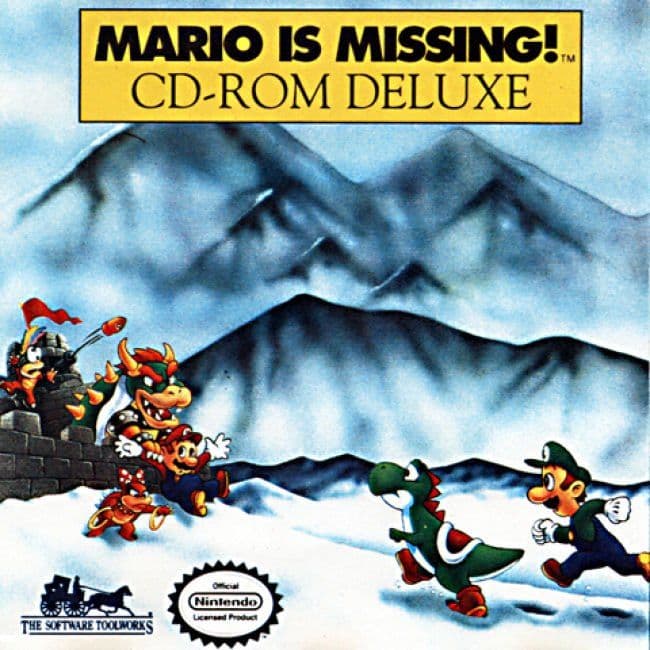
Mario is Missing! Deluxe
Streaming build
Checking storage…276 MB
Preload in background
In Mario is Missing! Deluxe, Nintendo licensed its biggest mascot to an external studio, only to leave Luigi wandering around real-world cities asking tourists for directions.
Swapping Mushroom Kingdom platforming for global geography in Mario is Missing! Deluxe
In 1993, edutainment software was filling up retail shelves. Publishers wanted a way to make geography lessons appealing to kids, and license deals were the obvious shortcut. The Software Toolworks solved this by putting Luigi in the starring role for the first time, taking him completely out of traditional side-scrolling levels.
Bowser sets up a base in Antarctica and opens portals to 25 real-world locations. His Koopas steal famous treasures, from Big Ben's hands in London to artifacts in Cairo, Beijing, Moscow, and San Francisco. Mario gets captured right at the start, leaving Luigi to clean up the mess across the globe.
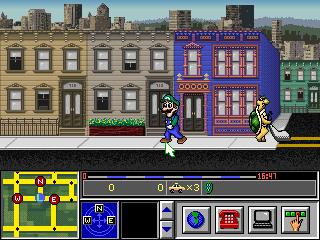
Instead of running through timed obstacle courses, you walk around street grids as a point-and-click adventure character. You hunt down wandering Koopas, snatch back stolen items, and talk to pedestrians to figure out which landmark you are standing next to.
How the Globulator and local trivia replace fire flowers
Each city level follows a strict, repeatable template. You arrive via a portal, snatch stolen artifacts off red Koopas, and show those items to locals on the sidewalk. Pedestrians give you snippets of real history or trivia that answer quiz questions at the tourist information counter.
Once you return an item to its proper owner, you take a photograph of the restored landmark. You then pull out a handheld device called the Globulator to determine your exact coordinates on a world map. Calling Yoshi to your location lets him eat the Pokey guarding the return pipe so you can leave.
Boss fights against Koopalings like Roy, Iggy, and Ludwig von Koopa clear out whole doors in Bowser's fortress. Yet these encounters require no real twitch skills or precise jumping. You cannot die, there are no death pits, and no health bar ever drains while you wander around.
The core gameplay loop relies entirely on reading text dialog and cross-referencing clues. It turns what could have been an action title into a slow paced puzzle game that tests your memory and reading comprehension.
CD-ROM upgrades, sound cards, and memory limits
The CD-ROM Deluxe release expanded the original floppy disk release with hardware upgrades typical for multimedia PC titles in 1993. The Software Toolworks, Inc. added full voice acting, digitized photography of real landmarks, and full-motion video clips that trigger when you solve a puzzle.
Composer Rob Wallace adapted classic Nintendo tunes into redbook audio and MIDI arrangements. Sound drivers configured through the Miles Sound System brought rich arrangements to Roland MT-32 and General MIDI devices, while giving standard Sound Blaster owners full voice playback for every civilian and boss character.
The game also carries a infamous technical quirk that frustrates modern PC players. If you allocate more than 2 to 4 megabytes of RAM under standard MS-DOS environments, the program crashes instantly. Memory allocation managers back in the nineties had to strip lower conventional memory clean just to get it running without throwing memory allocation errors.

Where the design falls flat for puzzle fans
While voice acting and video clips were impressive back then, the underlying loop gets repetitive very quickly. Walking around 25 distinct global locations feels mostly identical because every city layout shares similar grid structures, street art, and NPC walk cycles.
The control scheme also feels heavy and unresponsive compared to native DOS platformers. Moving Luigi around isometric intersections with a keyboard or early mouse setup often leads to awkward misclicks or getting caught on corner geometry.
The quizzes lack difficulty, even for young audiences. If you get an answer wrong at a landmark, you can simply guess again without penalty. The anti-climactic ending sequence after defeating Bowser feels equally sparse, offering very little reward for clearing dozens of cities.
Despite these shortcomings, the title achieved significant financial success. The Software Toolworks reported sales exceeding seven million dollars in a single quarter across console versions, with the broader franchise selling over a million copies across PC and console formats.
Why try this unusual DOS chapter today?
As a pure video game, this release sits in an odd spot. It lacks the tight mechanics of a proper Mario platformer, though its historical details and presentation keep it interesting. It offers a clear picture of how major properties were adapted during the early CD-ROM computer explosion.
If you enjoy educational games, curious oddities, or early digital voice work, spending an hour with this classic title provides plenty of genuine entertainment. The sheer contrast between Mushroom Kingdom aesthetics and digitized real-world photography remains hilarious to see in motion.
You can play Mario is Missing! Deluxe online, free in your browser right now with no setup needed. Launching this classic Mario is Missing! Deluxe MS-DOS game straight from your browser window lets you experience every voiced line, digitized picture, and city street without worrying about retro RAM limit bugs.
Players' controls
Touch and gamepad controls
The on-screen keyboard and gamepad mapping the browser player uses on a phone, a tablet or a controller, as opposed to the real keys above. $PRO members make their own in the player and share them here; anyone can pick one to play with.
Make your own touch controlsPRO
- 1Open the editorSign in below, then pick what to make. The game starts with the editor open over it.
- 2Place your keysAdd keys and drag them where your thumbs rest, or map a controller's buttons. Test plays the game with them; Save keeps them, and you play with them from then on.
- 3Share themShare them right after saving in the game, or name and share them here. Players vote, and the best become this game's controls for everyone.
Go PROSee how it worksSign in+20 XP for sharing · +50 XP if yours become the game's own
- The game's own controlsNone yet: played with a real keyboard only.In use
2 screenshots
From the archive
No gameplay video yet
No gameplay video for Mario is Missing! Deluxe yet. Sign in to add one.
No reviews yet
Tell the community what you think of Mario is Missing! Deluxe. Reviews are public and tied to your username.
No archived manuals for Mario is Missing! Deluxe yet
No manuals archived for this title yet. Sign in to upload the first scan.
Cheat codes, console commands and memory pokes for Mario is Missing! Deluxe — each one verified and attributed.
Sign in to submitNo cheats yet for this title
Know a working cheat, poke or trainer? Add it with the button above. Moderators check every entry before it goes live.
No archived soundtrack for Mario is Missing! Deluxe yet
No soundtrack archived for this title yet. Sign in to upload the first rip.
No save states for Mario is Missing! Deluxe yet
No save states for this title yet. Sign in to share one.
Discussions
Sign in to post- Threads0
- Total posts0
- Online now6
Community · Mario is Missing! Deluxe
Who's contributing, and what's new
- Reviews0
- Threads0
- Uploadsapproved0
- Contributors0
Recent activity
Nothing here yet
Reviews, discussion threads and approved uploads appear here as members add them.