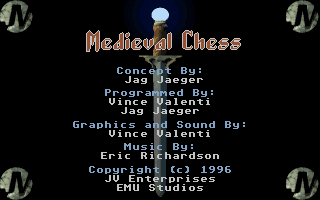
Medieval Chess
Rate this game
- Played
- Rarely
In Medieval Chess, taking a piece is only the opening invitation to a real fight, where standard rules of checkmate are thrown away so two armies can beat each other to death in top-down combat arenas.
Why Medieval Chess throws out the rulebook of checkmate
Most tactical board games ask you to think three moves ahead, but this DOS conversion asks whether your Knight can hit a moving target while taking arrow fire to the face. Programmed by Vince Valenti and Jag Jaeger for JV Enterprises, the game takes the general layout of classical chess and strips out every rule built around diplomatic surrender. You cannot win by trapping a King in checkmate because the concept of check does not exist here. To clear the board, you have to march up to the enemy King and reduce his hit points to zero in direct battle.
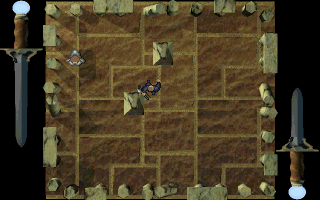
That fundamental change turns standard chess positioning into a completely different tactical exercise. Threatening a square is meaningless if your piece lacks the raw speed or firepower to survive the resulting brawl. When two pieces clash, the board view disappears and drops both combatants into a dedicated overhead attack screen where movement speed, weapon recharge timers, and projectile velocities dictate who survives.
The mechanics of top-down piece warfare
Every piece type carries its own distinct profile into battle, dictating how fast it moves and how often it can strike. Rooks swing heavy attacks that hit hard but recharge slowly, while Pawns rely on weaker strikes that require clever movement to land against faster units. When you instigate an attack on the main board, your piece receives a temporary strength boost inside the arena, rewarding aggressive play. However, that attacker advantage is completely nullified if you choose to strike the enemy King directly, preventing simple rush tactics from ending a match in the opening minutes.
Defending the leader comes down to army management rather than defensive geometry. The King possesses a scaling magical shield that grows stronger for every friendly piece left alive on the board, making early King hunting a quick way to lose your heavy hitters. Damage taken inside the arena is permanent across turns, though wounded pieces will gradually recover health over time if you keep them out of immediate combat. Pawns also operate under modified rules: en-passant captures are removed entirely, and reaching the opposite side of the board automatically converts the Pawn into your most recently lost major unit.
The core battle stats assigned to each piece include:
- Movement Speed: Dictates how quickly a piece can dodge incoming projectiles and close distances in the arena.
- Strength & Weapon Damage: Governs base hit points and damage dealt per successful attack.
- Weapon Recharge Rate: Controls the cooldown delay between consecutive attacks or projectile shots.
- Weapon Speed: Determines projectile flight time or strike execution speed across the field.
Where the balance falls short compared to classic action board games
While the overall concept brings plenty of energy to the grid, the actual combat balance reveals obvious flaws after a few matches. Reviewers at Home of the Underdogs pointed out upon release that the range of strategic choices feels noticeably more limited than the classic Archon, largely because certain units dominate combat far too easily. Losing a Knight early in a match makes winning exceptionally difficult, as the Knight's combination of speed and weapon speed allows a competent player to kite slower pieces across the arena without taking a hit.
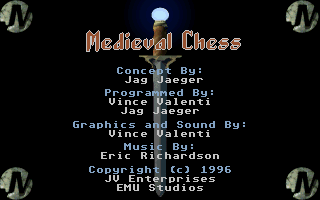
Audio design during these skirmishes relies on composition from Eric L. Richardson at EMU Studios, offering background tracks that keep the tension going while pieces chip away at each other's health bars. Yet no amount of music can hide the fact that high-tier combat relies heavily on simple circle-strafing. If you land a fast projectile piece against a slow melee unit, the board strategy dissolves into running circles around the arena border while firing on cooldown. The 1996 DOS release retains the bird's-eye battle layout of its earlier Atari ST incarnation, but it never quite solves the problem of high-speed pieces breaking the risk-reward structure of board positioning.
How to play Medieval Chess free in your browser
Despite its quirks and punishing unit balance, the game offers a fascinating look at mid-nineties tactical experimentations that tried to merge pure action with classic grid warfare. You can play Medieval Chess free in your browser right here on this page, running directly through your web browser with no setup required. When you start your first match, focus on preserving your Knights for defense and avoid rushing the enemy King until you have thinned out his supporting army to drop his magical resistance.
How Medieval Chess is played — the keys the game listens to, grouped by what they do.
- Movement
- Action
- Interface
- Left click — Action / Select piece
Highlighted keys are mapped — hover or tap one to see what it does.
Supports mouse, joystick, and two keyboard control setups for two players sharing a single keyboard.
Players' controls
Touch and gamepad controls
The on-screen keyboard and gamepad mapping the browser player uses on a phone, a tablet or a controller, as opposed to the real keys above. $PRO members make their own in the player and share them here; anyone can pick one to play with.
Make your own touch controlsPRO
- 1Open the editorSign in below, then pick what to make. The game starts with the editor open over it.
- 2Place your keysAdd keys and drag them where your thumbs rest, or map a controller's buttons. Test plays the game with them; Save keeps them, and you play with them from then on.
- 3Share themShare them right after saving in the game, or name and share them here. Players vote, and the best become this game's controls for everyone.
Go PROSee how it worksSign in+20 XP for sharing · +50 XP if yours become the game's own
- The game's own controlsKeyboardGamepadWhat every player starts with.In use
2 screenshots
From the archive
No gameplay video yet
No gameplay video for Medieval Chess yet. Sign in to add one.
No reviews yet
Tell the community what you think of Medieval Chess. Reviews are public and tied to your username.
No archived manuals for Medieval Chess yet
No manuals archived for this title yet. Sign in to upload the first scan.
Cheat codes, console commands and memory pokes for Medieval Chess — each one verified and attributed.
Sign in to submitNo cheats yet for this title
Know a working cheat, poke or trainer? Add it with the button above. Moderators check every entry before it goes live.
No archived soundtrack for Medieval Chess yet
No soundtrack archived for this title yet. Sign in to upload the first rip.
No save states for Medieval Chess yet
No save states for this title yet. Sign in to share one.
Discussions
Sign in to post- Threads0
- Total posts0
- Online now6
Community · Medieval Chess
Who's contributing, and what's new
- Reviews0
- Threads0
- Uploadsapproved0
- Contributors0
Recent activity
Nothing here yet
Reviews, discussion threads and approved uploads appear here as members add them.