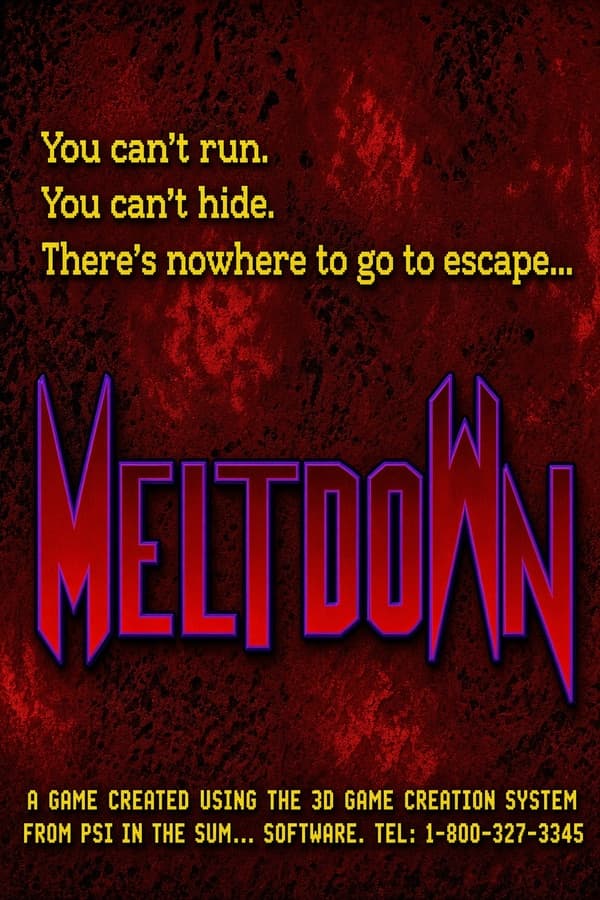
Meltdown (1995)
Rate this game
- Played
- Now and then
In 1995, loading up Meltdown gave players a swift blast of corridor shooting designed to prove that non-programmers could build their own 3D action titles from scratch.
Pie in the Sky wanted to let anyone build a shooter
By the middle of 1990s, three-dimensional action was rapidly becoming the dominant force on PC screens, but writing an engine from scratch required specialized engineering talent. Developer and publisher Pie in the Sky Software, founded by Kevin Stokes, sought to sell a middle ground: a suite called the 3D Game Creation System that let designers build levels, place enemies, and script simple triggers without typing a line of C code.
To demonstrate that their tool could produce something playable, level designer Terry F. Hamel constructed a brief technical sample level in March 1995. That sample level was distributed as this standalone 1995 release, accompanied by an inline slideshow promoting the software suite. It was never intended as a full commercial product, but rather as an interactive proof of concept that ended up in shareware circles and software archives across the world.
Shooting through guards to reach the elevator in Meltdown
When the level begins, your sole objective is to escape an armed military compound. Standing between you and freedom are dozens of uniform guards and a locked elevator, which requires a key that sits behind an active security barrier. You start with limited gear, but navigating the gray hallways reveals a straightforward armory where you can try out the different firing behaviors supported by the engine:
- Physical close-range kicks to save ammunition when cornered
- Grenades for clearing small rooms with area damage
- A machine gun for continuous rapid fire against groups
- A long-range rifle to take down guards at a distance
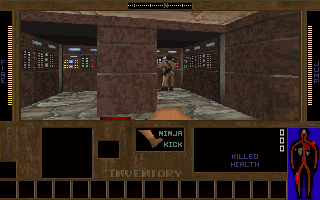
Your health and inventory sit cleanly on a permanent bottom status bar, where collected first aid kits remain ready for instant use. The core puzzle requires you to explore the complex, locate the terminal controlling the force field, disable the barrier to grab the elevator key, and sprint back to the lift before your health drops to zero.
Flat ceilings and oblivious guards reveal the engine limits
While the game fulfilled its promise as an accessible demonstration of the engine, playing through it exposes real design constraints. The visuals suffer from a harsh, flat perspective with low ceilings that squeeze the view, combined with heavily blurred pixel sprites whenever guards step close to your position. Room architecture remains uniformly square, relying heavily on repeating texture panels that make navigation disorienting without a built-in map.
The enemy artificial intelligence displays severe limitations during combat. Armed guards frequently stand still upon detecting you, failing to pursue or take cover even when you step behind a corner. In many rooms, you can walk straight past enemies without taking damage because their target tracking moves too slowly to hit a walking target. This lack of threat eliminates much of the tension, making the single level feel more like walking through a static shooting gallery than escaping a high-security prison.
Level designer Terry F. Hamel moved on to bigger things
The most fascinating element of this brief demo lies in its production history. Level designer Terry F. Hamel went on from this early project to contribute additional level design on Blood, the classic Build engine shooter released by Monolith Productions. Looking back at this shareware sample, you can spot early hints of the room layouts and switch puzzles that would later define late-90s PC action software.
As a historical slice of software, this piece illustrates the brief moment when full 3D game creation packages were sold directly to consumers in retail boxes. It belongs to the same era of experimental design tools as 3D Construction Kit, offering a rare glimpse into how smaller studios attempted to democratize level creation before unified engines took over the industry.
Fire up Meltdown free in your browser today
If you want to spend ten minutes exploring a obscure slice of engine history, you can play Meltdown online right now. It takes only a few moments to finish the single level, destroy the force field, and view the original slideshow presentation attached to the end of the run.
You can run this full Pie in the Sky Software release in your browser without downloading extra files or configuring an emulator. Direct keyboard controls let you experience the exact movement speeds and sprite scaling native to the original DOS execution, giving you an immediate feel for how early creation tools handled camera motion and hit detection back in 1995.
Players' controls
Touch and gamepad controls
The on-screen keyboard and gamepad mapping the browser player uses on a phone, a tablet or a controller, as opposed to the real keys above. $PRO members make their own in the player and share them here; anyone can pick one to play with.
Make your own touch controlsPRO
- 1Open the editorSign in below, then pick what to make. The game starts with the editor open over it.
- 2Place your keysAdd keys and drag them where your thumbs rest, or map a controller's buttons. Test plays the game with them; Save keeps them, and you play with them from then on.
- 3Share themShare them right after saving in the game, or name and share them here. Players vote, and the best become this game's controls for everyone.
Go PROSee how it worksSign in+20 XP for sharing · +50 XP if yours become the game's own
- The game's own controlsNone yet: played with a real keyboard only.In use
2 screenshots
From the archive
No gameplay video yet
No gameplay video for Meltdown (1995) yet. Sign in to add one.
No reviews yet
Tell the community what you think of Meltdown (1995). Reviews are public and tied to your username.
No archived manuals for Meltdown (1995) yet
No manuals archived for this title yet. Sign in to upload the first scan.
Cheat codes, console commands and memory pokes for Meltdown (1995) — each one verified and attributed.
Sign in to submitNo cheats yet for this title
Know a working cheat, poke or trainer? Add it with the button above. Moderators check every entry before it goes live.
No archived soundtrack for Meltdown (1995) yet
No soundtrack archived for this title yet. Sign in to upload the first rip.
No save states for Meltdown (1995) yet
No save states for this title yet. Sign in to share one.
Discussions
Sign in to post- Threads0
- Total posts0
- Online now6
Community · Meltdown (1995)
Who's contributing, and what's new
- Reviews0
- Threads0
- Uploadsapproved0
- Contributors0
Recent activity
Nothing here yet
Reviews, discussion threads and approved uploads appear here as members add them.