Moto Grand Prix
aka מוטו גרנד פרי
Rate this game
- Played
- Rarely
If you ever tried to race real motorcycle circuits on a PC in 1990, Moto Grand Prix handed you the handlebars, provided you could decipher its control scheme before hitting the grass.
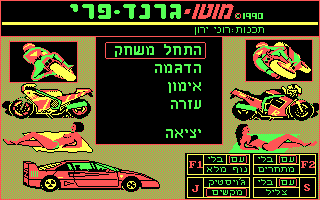
Navigating the Hebrew menus and track selection in Moto Grand Prix
Before home PCs had dedicated graphics cards, programmers had to build fast pseudo-3D track views out of pure CPU muscle. BUG Multisystem Ltd. released this motorcycle simulator in Israel, giving PC owners a rear-view perspective of international asphalt straight from their keyboards. A 24-year-old student named Ronnie Yaron programmed the whole thing, creating one of the earliest motorcycling attempts on the platform.
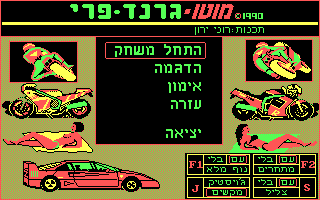
Booting up the BUG Multisystem Ltd. release brings up a menu entirely in Hebrew text. The options cover starting a race, watching an automated demo, starting a training session, viewing help, and quitting. The help screen lists default keys, though actually using those defaults is a quick route to a crash.
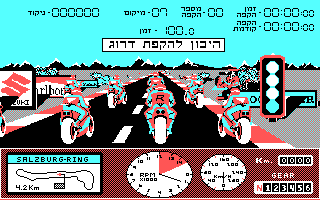
You choose between three real circuits: Misano, Salzburgring, and Laguna Seca. Each circuit varies in overall length, expected lap time, and the point bonus awarded upon finishing. You can practice endlessly in training mode to learn where each turn begins. When you switch to a real race, however, the game restricts you to a single lap.
Why the keyboard controls will test your patience
Driving straight sounds simple until you look at how key inputs function here. You press F10 to open the throttle and F9 to apply the brakes. To shift gears, you hold down F10 until the speed meter hits its limit for your current gear, which automatically steps you up from first gear through sixth.
Steering relies on the numeric keypad, where key 4 leans left and key 6 leans right. Crucially, the bike does not automatically straighten out when you release a key. You must press key 5 on the keypad to pull your bike back to a vertical line, or you will keep leaning until you run off the road.
This single detail trips up almost every player who tries the game for the first time. Missing key 5 after a long turn causes you to drift straight into the border. Once you establish a rhythm between lean keys, reset keys, and gear shifts, holding a racing line becomes a precise exercise.
One lap to rule them all
Without a multi-race championship mode, the game places all its weight on single-track performance. You pick a track, push for the highest bonus score, and try to beat your own time. The lack of opponent riders on the track turns every attempt into a solo time trial against the clock.
Looking back at racing games from 1990, the underlying engine handles smooth movement surprisingly well despite the primitive setup. Ronnie Yaron later took these foundational concepts and founded Compro Games, the studio responsible for the 1994 PC racer Cyclemania. You can see the roots of that later work right here in the way the track perspective shifts during deep turns.
Playing Moto Grand Prix online today
The game suffers from its complete lack of a full championship system and a control scheme that demands manual center-key resets after every turn. Yet the basic riding physics still offer a genuine challenge if you want to master the layout of Laguna Seca without crashing.
You can play Moto Grand Prix online free in your browser right here. There is nothing to install and no setup required to launch this classic Moto Grand Prix MS-DOS game. Jump into the practice mode first, get comfortable with key 5 for centering your rider, and see if you can complete a clean lap on Salzburgring.
Players' controls
Touch and gamepad controls
The on-screen keyboard and gamepad mapping the browser player uses on a phone, a tablet or a controller, as opposed to the real keys above. $PRO members make their own in the player and share them here; anyone can pick one to play with.
Make your own touch controlsPRO
- 1Open the editorSign in below, then pick what to make. The game starts with the editor open over it.
- 2Place your keysAdd keys and drag them where your thumbs rest, or map a controller's buttons. Test plays the game with them; Save keeps them, and you play with them from then on.
- 3Share themShare them right after saving in the game, or name and share them here. Players vote, and the best become this game's controls for everyone.
Go PROSee how it worksSign in+20 XP for sharing · +50 XP if yours become the game's own
- The game's own controlsNone yet: played with a real keyboard only.In use
2 screenshots
From the archive
No gameplay video yet
No gameplay video for Moto Grand Prix yet. Sign in to add one.
No reviews yet
Tell the community what you think of Moto Grand Prix. Reviews are public and tied to your username.
No archived manuals for Moto Grand Prix yet
No manuals archived for this title yet. Sign in to upload the first scan.
Cheat codes, console commands and memory pokes for Moto Grand Prix — each one verified and attributed.
Sign in to submitNo cheats yet for this title
Know a working cheat, poke or trainer? Add it with the button above. Moderators check every entry before it goes live.
No archived soundtrack for Moto Grand Prix yet
No soundtrack archived for this title yet. Sign in to upload the first rip.
No save states for Moto Grand Prix yet
No save states for this title yet. Sign in to share one.
Discussions
Sign in to post- Threads0
- Total posts0
- Online now6
Community · Moto Grand Prix
Who's contributing, and what's new
- Reviews0
- Threads0
- Uploadsapproved0
- Contributors0
Recent activity
Nothing here yet
Reviews, discussion threads and approved uploads appear here as members add them.