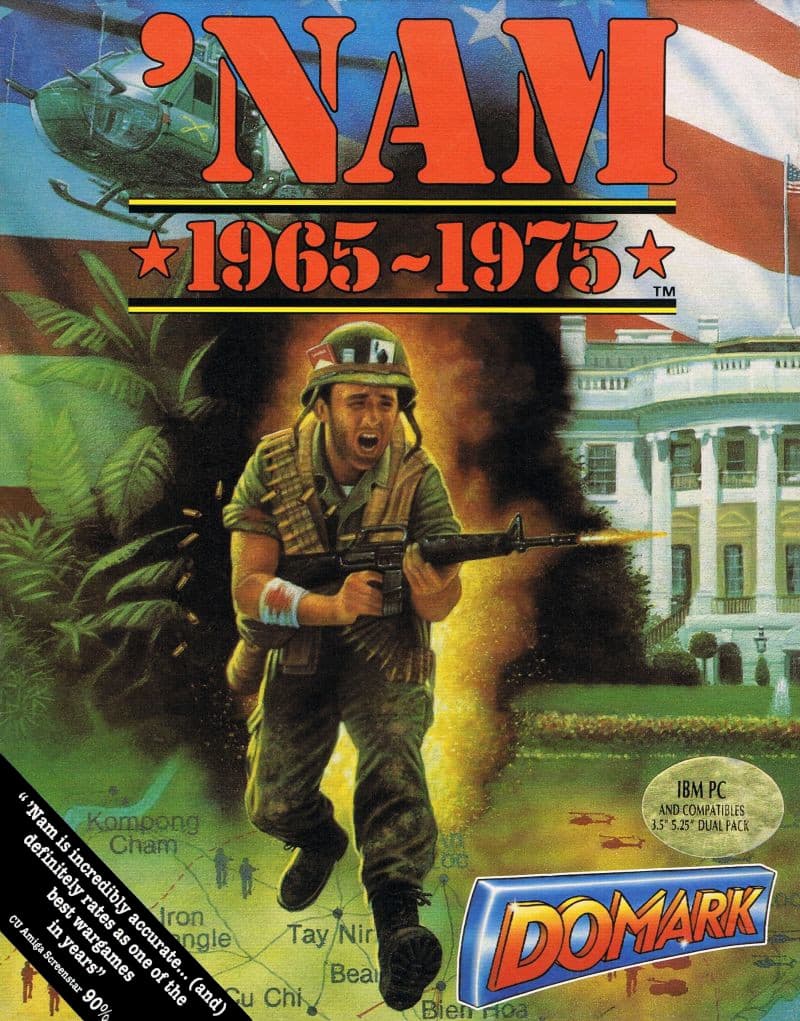
'Nam 1965-1975
In 'Nam 1965-1975, you do not just command troops in the jungle, you also have to keep American voters from revolting while managing the entire war effort from Washington.
The dual burden of policy and power in 'Nam 1965-1975
Most strategy games from the early nineties made you choose between a map of armies or a screen full of numbers. Programmer Matthew Stibbe took a year off from Oxford University to design a title that forces you to juggle both at once. Developed by The Kremlin and published by Domark Software Ltd, the title splits your responsibilities down the middle.
You play as both the Commander-in-Chief on the ground and the President back in the Oval Office. One moment you are reassigning battalion deployments on a tactical map, and the next you are watching domestic support plummet. If public opinion drops too low, Congress forces a withdrawal, and South Vietnam falls anyway.
The game splits its campaign structure into two distinct modes. You can play historical single-battle engagements like Khe Sanh, the Tet Offensive, or the 1975 offensive. Alternatively, you can start a full political scenario under Johnson in 1964 or Nixon in 1968, where long-term resource management decides the conflict.
Managing troops, public opinion, and the dreaded combat grid
Sitting down with this 1991 strategy game means staring at dense menus and waiting for news updates. In-game headlines arrive formatted as a newspaper front page, telling you whether your casualty rates are breaking the political military budget. You spend your turns balancing troop movements, air support, and supply lines while checking the headlines for domestic fallout.
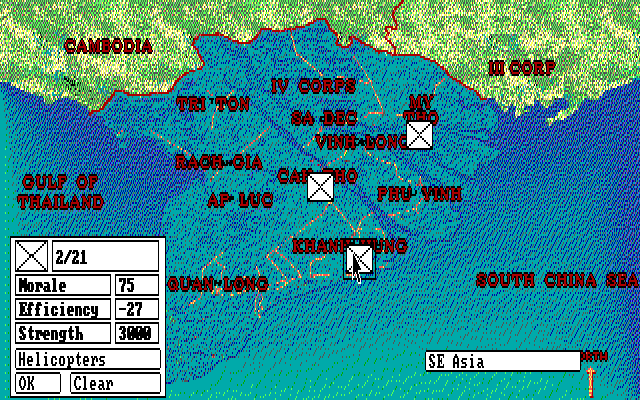
When armies make contact, the pacing shifts into real-time combat. You can adjust the speed of field engagements using keys F1 through F4, which is vital when Vietcong units push your positions hard. The real struggle comes from the interface, which packs command orders into nested menus that take hours to understand.
A typical list of operational duties includes:
- Balancing troop allocations between defensive garrisons and offensive sweeps.
- Monitoring anti-war sentiment back home through the in-game newspaper reports.
- Setting combat speeds with the function keys during active tactical battles.
- Deciding when to request extra military funding before political patience runs out.
Why 'Nam 1965-1975 split reviewers in 1991
When the game launched on MS-DOS, Atari ST, and Commodore Amiga, computer gaming magazines gave it mixed responses. ACE awarded the PC release an 80% score, appreciating the sheer ambition of combining high-level politics with low-level combat tactics. The One gave the Amiga build 77%, while Amiga Power marked it down to 69% for its steep learning curve.
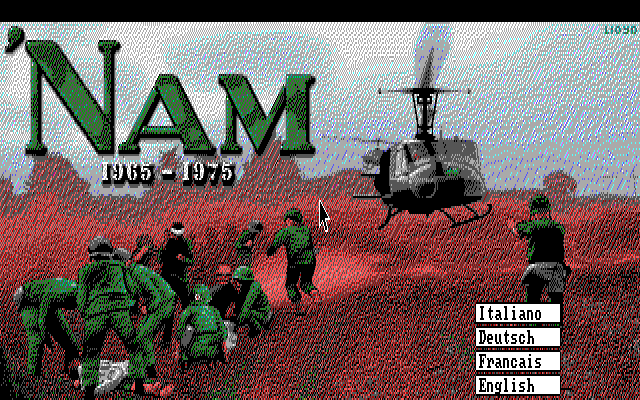
Reviewers praised the digitized artwork and military maps, though almost every critic complained about the clumsy control scheme. The aggressive artificial intelligence leaves almost no room for trial-and-error mistakes, punishing early strategic errors hours after you make them.
The core problem lies in how little feedback the interface gives you when a plan goes wrong. Without carefully reading every page of the physical manual, you will watch public opinion collapse without knowing which policy triggered the drop. That sharp wall of difficulty scared off casual players while rewarding dedicated wargamers.
Taking command straight from your browser
For wargame enthusiasts, this design holds up as an unusual experiment in dual-perspective command. While the user interface feels heavy and demanding, the strategic puzzle of balancing political survival against field combat remains genuinely challenging. It sits alongside classic DOS wargames as a stern test of planning under pressure.
You can play 'Nam 1965-1975 online free in your browser right now, with no installation needed. Fire up the 'Nam 1965-1975 MS-DOS game and load into the Tet Offensive scenario to see how fast you can stabilize the front lines while tapping F1 to control the tactical combat speed.