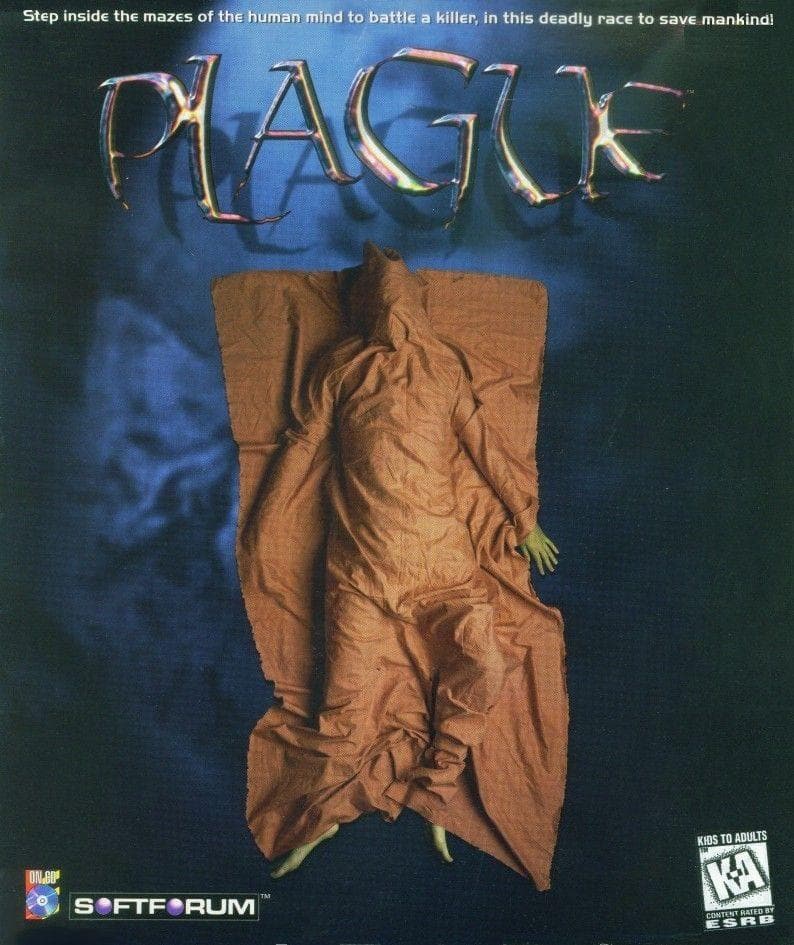
Plague: Maze of the Mind
aka Plague · Plague: In the Maze of the Mind · Plague: nel labirinto della mente
Streaming build
Checking storage…247 MB
Preload in background
JIT compiler
Rate this game
In Plague: Maze of the Mind, you drop into the brain of a comatose patient in the year 2012 to shoot mutant viral bugs and rewire damaged synapses inside a simulated cityscape.
Cyberpunk neurosurgery in Plague: Maze of the Mind makes for a bizarre 3D hybrid
Back in 1996, developers were throwing everything at the wall to see what real-time 3D could do, and Softforum Inc. landed on one of the strangest premises of the DOS era. You play as a virtual surgeon operating inside neural networks. A mutant computer virus spreads through radiation, altering genetic codes and trapping patients in deep comas. Instead of controlling a tiny scalpel or watching a wireframe grid, the game projects the human subconscious as a sprawling, dark fantasy world modeled on ancient Roman architecture.
Published by Microforum International, this action title tries to turn medical repair into a first-person shooter. You wander through stone corridors, courtyards, and pillared halls located entirely within a dying brain. Your objective requires you to locate loose neural ideas set free by the infection, clear out aggressive viral creatures, and fix broken synaptic links before the strain kills the host. It sounds brilliant on paper, even if the actual execution leans into surreal chaos.
Inside the virtual Roman cityscapes of the brain
When you start a level, the view puts you directly behind the surgeon's reticle in a first-person perspective. The level geometry pulls heavily from classic maze-crawlers, forcing you to navigate tight corners and check dark alcoves. Instead of picking up keycards or flipping industrial switches, you search for disconnected thought fragments scattered across the Roman ruins. Reconnecting these links lowers barriers and opens the path deeper into the patient's mind.
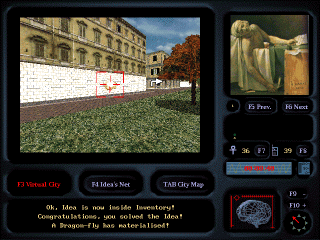
Swarms of viral monsters constantly interrupt your re-wiring efforts. Bloodthirsty creatures materialise out of the shadows, charging toward you to drain the patient's remaining life span. Combat happens in real time, requiring quick turns and fast reactions to keep from getting cornered in tight alleyways. Managing your health pool doubles as managing the patient's survival, so taking sloppy hits brings the host closer to total brain death.
Clunky navigation and abstract hazards derail the action
While the premise catches your attention, playing this 1996 title reveals why retrospectives often call it an avant-garde failure. The controls rely on simulated 3D effects and multi-directional camera shifts that can feel disorienting during heavy combat. Turning around in narrow hallways feels sluggish, and judging hitboxes on fast-moving viral bugs takes more patience than skill. When three enemies surround you in a blind corner, the engine struggles to keep the action readable.
The level layout creates its own headaches. Because every sector uses similar stone textures and Roman columns to represent brain tissue, losing your sense of direction happens constantly. You will often backpedal away from a fight only to fall into an unseen pit or dead end, forcing a tedious climb back through cleared areas. The lack of clear visual cues for interactive synaptic points means you spend a lot of time rubbing against walls to find the next objective.
Finding order inside an avant-garde MS-DOS experiment
Despite the incohesive mechanics, Softforum Inc. packed a surprising amount of content into the game's secret areas. Dozens of hidden chambers lie tucked behind false walls and hidden teleporters, offering extra supplies and shortcuts through the mind's labyrinth. Tracking down these hidden rooms becomes essential on higher difficulty levels, where raw health resources run thin.
The audio design relies heavily on digitized sound effects to set a moody tone. Strange hums, metallic screeching, and echoing footsteps boom through your speakers whenever enemies spawn nearby. It might not rival the top shooters of its year, but the audio creates a tense atmosphere that fits the high-stakes cybernetic surgery theme.
Play Plague: Maze of the Mind online without setting up an emulator
Plague: Maze of the Mind is far from a polished game, but it has plenty to offer anyone who loves weird mid-nineties PC software. Throwing neurosurgery lore, Roman architecture, and real-time combat together shows just how wild early 3D concepts could get. If you want a strange 1996 experiment to poke at, its odd ideas will easily fill an evening.
You can play Plague: Maze of the Mind online right now, running this original Plague: Maze of the Mind MS-DOS game directly in your web browser. You can dive straight into the neural pathways and fight off the viral threat without downloading files or tweaking hardware settings. Jump in for ten minutes just to see how 90s cybernetics imagined ancient Rome inside a human brain, and see if you can repair the first neural network before the patient slips away.
How Plague: Maze of the Mind is played — the keys the game listens to, grouped by what they do.
- Action
- Interface
- Right click + Move mouse — Swing door
Highlighted keys are mapped — hover or tap one to see what it does.
Control bindings for standard movement and actions are omitted as they were not specified in the primary documents.
Players' controls
Touch and gamepad controls
The on-screen keyboard and gamepad mapping the browser player uses on a phone, a tablet or a controller, as opposed to the real keys above. $PRO members make their own in the player and share them here; anyone can pick one to play with.
Make your own touch controlsPRO
- 1Open the editorSign in below, then pick what to make. The game starts with the editor open over it.
- 2Place your keysAdd keys and drag them where your thumbs rest, or map a controller's buttons. Test plays the game with them; Save keeps them, and you play with them from then on.
- 3Share themShare them right after saving in the game, or name and share them here. Players vote, and the best become this game's controls for everyone.
Go PROSee how it worksSign in+20 XP for sharing · +50 XP if yours become the game's own
- The game's own controlsKeyboardGamepadWhat every player starts with.In use
2 screenshots
From the archive
No gameplay video yet
No gameplay video for Plague: Maze of the Mind yet. Sign in to add one.
No reviews yet
Tell the community what you think of Plague: Maze of the Mind. Reviews are public and tied to your username.
No archived manuals for Plague: Maze of the Mind yet
No manuals archived for this title yet. Sign in to upload the first scan.
Cheat codes, console commands and memory pokes for Plague: Maze of the Mind — each one verified and attributed.
Sign in to submitNo cheats yet for this title
Know a working cheat, poke or trainer? Add it with the button above. Moderators check every entry before it goes live.
No archived soundtrack for Plague: Maze of the Mind yet
No soundtrack archived for this title yet. Sign in to upload the first rip.
No save states for Plague: Maze of the Mind yet
No save states for this title yet. Sign in to share one.
Discussions
Sign in to post- Threads0
- Total posts0
- Online now6
Community · Plague: Maze of the Mind
Who's contributing, and what's new
- Reviews0
- Threads0
- Uploadsapproved0
- Contributors0
Recent activity
Nothing here yet
Reviews, discussion threads and approved uploads appear here as members add them.