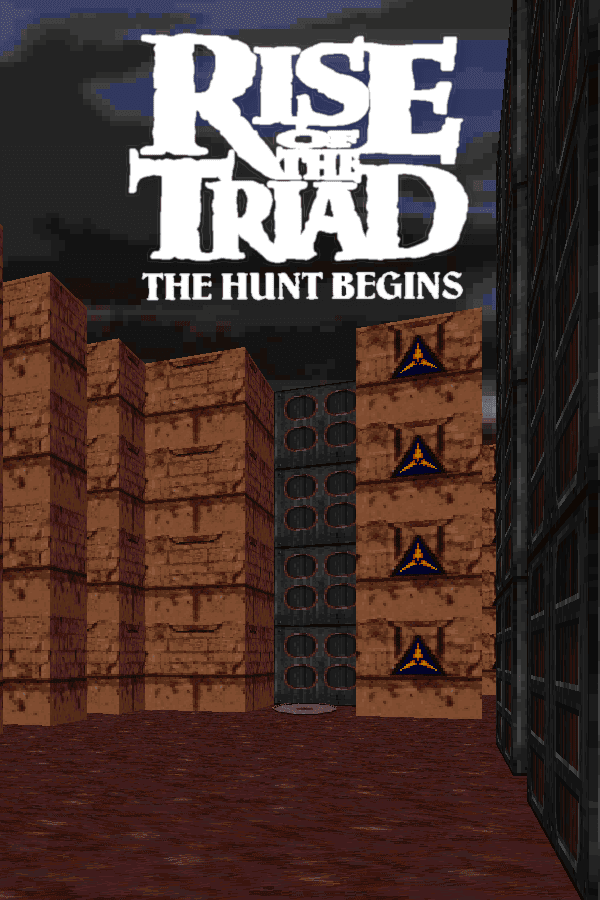

Before you even clear the first room in Rise of the Triad: The HUNT Begins, Apogee turns a basic raycasting engine into a chaotic machine of explosive destruction. Built around rocket launchers, bounce pads, and bizarre transformational power-ups, this expanded CD sampler trades realism for unadulterated arcade speed.
The project originally started production as a direct sequel to Wolfenstein 3D before turning into a standalone original property. Designers Tom Hall, Joe Siegler, and Marianna Vayntrub pushed the underlying tech as far as it would go under producers George Broussard and Scott Miller. Because the engine still relied on flat floors and strict 90-degree grid walls, the team had to hack in simulated tricks to create verticality and atmosphere.
Springy jump pads launch your agent high into the air to gather floating tokens, clear dynamic floor hazards, and ambush enemies from above. The engine handles dynamic lighting where light fixtures can be shot out, atmospheric fog that obscures long corridors, and destructible level geometry. Your chosen High-risk United Nations Task-force agent moves through halls at a breakneck sprint while digitized cult guards scream and fire back.
You can choose from five distinct operatives at the start, each with varying speed and durability traits. While bullet weapons like the dual pistols and MP40 have infinite ammunition, the main combat focuses on heavy artillery. Managing missile arcs in tight corridors is the core loop, making every fire fight a high-risk gamble between wiping out a room or vaporizing yourself against a doorway.
Instead of standard shotguns and rifles, combat revolves around an inventory of high-yield rocket launchers, split missiles, and absurd magic spells. You carry one bullet weapon and one heavy missile launcher at a time, forcing you to pick up and drop specialized ordinance constantly. Firing a split missile down a narrow hallway splits the warhead into multiple projectiles that bounce off walls and clean out rooms before you even step inside.
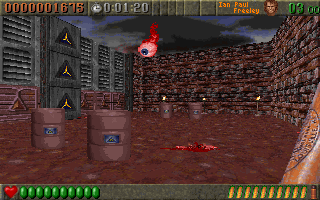
The power-up system leans entirely into absurd late-nineties humor. Picking up Dog Mode transforms your character into an invulnerable hound that barks shockwaves and bites digitized cult officers at knee height. Other pickups let you fly or turn enemy attacks into non-lethal magic spell effects that bounce harmlessly off walls.
When an explosive lands a direct hit on a group of enemies, the game proudly flashes a bold text banner across the screen reading Ludicrous Gibs! as digitized body parts fly toward the viewer. It is loud, unpretentious, and completely committed to its fast arcade energy. The soundtrack, composed by Lee Jackson and Bobby Prince, supports the high-velocity shooting with heavy synthetic baselines and guitar riffs on tracks like "Goin' Down the Fast Way."
Where this shooter falters is in its level architecture and maze design. Publisher LaserSoft distributed this physical CD-ROM Deluxe Edition in 1995, packing in six extra maps that were not available in the downloadable shareware release. While levels like "Prelude to a Kill", "Foggy Mountain", "Metal Threat", and "Boom Boom Boom" offer clever puzzle arrangements, the visual textures repeat constantly.
You will frequently run into dead ends, hit invisible triggers, and backtrack through identical stone corridors looking for missing keycards. Finding the exit in levels like "The Fourth Door" often devolves into hugging every wall segment to check for hidden sliding push-walls. The momentum halts entirely when you hit an instant-death wall trap or a spinning blade, forcing a complete reload if you failed to save mid-level.
Enemy variety also wears thin during longer play sessions. You fight the same digitized guards, blue-uniformed officers, and bullet-spongy cultists across all ten single-player levels. Their combat behaviors are straightforward, so the challenge relies almost entirely on ambush placements, crossfire turrets, and tight space constraints rather than intelligent opponent tactics.
Despite the confusing maze designs and repeated wall textures, Apogee Software, Ltd. delivered one of the most distinctive mid-nineties PC shooters. It hits a wild sweet spot between technical retro-engineering and pure, unfiltered splatter comedy that few contemporary action games ever attempted. The sound design alone, filled with booming explosions, punchy Sound Blaster audio, and catchy synth tracks like "Havana Smooth", makes running through a map deeply satisfying.
If you want to experience how developers hacked early 3D technology to create flying rocket battles and ridiculous gore effects, this expanded release gives you plenty to play with. Modern players often expect modern twin-stick movement or full mouse-look controls, but learning to steer your agent with pure keyboard strafing and fast spring-pad jumps is half the fun once you get the momentum down.
You can play Rise of the Triad: The HUNT Begins free in your browser right now on this page. There is nothing to install, so you can jump straight into San Nicholas Island, load up a rocket launcher, and start blasting cultists in seconds.
Before you even clear the first room in Rise of the Triad: The HUNT Begins, Apogee turns a basic raycasting engine into a chaotic machine of explosive destruction. Built around rocket launchers, bounce pads, and bizarre transformational power-ups, this expanded CD sampler trades realism for unadulterated arcade speed.
The project originally started production as a direct sequel to Wolfenstein 3D before turning into a standalone original property. Designers Tom Hall, Joe Siegler, and Marianna Vayntrub pushed the underlying tech as far as it would go under producers George Broussard and Scott Miller. Because the engine still relied on flat floors and strict 90-degree grid walls, the team had to hack in simulated tricks to create verticality and atmosphere.
Springy jump pads launch your agent high into the air to gather floating tokens, clear dynamic floor hazards, and ambush enemies from above. The engine handles dynamic lighting where light fixtures can be shot out, atmospheric fog that obscures long corridors, and destructible level geometry. Your chosen High-risk United Nations Task-force agent moves through halls at a breakneck sprint while digitized cult guards scream and fire back.
You can choose from five distinct operatives at the start, each with varying speed and durability traits. While bullet weapons like the dual pistols and MP40 have infinite ammunition, the main combat focuses on heavy artillery. Managing missile arcs in tight corridors is the core loop, making every fire fight a high-risk gamble between wiping out a room or vaporizing yourself against a doorway.
Instead of standard shotguns and rifles, combat revolves around an inventory of high-yield rocket launchers, split missiles, and absurd magic spells. You carry one bullet weapon and one heavy missile launcher at a time, forcing you to pick up and drop specialized ordinance constantly. Firing a split missile down a narrow hallway splits the warhead into multiple projectiles that bounce off walls and clean out rooms before you even step inside.
The power-up system leans entirely into absurd late-nineties humor. Picking up Dog Mode transforms your character into an invulnerable hound that barks shockwaves and bites digitized cult officers at knee height. Other pickups let you fly or turn enemy attacks into non-lethal magic spell effects that bounce harmlessly off walls.
When an explosive lands a direct hit on a group of enemies, the game proudly flashes a bold text banner across the screen reading Ludicrous Gibs! as digitized body parts fly toward the viewer. It is loud, unpretentious, and completely committed to its fast arcade energy. The soundtrack, composed by Lee Jackson and Bobby Prince, supports the high-velocity shooting with heavy synthetic baselines and guitar riffs on tracks like "Goin' Down the Fast Way."
Where this shooter falters is in its level architecture and maze design. Publisher LaserSoft distributed this physical CD-ROM Deluxe Edition in 1995, packing in six extra maps that were not available in the downloadable shareware release. While levels like "Prelude to a Kill", "Foggy Mountain", "Metal Threat", and "Boom Boom Boom" offer clever puzzle arrangements, the visual textures repeat constantly.
You will frequently run into dead ends, hit invisible triggers, and backtrack through identical stone corridors looking for missing keycards. Finding the exit in levels like "The Fourth Door" often devolves into hugging every wall segment to check for hidden sliding push-walls. The momentum halts entirely when you hit an instant-death wall trap or a spinning blade, forcing a complete reload if you failed to save mid-level.
Enemy variety also wears thin during longer play sessions. You fight the same digitized guards, blue-uniformed officers, and bullet-spongy cultists across all ten single-player levels. Their combat behaviors are straightforward, so the challenge relies almost entirely on ambush placements, crossfire turrets, and tight space constraints rather than intelligent opponent tactics.
Despite the confusing maze designs and repeated wall textures, Apogee Software, Ltd. delivered one of the most distinctive mid-nineties PC shooters. It hits a wild sweet spot between technical retro-engineering and pure, unfiltered splatter comedy that few contemporary action games ever attempted. The sound design alone, filled with booming explosions, punchy Sound Blaster audio, and catchy synth tracks like "Havana Smooth", makes running through a map deeply satisfying.
If you want to experience how developers hacked early 3D technology to create flying rocket battles and ridiculous gore effects, this expanded release gives you plenty to play with. Modern players often expect modern twin-stick movement or full mouse-look controls, but learning to steer your agent with pure keyboard strafing and fast spring-pad jumps is half the fun once you get the momentum down.
You can play Rise of the Triad: The HUNT Begins free in your browser right now on this page. There is nothing to install, so you can jump straight into San Nicholas Island, load up a rocket launcher, and start blasting cultists in seconds.
How Rise of the Triad: The HUNT Begins (Deluxe Edition) is played — the keys the game listens to, grouped by what they do.
Highlighted keys are mapped — hover or tap one to see what it does.
Controls and options can be customized by running SETUP.EXE in the game's directory.
The on-screen keyboard and gamepad mapping the browser player uses on a phone, a tablet or a controller, as opposed to the real keys above. $PRO members make their own in the player and share them here; anyone can pick one to play with.
Cheat codes, console commands and memory pokes for Rise of the Triad: The HUNT Begins (Deluxe Edition) — each one verified and attributed.
Sign in to submitHow Rise of the Triad: The HUNT Begins (Deluxe Edition) is played — the keys the game listens to, grouped by what they do.
Highlighted keys are mapped — hover or tap one to see what it does.
Controls and options can be customized by running SETUP.EXE in the game's directory.
The on-screen keyboard and gamepad mapping the browser player uses on a phone, a tablet or a controller, as opposed to the real keys above. $PRO members make their own in the player and share them here; anyone can pick one to play with.
Cheat codes, console commands and memory pokes for Rise of the Triad: The HUNT Begins (Deluxe Edition) — each one verified and attributed.
Sign in to submit