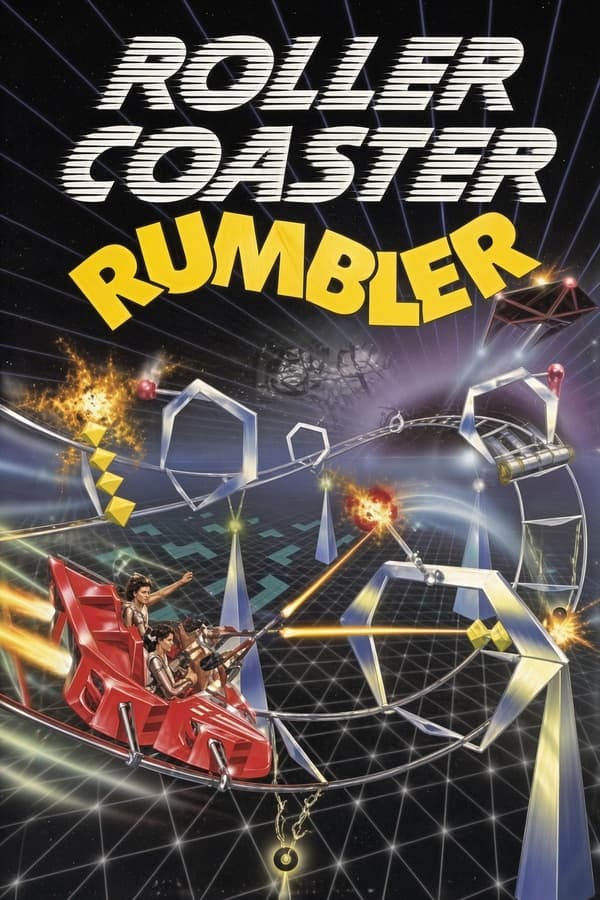
Playing Roller Coaster Rumbler means sitting in the front cart of a runaway track with crosshairs locked onto floating geometric targets while your stomach drops.
Before standard rail shooters established the formula on CD-ROM, Subway Software tried building one for standard floppy drives. You sit in the front seat of a coaster cart, aiming a mounted turret with limited ammunition at surreal pop-up targets as the track swings left, right, up, and down. The screen jerkily pulls you forward through every curve, demanding fast reflexes while your perspective tilts wildly.
The twist is what happens when you reach the end of the line. Instead of loading a new area, the cart stops, reverses, and sends you back through the exact same track facing backward. Learning a track forward is only half the battle; aiming at targets flying behind you while riding in reverse requires completely different timing.
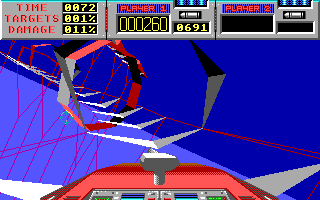
Subway Software designers Arnie Katz, Bill Kunkel, and Joyce Worley built the game around strict resource management. You do not just spray bullets across the screen. Running out of ammunition or taking too many hits leads to an instant game over, meaning every shot has to count while the cart sways under you. The 16-bit computer releases even shipped with an audio cassette tape packed with heavy metal music to play alongside the floppy disk audio.
It also features a simultaneous two-player mode where both players share the screen, each controlling their own set of crosshairs. Trying to clear targets together while the track sways around creates chaotic co-op sessions, especially when both of you are low on bullets. If you get stuck early on, the Amiga playguide famously pointed out a specific bomb trick to clear out the chaotic first level.
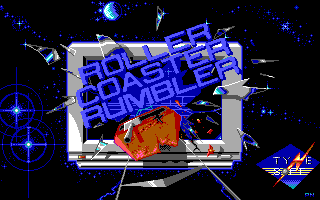
Period reviews were divided on the execution. Writing in January 1990, ST Action gave it 63%, calling it "a clever demo" but complaining that the underlying action was bland and unchanging. Meanwhile, Amiga-Spel awarded it 8/10, describing it as proof of real imagination and calling it "a very pointless game but oh so fun!"
The biggest flaw is how hard it pushes the hardware of its day. The 16-bit computer ports suffer from slow performance, and that janky frame rate makes tracking small floating targets far harder than it should be. The action game relies heavily on smooth tracking, so when the framerate hitches during a steep drop, lining up your crosshair turns into pure guesswork.
Hardware limitations bothered players in 1990, but the core design gives you straightforward arcade target shooting. If you enjoy early first-person rail experiments, this 1990 release from publisher Hi-Tech Expressions, Inc. is worth a look for its reversing mechanic alone.
You can play Roller Coaster Rumbler free in your browser right now, with nothing to install. Modern players usually expect infinite ammo and auto-aim, so remember to conserve your shots and watch out for the backward loop on your very first run.
Playing Roller Coaster Rumbler means sitting in the front cart of a runaway track with crosshairs locked onto floating geometric targets while your stomach drops.
Before standard rail shooters established the formula on CD-ROM, Subway Software tried building one for standard floppy drives. You sit in the front seat of a coaster cart, aiming a mounted turret with limited ammunition at surreal pop-up targets as the track swings left, right, up, and down. The screen jerkily pulls you forward through every curve, demanding fast reflexes while your perspective tilts wildly.
The twist is what happens when you reach the end of the line. Instead of loading a new area, the cart stops, reverses, and sends you back through the exact same track facing backward. Learning a track forward is only half the battle; aiming at targets flying behind you while riding in reverse requires completely different timing.

Subway Software designers Arnie Katz, Bill Kunkel, and Joyce Worley built the game around strict resource management. You do not just spray bullets across the screen. Running out of ammunition or taking too many hits leads to an instant game over, meaning every shot has to count while the cart sways under you. The 16-bit computer releases even shipped with an audio cassette tape packed with heavy metal music to play alongside the floppy disk audio.
It also features a simultaneous two-player mode where both players share the screen, each controlling their own set of crosshairs. Trying to clear targets together while the track sways around creates chaotic co-op sessions, especially when both of you are low on bullets. If you get stuck early on, the Amiga playguide famously pointed out a specific bomb trick to clear out the chaotic first level.

Period reviews were divided on the execution. Writing in January 1990, ST Action gave it 63%, calling it "a clever demo" but complaining that the underlying action was bland and unchanging. Meanwhile, Amiga-Spel awarded it 8/10, describing it as proof of real imagination and calling it "a very pointless game but oh so fun!"
The biggest flaw is how hard it pushes the hardware of its day. The 16-bit computer ports suffer from slow performance, and that janky frame rate makes tracking small floating targets far harder than it should be. The action game relies heavily on smooth tracking, so when the framerate hitches during a steep drop, lining up your crosshair turns into pure guesswork.
Hardware limitations bothered players in 1990, but the core design gives you straightforward arcade target shooting. If you enjoy early first-person rail experiments, this 1990 release from publisher Hi-Tech Expressions, Inc. is worth a look for its reversing mechanic alone.
You can play Roller Coaster Rumbler free in your browser right now, with nothing to install. Modern players usually expect infinite ammo and auto-aim, so remember to conserve your shots and watch out for the backward loop on your very first run.
The on-screen keyboard and gamepad mapping the browser player uses on a phone, a tablet or a controller, as opposed to the real keys above. $PRO members make their own in the player and share them here; anyone can pick one to play with.
Cheat codes, console commands and memory pokes for Roller Coaster Rumbler — each one verified and attributed.
Sign in to submitaka Rollercoaster Rumbler
The on-screen keyboard and gamepad mapping the browser player uses on a phone, a tablet or a controller, as opposed to the real keys above. $PRO members make their own in the player and share them here; anyone can pick one to play with.
Cheat codes, console commands and memory pokes for Roller Coaster Rumbler — each one verified and attributed.
Sign in to submit