
Secret Agent: The Escape
Rate this game
Starting without a single bullet in Secret Agent: The Escape forces you to sprint up to armed guards and rely entirely on a ninja kick to break out of jail. It takes the familiar shareware first-person shooter template and flips the opening moments on their head by making high-risk melee your only defense.
Starting with a boot to the jaw in Secret Agent: The Escape
Most first-person shooters of the mid-nineties handed you a reliable pistol or a standard pop-gun the moment you stepped into the first room. Secret Agent: The Escape throws you into a stark prison complex completely empty-handed, leaving you with nothing but a close-range ninja kick to deal with hostile guards. Charging straight at an armed enemy while swinging a leg forces an aggressive, slightly unhinged playstyle right from the start.
That initial reliance on melee completely alters how you approach grey corridors and tight corners. Instead of peeking around doorways to line up crosshairs, you end up baiting guards into narrow chokepoints so you can close the distance before they pull off a clean shot. It gives the early minutes of a run a frantic rhythm where taking cover and timing your assault matters much more than simple aim.
Once you survive those first few room clearances, searching for supplies becomes your main drive. Instead of just picking up health packs or ammo keys, you are hunting for any actual hardware that lets you fight back at range. Finding your very first gun changes the dynamic entirely, turning you from a desperate escapee into an active threat clearance agent.
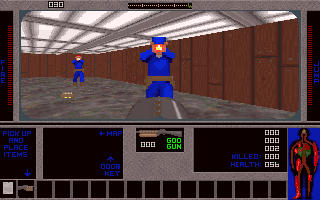
Navigating prison hallways without a map
The maze design of the prison complex relies heavily on classic action tropes from the DOS shareware scene. Corridors branch into identical-looking security sectors, locked doors require specific clearance, and straying off the main path usually puts you face to face with extra guard patrols. Because the layout can easily disorient you, paying attention to environmental landmarks like wall textures and switch placement is essential.
Scattered throughout the levels are messages left behind in the facility. Picking up these notes gives you vital context for navigating the compound and occasionally hints at where key items or switch panels are hidden. Reading every message you find does more than offer background story: it directly saves you from wandering aimlessly through cleared corridors while looking for the exit lift.
The level geometry itself presents a constant tactical challenge. Narrow passages mean you rarely have room to strafe effectively when enemy guards open fire. I found that managing lines of sight and using corner geometry to break incoming shots was far more effective than trying to circle-strafe in cramped hallways.
PhreAk Software brings the Goo Gun to the 3D maze
Created in 1996 by Garrie Wilson and Michael Wilford under the name PhreAk Software, this project took clear inspiration from the boom of 3D raycasting engines. Coming off their work on The Maze! earlier that same year, the duo focused on building a straightforward, fast-paced corridor shooter. Rather than overloading the player with complex inventory management, they kept the core focus on movement, shot placement, and quick reflexes.
The arms race picks up significantly once you unlock advanced arsenal upgrades, particularly the Goo Gun. Moving from basic firearms to specialized weaponry gives the combat a distinct punch. The Goo Gun allows you to control space far better, sticking damage onto targets or catching guards in tight passages before they can swarm your position.
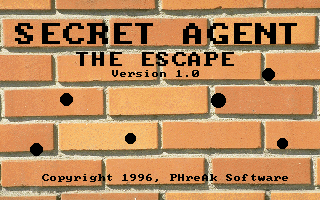
Balancing ammo conservation between basic weapons and heavy hitters like the Goo Gun keeps the resource hunt active. Waste your specialized rounds on single patrolmen, and you will find yourself right back to using the basic ninja kick when stronger security forces block your path in later sectors.
Where this shareware prison break gets tight
The mechanical friction in the game comes down to its strict health distribution and spatial control. Health drops are sparse, and because guards hit with hitscan accuracy the moment you step into their line of sight, mistakes accumulate fast. A single bad turn down an unchecked hall can strip away half your life bar before you even register where the shot came from.
While the visual design relies on repeated wall panels and standard DOS color palettes, the underlying loop holds up well for fans of early shareware shooters. It demands quick saving, careful cornering, and quick reflexes. The contrast between your complete vulnerability at the start and your heavy firepower near the end of a level gives the campaign a clear trajectory.
- Unarmed melee combat forces tight position control early on.
- Readable message items guide pathfinding through complex sector mazes.
- Unique weapons like the Goo Gun add variety to classic corridor gunplay.
Escape the complex right now in your web browser
For anyone who appreciates nineties shareware history, this keycard-hunting, guard-kicking escape act is well worth an hour of your time. The immediate transition from physical kicks to experimental weaponry keeps the action moving briskly, and the maze layout rewards players who pay attention to detail. It captures the raw spirit of garage game development from an era when two creators could assemble an entire 3D shooter experience on their own terms.
You can play Secret Agent: The Escape free in your browser right now, with zero installation needed. If you want to check out the classic PhreAk Software release, simply launch the emulate window above. Modern players often expect a standard pistol right at spawn, so remember to lead with your kick on the very first guard you meet before searching the room for actual ammo.
Players' controls
Touch and gamepad controls
The on-screen keyboard and gamepad mapping the browser player uses on a phone, a tablet or a controller, as opposed to the real keys above. $PRO members make their own in the player and share them here; anyone can pick one to play with.
Make your own touch controlsPRO
- 1Open the editorSign in below, then pick what to make. The game starts with the editor open over it.
- 2Place your keysAdd keys and drag them where your thumbs rest, or map a controller's buttons. Test plays the game with them; Save keeps them, and you play with them from then on.
- 3Share themShare them right after saving in the game, or name and share them here. Players vote, and the best become this game's controls for everyone.
Go PROSee how it worksSign in+20 XP for sharing · +50 XP if yours become the game's own
- The game's own controlsNone yet: played with a real keyboard only.In use
2 screenshots
From the archive
No gameplay video yet
No gameplay video for Secret Agent: The Escape yet. Sign in to add one.
No reviews yet
Tell the community what you think of Secret Agent: The Escape. Reviews are public and tied to your username.
No archived manuals for Secret Agent: The Escape yet
No manuals archived for this title yet. Sign in to upload the first scan.
Cheat codes, console commands and memory pokes for Secret Agent: The Escape — each one verified and attributed.
Sign in to submitNo cheats yet for this title
Know a working cheat, poke or trainer? Add it with the button above. Moderators check every entry before it goes live.
No archived soundtrack for Secret Agent: The Escape yet
No soundtrack archived for this title yet. Sign in to upload the first rip.
No save states for Secret Agent: The Escape yet
No save states for this title yet. Sign in to share one.
Discussions
Sign in to post- Threads0
- Total posts0
- Online now6
Community · Secret Agent: The Escape
Who's contributing, and what's new
- Reviews0
- Threads0
- Uploadsapproved0
- Contributors0
Recent activity
Nothing here yet
Reviews, discussion threads and approved uploads appear here as members add them.