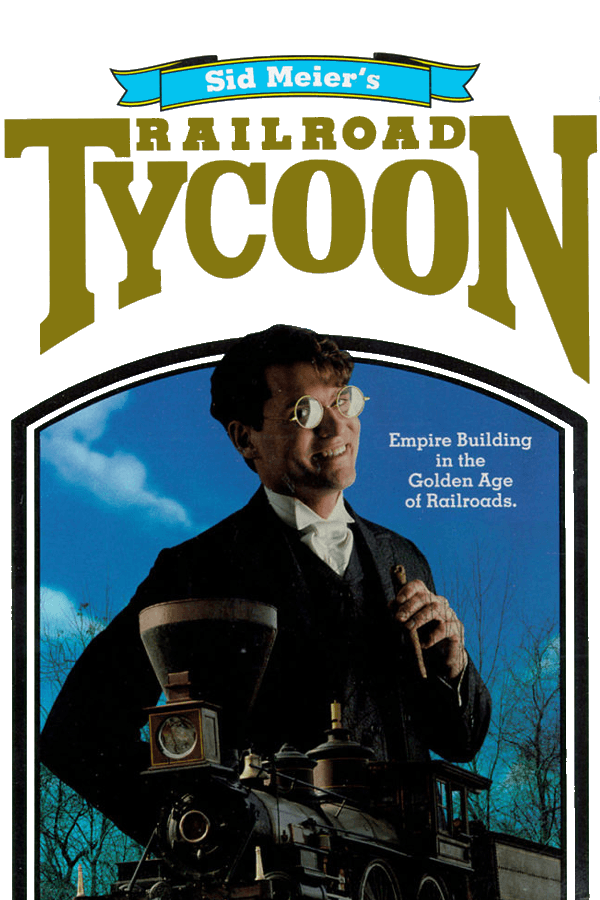
When Sid Meier's Railroad Tycoon launched in 1990, it asked players to manage track construction, regional freight demands, and aggressive corporate stock buyouts all at once.
You start your company with a million dollars in capital, though half of that cash is immediately offset by debt. Choosing between Western USA, Northeast USA, Great Britain, or Continental Europe sets up a century of expansion where every mile of iron rail eats into your operating budget. Supply and demand dictate your routes, forcing you to link coal mines to power plants or iron ore deposits directly to steel mills.
Buying up supply facilities turns basic cargo hauling into direct industrial profit. When your trains transport raw iron ore to a steel mill you personally own, your company collects revenue on both the transport and the finished product. Cargo splits into distinct tiers, from slow heavy freight to urgent passenger traffic and mail. High-speed express runs pay high bonuses, but only if your locomotives can maintain top speed without choking on steep mountain grades.
Designing efficient routes requires managing train schedules and station capacity carefully. Larger stations draw cargo from a broader radius, but building them everywhere drains precious reserves early on. As engine technology advances over the years, older locomotives become expensive money pits, forcing you to replace or upgrade fleet stock to maintain fast turnarounds.
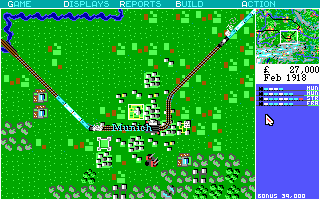
The operational layer of this classic strategy game is deep, but the physical interaction with the map presents a steep wall. Laying track requires toggling your numeric keypad with NumLock engaged, nudging lines segment by segment across eight directions. Turning a line into a smooth curve while fighting elevation changes feels tedious until muscle memory takes over.
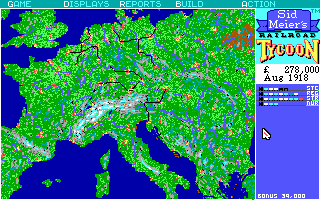
The user interface relies on multi-layered submenus to handle basic construction tasks. Simply laying a stretch of track means stepping through top-level options down into secondary build choices. Combined with high-resolution 16-color VGA graphics that prioritize grid readability over visual flair, the screen often looks more like a colorful spreadsheet than a bustling transit empire.
Audio is similarly sparse during active gameplay. Beyond a catchy intro rendered on AdLib or Roland MT-32 hardware, the actual work of laying track and directing engines relies on minimal PC speaker clicks. MicroProse also implemented visual copy protection at launch, requiring players to identify specific locomotive drawings from the 180-page manual. Guessing incorrectly capped your active fleet at two trains total, effectively ending serious runs before they began.
Designing efficient line networks is only half the battle, because AI rival barons actively hunt for control of your company. Designers Sid Meier and Bruce Shelley drew inspiration directly from Avalon Hill's board game 1830: The Game of Railroads and Robber Barons. Rival entrepreneurs trigger price wars on shared lines and raid open stock listings whenever your reserves dip low.
Financially savvy players quickly learn to use the stock exchange as a weapon. You can issue $500,000 bonds to fund sudden construction pushes or aggressively grab competitor shares. Securing over 50 percent of a rival's equity hands you direct control over their entire rail line and revenue stream, letting you cannibalize their assets to fuel your own expansion.
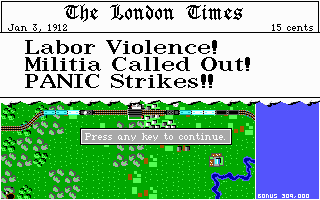
This ruthless financial layer takes the game far beyond simple track placement. Computer Gaming World crowned it Game of the Year in 1990, highlighting how economic warfare complemented transit management. When your century of operation ends, the game tallies your net worth and assigns a final political title, ranking your performance anywhere from minor manager up to President or Prime Minister.
Decades after launching as a 1990 MS-DOS game built by MPS Labs and MicroProse, the core economic loop still holds up. The visual interface is rigid and the keyboard layout takes real effort to master, but constructing profitable freight loops while defending your board seats against hostile AI buyouts keeps the pressure high.
You can play Sid Meier's Railroad Tycoon free in your browser right here. Jump straight into the Northeast USA map, take out your initial loan, and practice connecting your first coal line to a nearby city before your AI rivals buy up the surrounding land rights.
When Sid Meier's Railroad Tycoon launched in 1990, it asked players to manage track construction, regional freight demands, and aggressive corporate stock buyouts all at once.
You start your company with a million dollars in capital, though half of that cash is immediately offset by debt. Choosing between Western USA, Northeast USA, Great Britain, or Continental Europe sets up a century of expansion where every mile of iron rail eats into your operating budget. Supply and demand dictate your routes, forcing you to link coal mines to power plants or iron ore deposits directly to steel mills.
Buying up supply facilities turns basic cargo hauling into direct industrial profit. When your trains transport raw iron ore to a steel mill you personally own, your company collects revenue on both the transport and the finished product. Cargo splits into distinct tiers, from slow heavy freight to urgent passenger traffic and mail. High-speed express runs pay high bonuses, but only if your locomotives can maintain top speed without choking on steep mountain grades.
Designing efficient routes requires managing train schedules and station capacity carefully. Larger stations draw cargo from a broader radius, but building them everywhere drains precious reserves early on. As engine technology advances over the years, older locomotives become expensive money pits, forcing you to replace or upgrade fleet stock to maintain fast turnarounds.
The operational layer of this classic strategy game is deep, but the physical interaction with the map presents a steep wall. Laying track requires toggling your numeric keypad with NumLock engaged, nudging lines segment by segment across eight directions. Turning a line into a smooth curve while fighting elevation changes feels tedious until muscle memory takes over.
The user interface relies on multi-layered submenus to handle basic construction tasks. Simply laying a stretch of track means stepping through top-level options down into secondary build choices. Combined with high-resolution 16-color VGA graphics that prioritize grid readability over visual flair, the screen often looks more like a colorful spreadsheet than a bustling transit empire.
Audio is similarly sparse during active gameplay. Beyond a catchy intro rendered on AdLib or Roland MT-32 hardware, the actual work of laying track and directing engines relies on minimal PC speaker clicks. MicroProse also implemented visual copy protection at launch, requiring players to identify specific locomotive drawings from the 180-page manual. Guessing incorrectly capped your active fleet at two trains total, effectively ending serious runs before they began.
Designing efficient line networks is only half the battle, because AI rival barons actively hunt for control of your company. Designers Sid Meier and Bruce Shelley drew inspiration directly from Avalon Hill's board game 1830: The Game of Railroads and Robber Barons. Rival entrepreneurs trigger price wars on shared lines and raid open stock listings whenever your reserves dip low.
Financially savvy players quickly learn to use the stock exchange as a weapon. You can issue $500,000 bonds to fund sudden construction pushes or aggressively grab competitor shares. Securing over 50 percent of a rival's equity hands you direct control over their entire rail line and revenue stream, letting you cannibalize their assets to fuel your own expansion.
This ruthless financial layer takes the game far beyond simple track placement. Computer Gaming World crowned it Game of the Year in 1990, highlighting how economic warfare complemented transit management. When your century of operation ends, the game tallies your net worth and assigns a final political title, ranking your performance anywhere from minor manager up to President or Prime Minister.
Decades after launching as a 1990 MS-DOS game built by MPS Labs and MicroProse, the core economic loop still holds up. The visual interface is rigid and the keyboard layout takes real effort to master, but constructing profitable freight loops while defending your board seats against hostile AI buyouts keeps the pressure high.
You can play Sid Meier's Railroad Tycoon free in your browser right here. Jump straight into the Northeast USA map, take out your initial loan, and practice connecting your first coal line to a nearby city before your AI rivals buy up the surrounding land rights.
How Sid Meier's Railroad Tycoon is played — the keys the game listens to, grouped by what they do.
Highlighted keys are mapped — hover or tap one to see what it does.
Can be played entirely via keyboard or using mouse and keyboard. Joysticks are not supported.
The on-screen keyboard and gamepad mapping the browser player uses on a phone, a tablet or a controller, as opposed to the real keys above. $PRO members make their own in the player and share them here; anyone can pick one to play with.
Cheat codes, console commands and memory pokes for Sid Meier's Railroad Tycoon — each one verified and attributed.
Sign in to submitHow Sid Meier's Railroad Tycoon is played — the keys the game listens to, grouped by what they do.
Highlighted keys are mapped — hover or tap one to see what it does.
Can be played entirely via keyboard or using mouse and keyboard. Joysticks are not supported.
The on-screen keyboard and gamepad mapping the browser player uses on a phone, a tablet or a controller, as opposed to the real keys above. $PRO members make their own in the player and share them here; anyone can pick one to play with.
Cheat codes, console commands and memory pokes for Sid Meier's Railroad Tycoon — each one verified and attributed.
Sign in to submit