
Sid Meier's Railroad Tycoon Deluxe
Checking…
Playing Sid Meier's Railroad Tycoon Deluxe places you in the corporate chair of a fledgling rail line, tasking you with expanding across sprawling continents while battling aggressive rivals and unpredictable markets. It refines MicroProse's ground-breaking business simulation with fresh historical scenarios and upgraded visual detail, though its cutthroat financial mechanics ensure that survival is never guaranteed.
Why the financial balance sheet makes or breaks your network
Every match opens with the same high-stakes equation. You pick a starting region, survey the raw topography, and spend your tiny pool of initial capital laying iron track between a pair of hungry industrial towns. Your real enemy in the early game is not the terrain, but the brutal cost of debt. Expanding track across rivers requires expensive bridges, and if you miscalculate your cash flow, you are forced to issue high-yield bonds carrying crippling interest rates around 12 percent.
Once you are in a negative cash balance, those interest payments hit like a tidal wave during economic recessions. Freight profits evaporate, leaving you unable to service the debt while rival tycoons quietly buy up your company stock on the open market. A single bad quarter of track expansion can drag you into an inescapable debt spiral where your operational revenue fails to cover basic interest payments, resulting in total liquidation before your trains even hit their full speed.
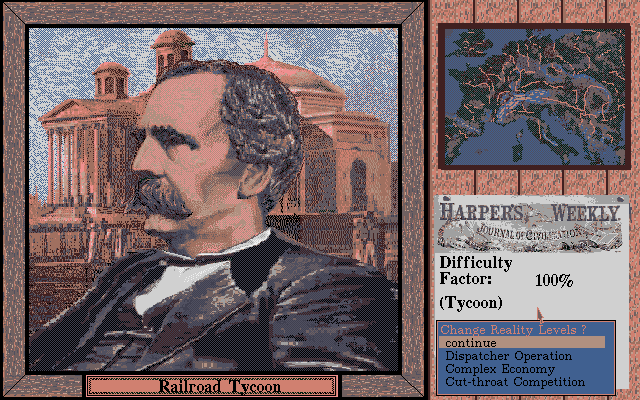
The operational layer demands continuous attention to supply and demand mechanics. Linking a coal mine to a steel mill yields solid returns, but profits quickly decay if you fail to balance locomotive speed, station wait times, and cargo priorities. The main features introduced across these regional maps include:
- Expanded geographic regions spanning Eastern and Western United States, South America, Europe, and Africa.
- 11 unique historical locomotives added to the roster, giving you fresh choices for regional express routes.
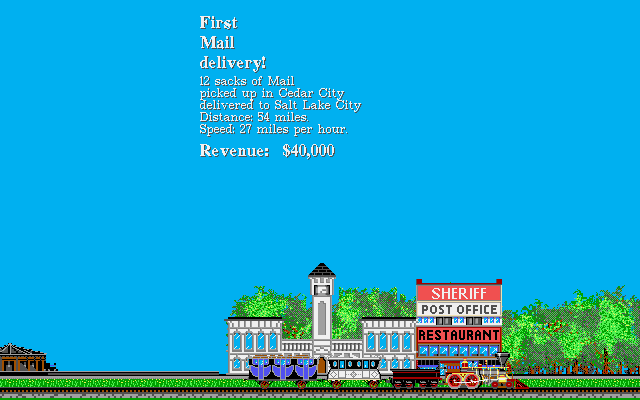
- Dynamic regional hazards, such as train bandits looting mail cargo across North American scenarios.
- Stock trading mechanics that let you stage hostile takeovers or defend against rival rate wars.
Sid Meier's Railroad Tycoon Deluxe brings VGA paint and new maps without Sid Meier
While his name stayed prominent on the box art, designer Sid Meier was not directly involved in creating this expanded 1993 edition. Instead, MicroProse Software, Inc. tasked their internal MPS Labs team with giving the 1990 original a thorough structural makeover. The development team upgraded the entire engine to full VGA resolution, replacing older lower-color graphics with detailed train engines, varied landscapes, and distinct regional architecture.
The audio side received a massive boost as well. MicroProse integrated native digitized sound effects and upgraded music drivers tailored for modern sound hardware. If you ran the game on a Sound Blaster Pro or connected a Roland LAPC-1 or General MIDI synthesizer, engine chugs, train whistles, and atmospheric tunes sounded far clearer than the blips of a standard PC speaker.
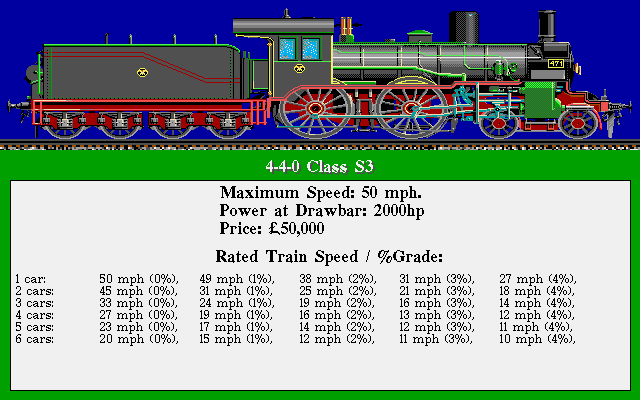
These cosmetic upgrades came alongside significant map additions. The new South America and Africa maps forced players to adapt to dramatically different geography and industrial chains, while splitting North America into Eastern and Western regional maps offered tighter, highly focused historical battles over territory.
Technical slowdowns and debt spirals frustrated early players
When the game launched in 1993, critical reaction was sharp and divided. Gaming magazines lined up to praise the expanded strategic scope. Computer Gaming World hailed it as a strategy title par excellence, while Compute! pointed out that it put a polished modern face on an already solid foundation, and PC Zone named it a top purchase for simulation fans. Yet players at home quickly ran into serious technical headaches.
The expanded VGA graphics and additional AI routines put severe strain on contemporary hardware. On standard 386 and early 486 computers, game performance dropped noticeably once multiple computer players built large rail networks. Severe technical bugs and persistent slowdown ruined long sessions for many, causing the game to fall short commercially compared to the original release.
The interface presented its own hurdle. Laying track meant using specific numeric keypad combinations to route rails through hexagonal directions. Missing a manual key code or getting stuck in the built-in copy protection check left many players stranded before their networks even generated a profit.
Play Sid Meier's Railroad Tycoon Deluxe online in your browser
For fans of the strategy tactics genre, this expanded edition turns into a deep financial sandbox once you understand its quirks. The severe bugs that plagued its 1993 retail release are far easier to manage today, leaving behind a demanding transport system where corporate strategy matters just as much as laying efficient routes. If you enjoy balancing strict operational budgets against hostile AI competitors, it provides hours of absorbing planning.
Modern players often assume this is a relaxed model train simulator, only to get bankrupted by high interest debt within twenty minutes. You can test your business chops and play Sid Meier's Railroad Tycoon Deluxe online right now. It runs as a full Sid Meier's Railroad Tycoon Deluxe free in your browser session with no extra software or setup needed, letting you dive directly into the classic Sid Meier's Railroad Tycoon Deluxe MS-DOS game experience. Keep your bond debt low on your first run, pay close attention to city demand, and keep an eye on rival stock prices before they buy you out.
How Sid Meier's Railroad Tycoon Deluxe is played — the keys the game listens to, grouped by what they do.
- Interface
- Left click — Opens a menu or makes selection
- Right click — Exits toggle menus or closes selection
Highlighted keys are mapped — hover or tap one to see what it does.
Railroad Tycoon Deluxe does not support a joystick. Full key map is incomplete in source notes.
Players' controls
Touch and gamepad controls
The on-screen keyboard and gamepad mapping the browser player uses on a phone, a tablet or a controller, as opposed to the real keys above. $PRO members make their own in the player and share them here; anyone can pick one to play with.
Make your own touch controlsPRO
- 1Open the editorSign in below, then pick what to make. The game starts with the editor open over it.
- 2Place your keysAdd keys and drag them where your thumbs rest, or map a controller's buttons. Test plays the game with them; Save keeps them, and you play with them from then on.
- 3Share themShare them right after saving in the game, or name and share them here. Players vote, and the best become this game's controls for everyone.
Go PROSee how it worksSign in+20 XP for sharing · +50 XP if yours become the game's own
- The game's own controlsKeyboardGamepadWhat every player starts with.In use
9 screenshots
From the archive
No gameplay video yet
No gameplay video for Sid Meier's Railroad Tycoon Deluxe yet. Sign in to add one.
No reviews yet
Tell the community what you think of Sid Meier's Railroad Tycoon Deluxe. Reviews are public and tied to your username.
No archived manuals for Sid Meier's Railroad Tycoon Deluxe yet
No manuals archived for this title yet. Sign in to upload the first scan.
Cheat codes, console commands and memory pokes for Sid Meier's Railroad Tycoon Deluxe — each one verified and attributed.
Sign in to submitNo cheats yet for this title
Know a working cheat, poke or trainer? Add it with the button above. Moderators check every entry before it goes live.
No archived soundtrack for Sid Meier's Railroad Tycoon Deluxe yet
No soundtrack archived for this title yet. Sign in to upload the first rip.
No save states for Sid Meier's Railroad Tycoon Deluxe yet
No save states for this title yet. Sign in to share one.
Discussions
Sign in to post- Threads0
- Total posts0
- Online now6
Community · Sid Meier's Railroad Tycoon Deluxe
Who's contributing, and what's new
- Reviews0
- Threads0
- Uploadsapproved0
- Contributors0
Recent activity