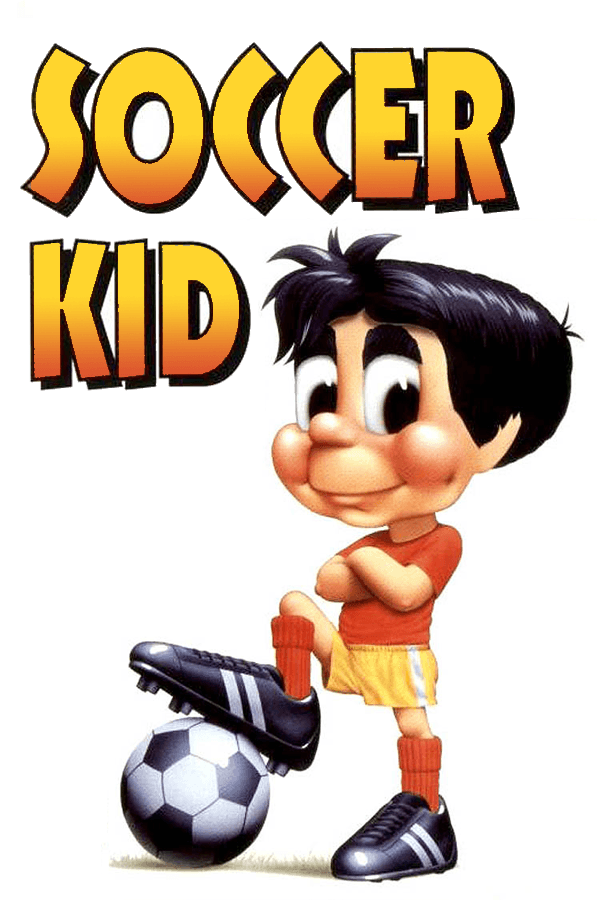

In Soccer Kid, your only real weapon against an invading alien pirate is the football glued to your toes.
Save the World Cup one trick kick at a time
The story opens on an alien pirate named Scab, who tries to steal the World Cup trophy, breaks it into five pieces during a high-speed chase, and scatters the wreckage across the globe. You play as a nameless young fan who sets out to track down every missing fragment across Britain, Italy, Russia, Japan, and the USA. To get your hands on a trophy piece at the end of a world, you have to collect 11 Player Cards hidden across its levels. It is a silly premise, but it gives Krisalis Software Ltd. a perfect excuse to send you bouncing through different international backdrops.
Instead of jumping on heads or shooting lasers, your football does all the work. You kick it into enemies, hit out-of-reach switches, and pull off headers, bicycle kicks, and overhead volleys to clear tricky angles. If you misplace your ball during a chaotic fight, holding down the kick button magically calls it back to your feet. You can even hop onto the ball to bounce up to high platforms. It takes time to get used to the heavy momentum, but pulling off a high volley into a moving enemy feels great once you master the timing.
Complex controls and strict limits hold Soccer Kid back
The developers packed over a dozen distinct ball tricks into the control scheme, which created a steep learning curve. While console versions spread these moves across multiple buttons, the Soccer Kid MS-DOS game maps everything to a single key combined with directional arrows. Trying to line up a precise overhead kick while a bad guy charges at you often leads to frantic button-mashing instead of clean execution. The level design also suffers from repetition after the first few countries, reusing familiar platform setups over and over.
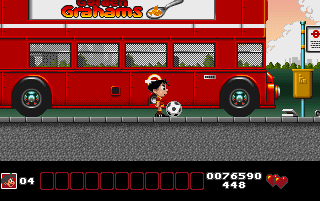
Difficulty spikes strike hard, especially during boss fights. A tiny timing mistake can drain your entire health bar in seconds. Making matters worse is the harsh save system, which only lets you save your progress after clearing an entire country. Losing your lives near the end of a long region forces you to replay several levels from scratch, making late-game mistakes incredibly expensive.
How the PC version brought Amiga sound to DOS
When this platformer landed on PC displays in 1994, standard MS-DOS games usually relied on standard MIDI synthesizer tracks. Krisalis took a different route by using a digital MOD soundtrack, matching the audio quality of the original Amiga version. Matt Furniss composed a fast-paced, synth-heavy soundtrack that streams smoothly alongside digitized sound effects. Visually, the smooth-scrolling 2D VGA graphics look bright and crisp, featuring fun background details like real in-game advertisements for Golden Grahams cereal.
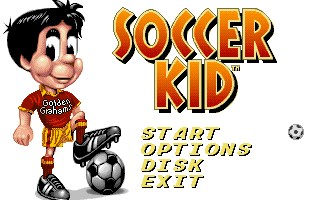
Published in North America by General Admission Software, the game arrived in a crowded market filled with side-scrolling competition like Jazz Jackrabbit and Commander Keen. On the Super Nintendo, publishers even renamed it The Adventures of Kid Kleets for American audiences. What sets the PC version apart are its unusual ball mechanics and impressive audio tech.
- Five playable countries: Britain, Italy, Russia, Japan, and the USA
- 11 hidden Player Cards to locate in each region
- Unique ball-recall mechanic so you never permanently lose your weapon
- Custom digital MOD sound system on MS-DOS instead of standard MIDI
Play Soccer Kid free in your browser right now
If you enjoy classic action games from 1994, this title is well worth a look today. The frustrating save system and tricky inputs might annoy you early on, but learning the physics of the ball mechanics changes the routine of standard platforming. It is far more technical than its art style lets on, rewarding players who take the time to learn its control scheme.
You can play Soccer Kid free in your browser right now with no downloads required. Jump straight into the action, start juggling your ball, and see if you can recover the lost trophy pieces without losing your cool on the tricky boss battles.