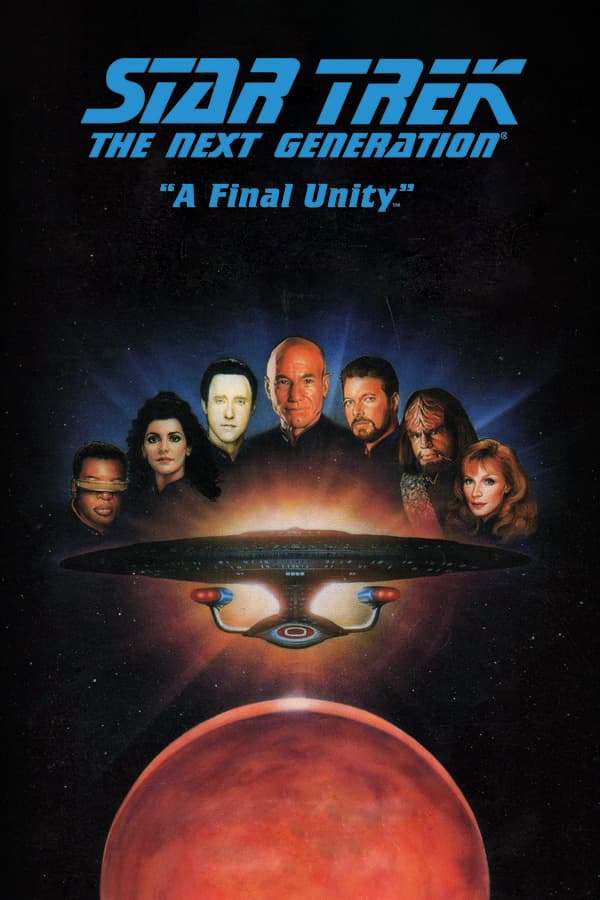
aka Star Trek TNG: The Trivia Game · Star Trek: The Next Generation - Trivia - Volume 1 · Next Generation Trivia
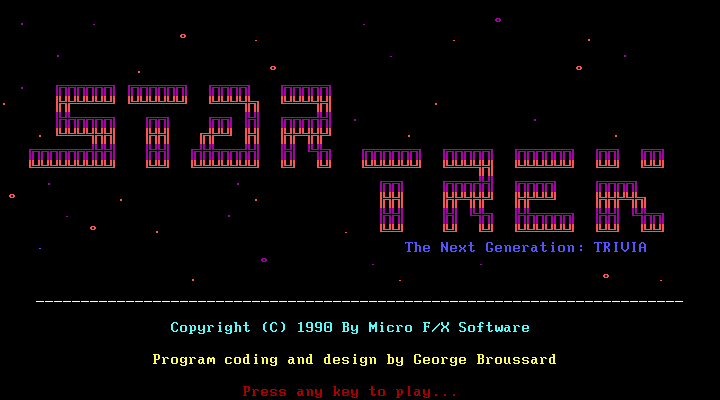
If you think you know Picard and crew, Star Trek: The Next Generation - Trivia puts that confidence to a ruthless test across three hundred text-only questions and a unforgiving fifteen-second timer.
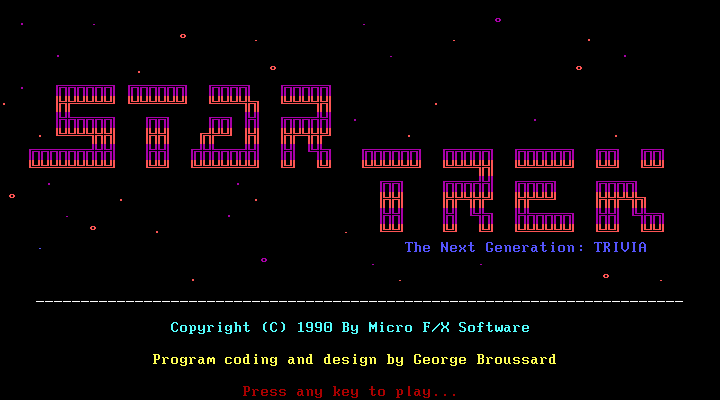
You launch the program, and there are no digitized starships or sound clips to greet you. Instead, this 1990 text-based quiz drops you right onto a stark prompt where every second counts against your final score. You read a question about the first three seasons of the show, hit the number key for your answer, and hope your memory of early episodic minutiae holds up under pressure.
The core system revolves around speed and precision. Every question gives you a fifteen-second window to choose an answer, and the bonus points attached to that question tick away steadily as the clock counts down. Answering quickly matters, but guessing blindly will break your run fast. You start with three Free Misses, losing one every time you select the wrong hotkey, though answering ten questions correctly earns one back. If you burn through your safety net and rack up five wrong answers total, your run is over instantly.
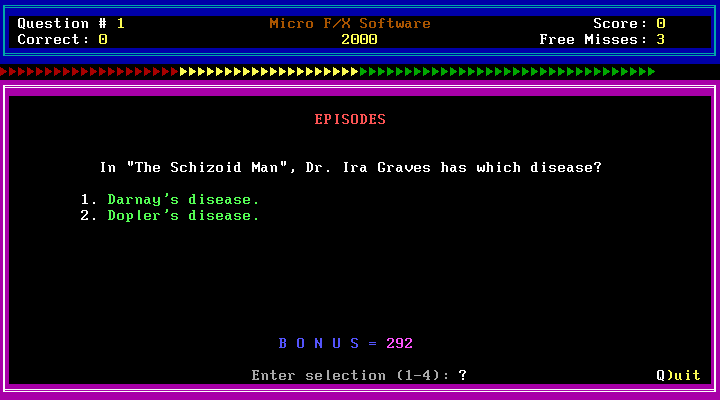
That score penalty creates a distinct tension during play. Do you lock in an answer immediately on a half-remembered quote to bank maximum bonus points, or do you take five extra seconds to verify the detail in your head while watching your score bleed away? That single mechanic turns what could have been a standard flashcard utility into something far more stressful.
Before Apogee Software became a titan of shareware publishing, co-founder George Broussard designed this title under the banner of Micro F/X Software. Distributed across three separate volumes of one hundred questions each, Volume 1 was given away free as shareware to hook players, while the remaining volumes were sold commercially. Broussard even offered the complete Turbo Pascal source code of the project to interested buyers for a hundred dollars.
The commercial release eventually caught the eye of Paramount Pictures. Because the project was developed without an official license from the franchise owner, Paramount contacted Apogee with an offer to formalize the rights. When Apogee evaluated the licensing costs, they realized the fee would wipe out any real return from such a small utility. Rather than risk a courtroom fight, Apogee pulled the software from their official catalog completely and placed the program into the public domain, leaving it as a curious piece of early shareware history.
The sheer difficulty of the question bank is what modern players bring up immediately. Rather than sticking to basic lore like the registry number of the Enterprise or the names of the main bridge crew, the game delights in pulling from obscure corners of seasons one through three. You might be asked to recall the exact name of a single-episode alien culture, a minor technical designation given in passing, or a specific line of dialogue from a secondary character.
This level of obscurity turns every run into a true test of fanaticism. For players looking to test their knowledge, it separates casual viewers from people who kept episode guides next to their couch. The game demands absolute precision, meaning a missed detail from a season one filler episode can end your game just as quickly as a question about a major season finale.
Without high-resolution character portraits or digitized sound bites, the entire weight of the program rests on its presentation and text formatting. The visuals are completely standard DOS text characters without graphical flourishes, and the PC speaker sound effects are basic enough that many players preferred turning the audio off entirely. When compared to typical educational games of the era, the software feels less like an entertainment package and more like an aggressive exam environment.
Yet that lack of visual distraction actually works in its favor once you start playing. The interface never gets in the way of your typing, and selecting answers via number keys is instantaneous. There are no heavy menus to navigate or long loading pauses between questions, allowing you to restart a failed run and jump right back into the question queue within seconds.
If you consider yourself a true expert on early TNG, this software offers an unvarnished, high-stakes way to prove it. The straightforward rules mean you can jump into a round without reading a manual or memorizing complex controls. Star Trek: The Next Generation - Trivia nails that early shareware formula: simple rules, ruthless questions, and zero interest in wasting your time with flashy visuals.
You can play Star Trek: The Next Generation - Trivia online, free in your browser right now with no setup needed. First-time players often assume they can coast through the early rounds on general knowledge, but you will quickly find that speed and exact recall of obscure season one lore are essential if you want to keep your Free Misses intact past the first twenty questions.
If you think you know Picard and crew, Star Trek: The Next Generation - Trivia puts that confidence to a ruthless test across three hundred text-only questions and a unforgiving fifteen-second timer.
You launch the program, and there are no digitized starships or sound clips to greet you. Instead, this 1990 text-based quiz drops you right onto a stark prompt where every second counts against your final score. You read a question about the first three seasons of the show, hit the number key for your answer, and hope your memory of early episodic minutiae holds up under pressure.
The core system revolves around speed and precision. Every question gives you a fifteen-second window to choose an answer, and the bonus points attached to that question tick away steadily as the clock counts down. Answering quickly matters, but guessing blindly will break your run fast. You start with three Free Misses, losing one every time you select the wrong hotkey, though answering ten questions correctly earns one back. If you burn through your safety net and rack up five wrong answers total, your run is over instantly.
That score penalty creates a distinct tension during play. Do you lock in an answer immediately on a half-remembered quote to bank maximum bonus points, or do you take five extra seconds to verify the detail in your head while watching your score bleed away? That single mechanic turns what could have been a standard flashcard utility into something far more stressful.
Before Apogee Software became a titan of shareware publishing, co-founder George Broussard designed this title under the banner of Micro F/X Software. Distributed across three separate volumes of one hundred questions each, Volume 1 was given away free as shareware to hook players, while the remaining volumes were sold commercially. Broussard even offered the complete Turbo Pascal source code of the project to interested buyers for a hundred dollars.
The commercial release eventually caught the eye of Paramount Pictures. Because the project was developed without an official license from the franchise owner, Paramount contacted Apogee with an offer to formalize the rights. When Apogee evaluated the licensing costs, they realized the fee would wipe out any real return from such a small utility. Rather than risk a courtroom fight, Apogee pulled the software from their official catalog completely and placed the program into the public domain, leaving it as a curious piece of early shareware history.
The sheer difficulty of the question bank is what modern players bring up immediately. Rather than sticking to basic lore like the registry number of the Enterprise or the names of the main bridge crew, the game delights in pulling from obscure corners of seasons one through three. You might be asked to recall the exact name of a single-episode alien culture, a minor technical designation given in passing, or a specific line of dialogue from a secondary character.
This level of obscurity turns every run into a true test of fanaticism. For players looking to test their knowledge, it separates casual viewers from people who kept episode guides next to their couch. The game demands absolute precision, meaning a missed detail from a season one filler episode can end your game just as quickly as a question about a major season finale.
Without high-resolution character portraits or digitized sound bites, the entire weight of the program rests on its presentation and text formatting. The visuals are completely standard DOS text characters without graphical flourishes, and the PC speaker sound effects are basic enough that many players preferred turning the audio off entirely. When compared to typical educational games of the era, the software feels less like an entertainment package and more like an aggressive exam environment.
Yet that lack of visual distraction actually works in its favor once you start playing. The interface never gets in the way of your typing, and selecting answers via number keys is instantaneous. There are no heavy menus to navigate or long loading pauses between questions, allowing you to restart a failed run and jump right back into the question queue within seconds.
If you consider yourself a true expert on early TNG, this software offers an unvarnished, high-stakes way to prove it. The straightforward rules mean you can jump into a round without reading a manual or memorizing complex controls. Star Trek: The Next Generation - Trivia nails that early shareware formula: simple rules, ruthless questions, and zero interest in wasting your time with flashy visuals.
You can play Star Trek: The Next Generation - Trivia online, free in your browser right now with no setup needed. First-time players often assume they can coast through the early rounds on general knowledge, but you will quickly find that speed and exact recall of obscure season one lore are essential if you want to keep your Free Misses intact past the first twenty questions.
How Star Trek: The Next Generation - Trivia is played — the keys the game listens to, grouped by what they do.
Highlighted keys are mapped — hover or tap one to see what it does.
The notes indicate players must type answers to trivia questions under a 15-second countdown timer. Full key mapping documentation is incomplete in available primary sources.
The on-screen keyboard and gamepad mapping the browser player uses on a phone, a tablet or a controller, as opposed to the real keys above. $PRO members make their own in the player and share them here; anyone can pick one to play with.
Cheat codes, console commands and memory pokes for Star Trek: The Next Generation - Trivia — each one verified and attributed.
Sign in to submit
Cheat codes, console commands and memory pokes for Star Trek: The Next Generation - Trivia — each one verified and attributed.
Sign in to submit