Star Wars
aka Star Wars: The Arcade Game
Sitting in the cockpit of Red Five in Star Wars means staring straight into a stark grid of vector lines while dodging glowing enemy fire at blinding speeds.
Vector lines and high-speed dogfights in Star Wars
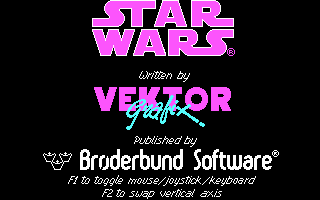
When Mike Hally designed the original coin-op arcade machine for Atari, Inc. in 1983, it captured public imagination through a custom color vector display and an analog flight yoke. Programmers Greg Rivera and Norm Avellar built an engine capable of shifting 3D wireframe models around the screen at high frame rates, while Earl Vickers supplied digitized voice synthesis that shouted lines straight from the movie through the cabinet speakers. Bringing that experience to home microcomputers required clever engineering, which UK development outfit Vektor Grafix handled for Brøderbund Software, Inc. when bringing the title to DOS PCs in 1989.
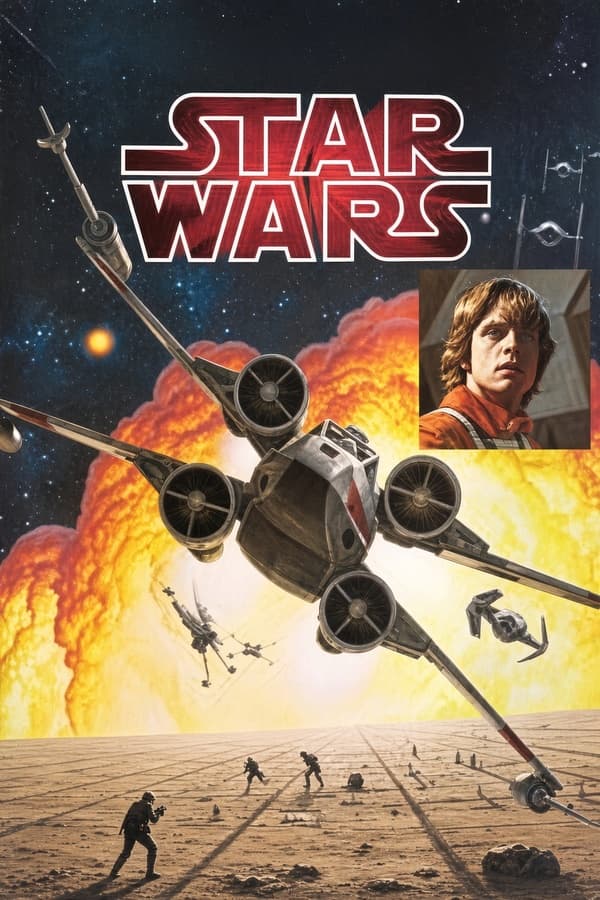
The home port opens immediately in deep space, throwing your X-Wing into a chaotic dogfight against Imperial TIE Fighters. Fireball energy bolts stream across the screen, demanding rapid twitch adjustments to align your crosshairs and destroy incoming targets before they impact your cockpit. You start with six shield units, and every unblocked enemy shot or collision chisels away at that pool until your ship disintegrates. Darth Vader's custom TIE Advanced fighter looms among the waves, weaving across the screen while launching fast-moving red plasma towards your hull.
Surviving the Death Star surface and the trench run
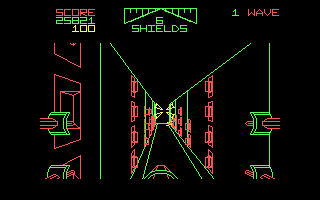
Surviving the opening space battle shifts the action directly down to the Death Star surface. The geometry expands into a wide plane populated by towering laser turrets and ground-level bunker emplacements that track your flight path. Clearing this phase requires prioritizing targets while constantly moving your aiming sight to intercept incoming artillery shells before they strike your shields.
The ultimate objective arrives in the third stage, which drops your fighter into the narrow Death Star trench. Red and blue fireballs fill the corridor, while yellow forcefield barriers force you to shoot out upper or lower obstacle segments to create a clean opening. The sequence culminates at the thermal exhaust port, where you must launch your limited store of proton torpedoes with precise timing to trigger a chain reaction.
The progression breaks down into three distinct operational phases:
- Space combat: Intercept waves of Imperial TIE Fighters and survive direct strafing runs from Darth Vader.
- Surface assault: Neutralize ground-based bunker turrets and tall laser towers across the Death Star exterior.
- The trench run: Weave through plasma fire and structural barriers before timing your torpedo drop into the exhaust port.
Hidden inside the vector rendering routines is a neat graphical easter egg carried over from the original arcade code. On odd-numbered waves, the grid lines painted across the Death Star surface spell out the phrase "MAY THE FORCE BE WITH YOU" in plain sight. On even-numbered waves, those same geometric lines alter their configuration to spell out the names of the original coin-op development team.
Keyboard precision and the limits of PC hardware
Reviewing the computer conversions in Issue #145 of Dragon Magazine, reviewers Hartley, Patricia, and Kirk Lesser awarded the title 3 out of 5 stars. Their primary critique centered on visual presentation; while 16-color EGA graphics hardware had become common across home setups, the vector engine rendered simple wireframe lines that barely utilized the expanded color palettes available on modern PC monitors. Furthermore, sound output relied entirely on the internal monophonic PC speaker, missing the digital audio samples that made arcade cabinets rumble.
Control inputs present an even greater hurdle for modern players. The original arcade cabinet relied on a smooth analog yoke controller that allowed subtle, fluid crosshair movement across the entire view area. On a standard 1980s PC setup using digital joysticks or standard keyboards, steering feels far more rigid. Trying to land fine adjustments on a distant fireball using arrow keys often results in overshooting your aim, leaving your ship exposed to damage during dense attack waves.
The structural loop reflects its pure quarter-eating origins. Once you blow up the Death Star, the mission resets immediately, sending you back into space against faster enemy waves with more aggressive laser fire and denser trench obstacles. Without any save system or mid-game checkpoints, a single mistake on higher difficulty loops rapidly wipes out your remaining shield reserves.
Where this Star Wars MS-DOS game succeeds and falls short
What keeps this early action game fun is its sheer speed and raw focus on reflexes. Rendering full 3D line geometry on 286-class processors without texture mapping allowed Vektor Grafix to preserve a high frame rate that few action titles in 1989 could match. The sense of scale when diving into the trench holds up well, proving that crisp vector mathematics can deliver strong feedback without relying on heavy bitmap graphics.
Where it struggles is long-term depth and audio presentation. The monophonic bleeps of the PC speaker turn classic orchestral melodies into harsh, chirping tones, and the endless gameplay loop offers no narrative progression beyond chasing a higher personal score. Compared to rich space simulations that emerged on floppy disk a few years later, this vector shooter works strictly as arcade-style twitch action scaled down to fit early home systems.
Fire up your X-Wing and play Star Wars online
You can try this classic space shooter right now, running full speed and ready to fire up. You can play Star Wars free in your browser with zero hassle, letting you experience every line of wireframe combat in seconds.
Once you jump into the pilot seat, keep your eyes on the center of the screen during your initial space dogfight. Focus on blasting enemy fireballs out of the air before chasing individual TIE Fighters, because protecting your initial six shields is the only way you will survive long enough to drop torpedoes into the trench port.