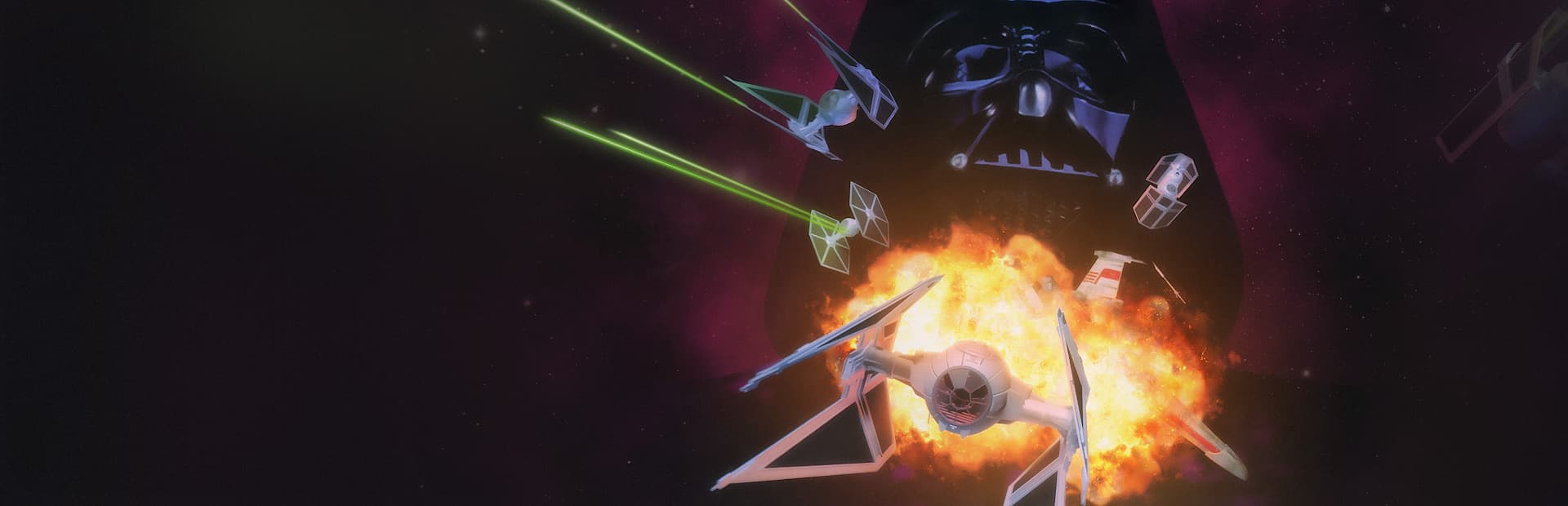
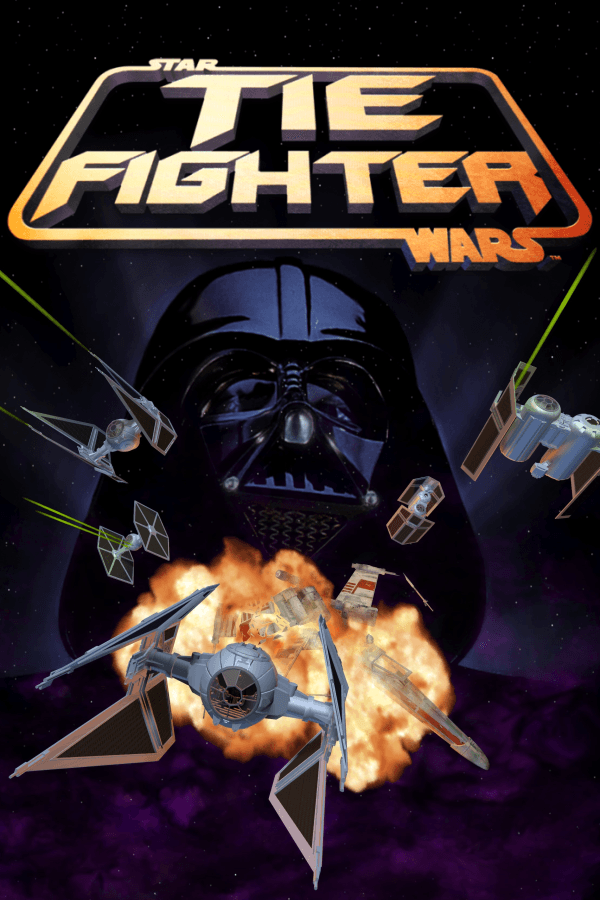
Playing Star Wars: TIE Fighter turns the familiar space fantasy inside out by placing you in the cockpit of an unshielded Imperial starfighter, taking orders from a dark Empire that treats your survival as optional.
Most sci-fi simulators hand you a heavily shielded craft, a suite of defensive measures, and a warm sense of moral superiority. Totally Games flipped that formula entirely by putting you in the seat of an Imperial pilot - named Maarek Stele in the companion lore - where your basic craft lacks shields, your hull collapses under minimal laser fire, and your superiors view you as an expendable asset. It alters how you approach dogfights: you cannot rely on taking hits while lining up a shot, so energy management becomes your primary survival tool.
Balancing systems in mid-flight requires constant adjustments. You route power away from your engines to top up laser capacitors, matching speed with fleeing Rebel craft or rogue Imperial traitors before diverting energy back to thrusters when missiles are locked onto your tail. The 1995 Collector's CD-ROM upgrade built upon the original 3D engine with Gouraud-shaded polygons, offering a crisp 640x480 SVGA mode that made targeting distant starships and reading tactical readouts far clearer than before.
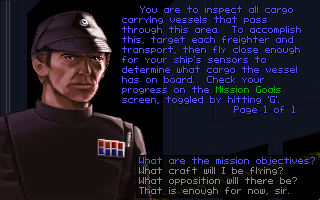
The 1995 CD-ROM release does far more than tidy up the original game: it brings together the base campaign, the Defender of the Empire add-on, and the exclusive Enemies of the Empire expansion into over 100 missions across 13 distinct battle theaters. You move from suppressing regional pirates to escorting Grand Admiral Thrawn's tactical fleet and running covert operations directly under Darth Vader.
What sets the mission design apart is the dual layer of objectives. Beyond your primary flight goals, a mysterious hooded figure representing the Secret Order of the Emperor hands you secondary and hidden tasks. Completing these side goals - like scanning specific cargo containers before destroying a transport - earns you secret tattoos and grants entry into the Emperor's inner circle. It rewards thorough reconnaissance work rather than simple trigger-happy dogfighting.
The audio upgrade in this release also changes the atmosphere entirely. Known as the "Talkie" edition, it introduced full voice acting for mission briefings and radio chatter. Paired with LucasArts' dynamic iMUSE engine, the MIDI score shifts tracks in real time as you cruise empty space, trade fire with an X-Wing squadron, or suffer catastrophic hull damage.
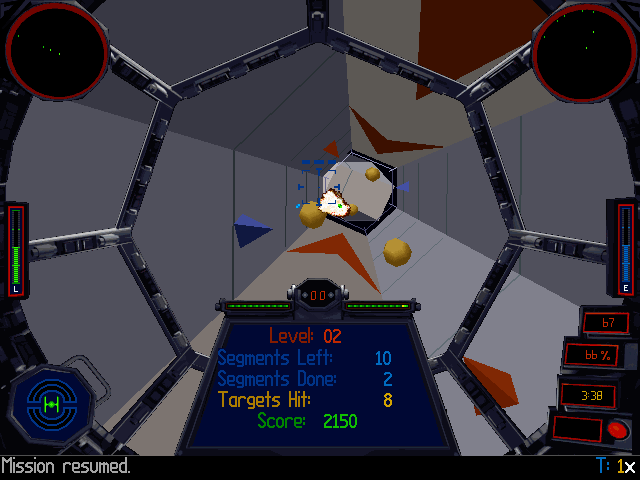
For all its brilliance, the game features some notoriously brutal design choices. The difficulty curve in mid-to-late expansion acts - such as "Battle Three: Battle on the Frontier" - can feel like hitting a concrete wall. Several escort missions force you to protect slow, unshielded non-combat freighters against waves of enemy warhead launchers while you fly a fragile standard TIE Fighter. One misplaced turn or missed target priority means immediate mission failure, forcing a complete restart.
If you find those protection runs overwhelming, the developers included built-in toggles for invulnerability and unlimited warheads directly in the options menu, offering a relief valve for the nastiest scenarios. Another minor flaw noted by players lies in the sound design: when your warheads are completely depleted, firing default laser cannons produces a light clicking effect that lacks punch, sounding more like a toy than a military-grade weapon.
When LucasArts later ported the game to Windows in 1998, they made a controversial trade-off: they added Direct3D hardware acceleration but replaced the dynamic MIDI soundtrack with static CD audio tracks. That change stripped away the fluid musical transitions that made combat feel so reactive. Because of that, fans consistently point back to this 1995 MS-DOS CD-ROM release, running on vintage hardware setups with a Sound Blaster 16 or Gravis UltraSound, as the absolute peak of the series created by Totally Games and LucasArts.
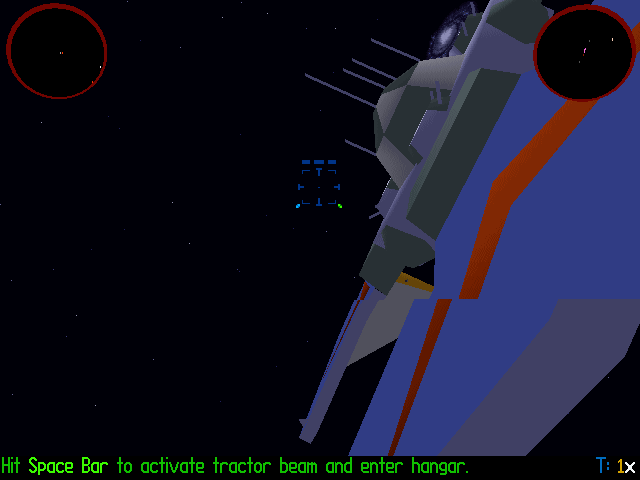
The simulation mechanics hold up well, though getting a modern controller working usually requires mapping utilities like JoyToKey. If you enjoy deep tactical systems, pitch-perfect space combat physics, and a campaign that treats you like a military professional rather than a savior, this game still delivers an experience few flight simulators have ever matched.
You can play Star Wars: TIE Fighter online free in your browser right now, with zero setup required. Launch right into the flight deck, route power to your laser cannons, and see if you have what it takes to survive the front lines of the Empire.
Playing Star Wars: TIE Fighter turns the familiar space fantasy inside out by placing you in the cockpit of an unshielded Imperial starfighter, taking orders from a dark Empire that treats your survival as optional.
Most sci-fi simulators hand you a heavily shielded craft, a suite of defensive measures, and a warm sense of moral superiority. Totally Games flipped that formula entirely by putting you in the seat of an Imperial pilot - named Maarek Stele in the companion lore - where your basic craft lacks shields, your hull collapses under minimal laser fire, and your superiors view you as an expendable asset. It alters how you approach dogfights: you cannot rely on taking hits while lining up a shot, so energy management becomes your primary survival tool.
Balancing systems in mid-flight requires constant adjustments. You route power away from your engines to top up laser capacitors, matching speed with fleeing Rebel craft or rogue Imperial traitors before diverting energy back to thrusters when missiles are locked onto your tail. The 1995 Collector's CD-ROM upgrade built upon the original 3D engine with Gouraud-shaded polygons, offering a crisp 640x480 SVGA mode that made targeting distant starships and reading tactical readouts far clearer than before.

The 1995 CD-ROM release does far more than tidy up the original game: it brings together the base campaign, the Defender of the Empire add-on, and the exclusive Enemies of the Empire expansion into over 100 missions across 13 distinct battle theaters. You move from suppressing regional pirates to escorting Grand Admiral Thrawn's tactical fleet and running covert operations directly under Darth Vader.
What sets the mission design apart is the dual layer of objectives. Beyond your primary flight goals, a mysterious hooded figure representing the Secret Order of the Emperor hands you secondary and hidden tasks. Completing these side goals - like scanning specific cargo containers before destroying a transport - earns you secret tattoos and grants entry into the Emperor's inner circle. It rewards thorough reconnaissance work rather than simple trigger-happy dogfighting.
The audio upgrade in this release also changes the atmosphere entirely. Known as the "Talkie" edition, it introduced full voice acting for mission briefings and radio chatter. Paired with LucasArts' dynamic iMUSE engine, the MIDI score shifts tracks in real time as you cruise empty space, trade fire with an X-Wing squadron, or suffer catastrophic hull damage.

For all its brilliance, the game features some notoriously brutal design choices. The difficulty curve in mid-to-late expansion acts - such as "Battle Three: Battle on the Frontier" - can feel like hitting a concrete wall. Several escort missions force you to protect slow, unshielded non-combat freighters against waves of enemy warhead launchers while you fly a fragile standard TIE Fighter. One misplaced turn or missed target priority means immediate mission failure, forcing a complete restart.
If you find those protection runs overwhelming, the developers included built-in toggles for invulnerability and unlimited warheads directly in the options menu, offering a relief valve for the nastiest scenarios. Another minor flaw noted by players lies in the sound design: when your warheads are completely depleted, firing default laser cannons produces a light clicking effect that lacks punch, sounding more like a toy than a military-grade weapon.
When LucasArts later ported the game to Windows in 1998, they made a controversial trade-off: they added Direct3D hardware acceleration but replaced the dynamic MIDI soundtrack with static CD audio tracks. That change stripped away the fluid musical transitions that made combat feel so reactive. Because of that, fans consistently point back to this 1995 MS-DOS CD-ROM release, running on vintage hardware setups with a Sound Blaster 16 or Gravis UltraSound, as the absolute peak of the series created by Totally Games and LucasArts.

The simulation mechanics hold up well, though getting a modern controller working usually requires mapping utilities like JoyToKey. If you enjoy deep tactical systems, pitch-perfect space combat physics, and a campaign that treats you like a military professional rather than a savior, this game still delivers an experience few flight simulators have ever matched.
You can play Star Wars: TIE Fighter online free in your browser right now, with zero setup required. Launch right into the flight deck, route power to your laser cannons, and see if you have what it takes to survive the front lines of the Empire.
How Star Wars: TIE Fighter (Collector's CD-ROM) is played — the keys the game listens to, grouped by what they do.
Highlighted keys are mapped — hover or tap one to see what it does.
Mouse or joystick is available for primary flight steering. Player types name during registration at the concourse.
The on-screen keyboard and gamepad mapping the browser player uses on a phone, a tablet or a controller, as opposed to the real keys above. $PRO members make their own in the player and share them here; anyone can pick one to play with.
Cheat codes, console commands and memory pokes for Star Wars: TIE Fighter (Collector's CD-ROM) — each one verified and attributed.
Sign in to submitaka Star Wars: TIE Fighter - CD-ROM Collector · Star Wars: TIE Fighter - CD-ROM Edition · Star Wars: TIE Fighter - Coleccionistas del CD-ROM · Star Wars: TIE Fighter - Collectors' CD-ROM · Star Wars: TIE Fighter - Special Edition
How Star Wars: TIE Fighter (Collector's CD-ROM) is played — the keys the game listens to, grouped by what they do.
Highlighted keys are mapped — hover or tap one to see what it does.
Mouse or joystick is available for primary flight steering. Player types name during registration at the concourse.
The on-screen keyboard and gamepad mapping the browser player uses on a phone, a tablet or a controller, as opposed to the real keys above. $PRO members make their own in the player and share them here; anyone can pick one to play with.
Cheat codes, console commands and memory pokes for Star Wars: TIE Fighter (Collector's CD-ROM) — each one verified and attributed.
Sign in to submit