
Strip Poker II Plus
aka Strip Poker II+ · Strip Poker II · Strip Poker 2 Plus
Rate this game
- Played
- A lot
Anco's Strip Poker II Plus took basic five-card draw poker and attached digitized portraits of your opponents, promising to strip away their clothes with every lost bankroll.
The rules of basic five-card draw hit immediate AI walls
The core setup in Strip Poker II Plus is strictly heads-up, one-on-one poker against a computer opponent. You begin a round with a $100 stack, facing off against either Donna or Samantha. Bets start at $5 minimum and cap out at a maximum raise of $25 per cycle. You get dealt five cards, decide which ones to keep or toss, take your replacement cards on the draw, and then bet a second round before showing your hands. It is straightforward card play reduced to its bare minimums, stripped of any secondary mechanics or multi-player tables.
The problem is that the artificial intelligence governing both Donna and Samantha falls apart under the mildest pressure. The computer opponents do not calculate odds or track player patterns; they respond directly to heavy aggression. Raising to the $25 cap on the first betting phase causes the opponent to fold almost every single hand unless they happen to hold a high pair or better straight out of the deal. You can systematically drain an opponent's initial chip stack in a handful of deals simply by mashing the maximum bet before the draw even happens.
When you inevitably empty their wallet, the opponent agrees to sell an item of clothing back to the house to replenish their cash. If you make a mistake and lose your own bankroll, your on-screen male silhouette loses an garment instead, covering himself in defeat. Because the cards are dealt completely at random and the computer forfeits so easily to high bets, a full game loop rarely lasts longer than ten minutes.
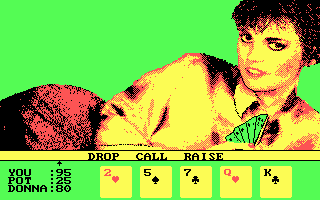
Visual digitized portraits trade realism for horrifying editing
When Anco Software Ltd. released this disk in 1988, the main selling point was the use of digitized photography rather than hand-drawn pixel graphics. At a distance, seeing real photographs converted to PC screen palettes gave the illusion of high technology. The actual execution tells a very different story once you win a few hands and examine the images up close.
To mask flaws in photo digitization or alter facial expressions across different frames, the artists manually painted over the digitized faces using crude editing software. The eyes and mouth areas often feature drawn-on black pupils and thick dark outlines that do not align with the lighting of the original photographs. The result is an unintentional uncanny valley effect where the faces look less like human opponents and more like animated cutout puppets from early television cartoons.
Magazine reviewers at the time were sharply divided over the presentation. *Amiga User International* awarded the title an 8/10 score for its novelty, while *ACE* magazine handed out a dismal 392 out of 1000 rating, calling out the weak card game underlying the graphics. The digitized photos were meant to carry the whole package, but the stark contrast between smooth photographic skin and flat brushstroke eyes makes the visual reward feel bizarre rather than alluring.
Data disks and software tweaks extended the basic engine
Because the core engine of Strip Poker II Plus contains no deep campaign or multi-layered progression, Anco kept the title alive by selling expansion disks. These expansion add-ons let players swap out Donna and Samantha for new sets of digitized opponents without touching the underlying game code. Packs included opponent pairs like Beverley and Dawn, Suzanne and Bianca, or Rachel and Kim.
Anco also published Data Disk #2 featuring Lee and Roy. This pack replaced the standard opponents with male models, a rare inclusion for adult-themed gambling games of that decade. The game architecture treated graphics strictly as loose data files, allowing total swaps of character sets while leaving the standard $5 to $25 betting logic entirely untouched.
For players on home computers like the Commodore family, modifying game memory through system monitor POKEs became a common trick to skip the weak card engine entirely. Entering standard monitor edits allowed players to bypass hand checks and automatically force the opponent to lose their cash stack on demand, demonstrating just how eager players were to bypass the tedious draw routines.
Evaluating the MS-DOS game code today
Taken purely as a poker simulation, this title does not hold up against standard single-player card titles from the late eighties. Without realistic bluffing routines, position play, or varied betting behaviors, the match devolves into a repetitive cycle of pushing maximum bets until the AI folds. The novelty of the digitized portraits wears off quickly due to the heavy-handed touch-ups painted across their faces.
Yet as a slice of software history from Anco Software Ltd., it demonstrates how microcomputer developers scrambled to utilize digitizers and photo conversion tools long before full-motion video became practical. It is worth a brief look for anyone interested in the odd evolution of early PC adult entertainment and early digital art techniques.
You can play Strip Poker II Plus free in your browser right here on this page with no extra setup required. Launch the game, pick your initial bet limit, and try pushing high early stakes against Donna to see how fast the standard AI forfeits its hand.
Players' controls
Touch and gamepad controls
The on-screen keyboard and gamepad mapping the browser player uses on a phone, a tablet or a controller, as opposed to the real keys above. $PRO members make their own in the player and share them here; anyone can pick one to play with.
Make your own touch controlsPRO
- 1Open the editorSign in below, then pick what to make. The game starts with the editor open over it.
- 2Place your keysAdd keys and drag them where your thumbs rest, or map a controller's buttons. Test plays the game with them; Save keeps them, and you play with them from then on.
- 3Share themShare them right after saving in the game, or name and share them here. Players vote, and the best become this game's controls for everyone.
Go PROSee how it worksSign in+20 XP for sharing · +50 XP if yours become the game's own
- The game's own controlsNone yet: played with a real keyboard only.In use
2 screenshots
From the archive
No gameplay video yet
No gameplay video for Strip Poker II Plus yet. Sign in to add one.
No reviews yet
Tell the community what you think of Strip Poker II Plus. Reviews are public and tied to your username.
No archived manuals for Strip Poker II Plus yet
No manuals archived for this title yet. Sign in to upload the first scan.
Cheat codes, console commands and memory pokes for Strip Poker II Plus — each one verified and attributed.
Sign in to submitNo cheats yet for this title
Know a working cheat, poke or trainer? Add it with the button above. Moderators check every entry before it goes live.
No archived soundtrack for Strip Poker II Plus yet
No soundtrack archived for this title yet. Sign in to upload the first rip.
No save states for Strip Poker II Plus yet
No save states for this title yet. Sign in to share one.
Discussions
Sign in to post- Threads0
- Total posts0
- Online now6
Community · Strip Poker II Plus
Who's contributing, and what's new
- Reviews0
- Threads0
- Uploadsapproved0
- Contributors0
Recent activity
Nothing here yet
Reviews, discussion threads and approved uploads appear here as members add them.