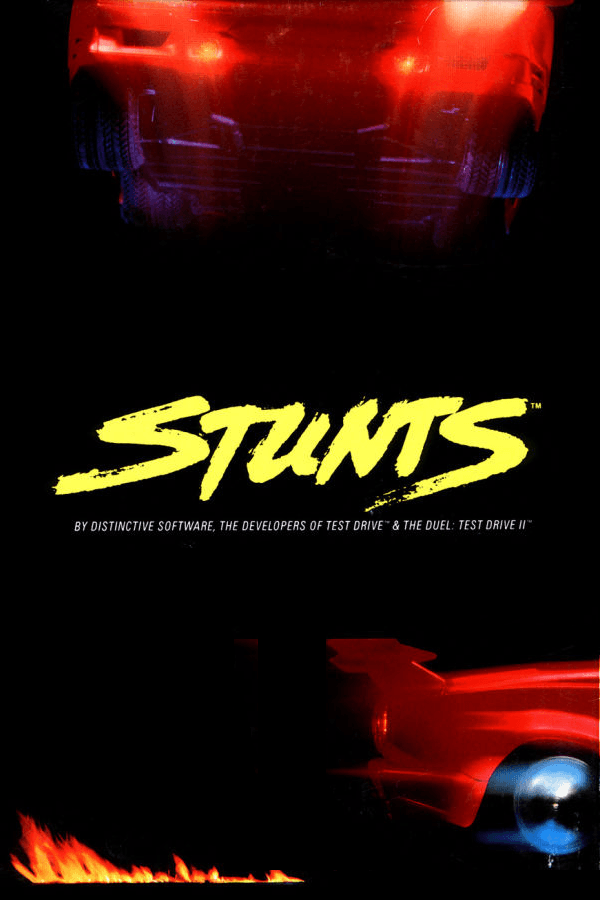
aka 4D Sports Driving · 4D Driving · Skid Marks
In Stunts, taking a simple right-hand turn at seventy miles per hour can send your sports car launching straight off a high concrete ramp, spinning into a double corkscrew, and crashing into the roof of a skyscraper if you miscalculate your line by an inch.
Before you even put your foot on the gas, the game tests you. The original MS-DOS release demanded that you open the printed manual and answer a security question, locating specific words on specific pages just to prove you bought the box. Pass that check, and you drop into a flat, grid-based arena enclosed by a perimeter fence. The engine, coded by Kevin Pickell at Distinctive Software, pulled 3D polygon graphics out of an IBM PC that were directly inspired by the arcade cabinet for Hard Drivin'. You hit the key to launch, the engine whine kicks in through your Sound Blaster or PC Speaker, and the road ahead instantly twists into an absurd obstacle course.
The real fun comes down to how the game handles track design. Beyond the stock courses, the included track editor gives you a top-down grid to drop down loops, slaloms, high bridges, split paths, and massive jumps over water or buildings. If you drive your car into the water surrounding the perimeter, it is destroyed on impact; hit the grass, and your speed instantly drops to a crawl.
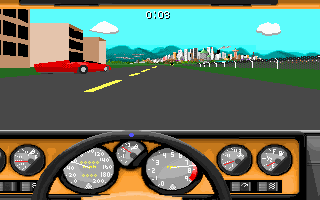
Because the engine is so uncompromising, designed back in 1990 around early 3D polygon geometry, every single track tile demands respect. The handling is precise, meaning pulling off a clean series of aerial tricks feels earned, but the physics are brutal. A tiny bump on a landing ramp can send your vehicle tumbling end over end until it lands as a mangled heap of metal.
While driving solo against the clock is pure trial-and-error fun, racing against the computer reveals the game's biggest flaw. You can select from one of six AI opponents, but they are notoriously easy to beat. The artificial intelligence routinely stumbles over technical stunt geometry, drives far too slowly, and crashes into obstacles on custom-built tracks without much pushing.
If you want a genuine challenge, you end up competing against your own ghost or trading lap times with a friend rather than relying on the computer drivers. Broderbund published the game as Stunts in North America, while Mindscape released it in Europe under the title 4D Sports Driving, but both versions suffer from the exact same dim-witted opponent logic.
What keeps this game playable decades later is its custom system architecture and built-in rewind mechanics. To get smooth performance on older hardware, the developers created a custom executable routine named LOAD.EXE that dynamically swapped out graphics code modules depending on whether your machine had CGA, EGA, MCGA, VGA, Hercules, or Tandy displays.
Even more impressive for its day was the instant replay system. After a race, or mid-crash, you can view your run from four distinct camera angles. More importantly, you can pause the replay, rewind to a point before you flew off a cliff, and hit a key to resume driving directly from that exact moment. That single system took the sting out of the game's unforgiving physics, turning lethal mistakes into simple teaching moments.
The core handling and track construction still hold up exceptionally well, even if the computer opponents are practically helpless. If you want to sample early 3D racing / driving history, you can play Stunts free in your browser right here. There is nothing to install, so you can jump straight into the driver's seat, build a ridiculous track full of double loops, and see how fast you can hit the ramps before wrecking your chassis.
In Stunts, taking a simple right-hand turn at seventy miles per hour can send your sports car launching straight off a high concrete ramp, spinning into a double corkscrew, and crashing into the roof of a skyscraper if you miscalculate your line by an inch.
Before you even put your foot on the gas, the game tests you. The original MS-DOS release demanded that you open the printed manual and answer a security question, locating specific words on specific pages just to prove you bought the box. Pass that check, and you drop into a flat, grid-based arena enclosed by a perimeter fence. The engine, coded by Kevin Pickell at Distinctive Software, pulled 3D polygon graphics out of an IBM PC that were directly inspired by the arcade cabinet for Hard Drivin'. You hit the key to launch, the engine whine kicks in through your Sound Blaster or PC Speaker, and the road ahead instantly twists into an absurd obstacle course.
The real fun comes down to how the game handles track design. Beyond the stock courses, the included track editor gives you a top-down grid to drop down loops, slaloms, high bridges, split paths, and massive jumps over water or buildings. If you drive your car into the water surrounding the perimeter, it is destroyed on impact; hit the grass, and your speed instantly drops to a crawl.

Because the engine is so uncompromising, designed back in 1990 around early 3D polygon geometry, every single track tile demands respect. The handling is precise, meaning pulling off a clean series of aerial tricks feels earned, but the physics are brutal. A tiny bump on a landing ramp can send your vehicle tumbling end over end until it lands as a mangled heap of metal.
While driving solo against the clock is pure trial-and-error fun, racing against the computer reveals the game's biggest flaw. You can select from one of six AI opponents, but they are notoriously easy to beat. The artificial intelligence routinely stumbles over technical stunt geometry, drives far too slowly, and crashes into obstacles on custom-built tracks without much pushing.
If you want a genuine challenge, you end up competing against your own ghost or trading lap times with a friend rather than relying on the computer drivers. Broderbund published the game as Stunts in North America, while Mindscape released it in Europe under the title 4D Sports Driving, but both versions suffer from the exact same dim-witted opponent logic.

What keeps this game playable decades later is its custom system architecture and built-in rewind mechanics. To get smooth performance on older hardware, the developers created a custom executable routine named LOAD.EXE that dynamically swapped out graphics code modules depending on whether your machine had CGA, EGA, MCGA, VGA, Hercules, or Tandy displays.
Even more impressive for its day was the instant replay system. After a race, or mid-crash, you can view your run from four distinct camera angles. More importantly, you can pause the replay, rewind to a point before you flew off a cliff, and hit a key to resume driving directly from that exact moment. That single system took the sting out of the game's unforgiving physics, turning lethal mistakes into simple teaching moments.
The core handling and track construction still hold up exceptionally well, even if the computer opponents are practically helpless. If you want to sample early 3D racing / driving history, you can play Stunts free in your browser right here. There is nothing to install, so you can jump straight into the driver's seat, build a ridiculous track full of double loops, and see how fast you can hit the ramps before wrecking your chassis.
How Stunts is played — the keys the game listens to, grouped by what they do.
Highlighted keys are mapped — hover or tap one to see what it does.
Input controls and game options can be chosen or configured via SETUP.EXE or the options screen.
The on-screen keyboard and gamepad mapping the browser player uses on a phone, a tablet or a controller, as opposed to the real keys above. $PRO members make their own in the player and share them here; anyone can pick one to play with.
Cheat codes, console commands and memory pokes for Stunts — each one verified and attributed.
Sign in to submitHow Stunts is played — the keys the game listens to, grouped by what they do.
Highlighted keys are mapped — hover or tap one to see what it does.
Input controls and game options can be chosen or configured via SETUP.EXE or the options screen.
The on-screen keyboard and gamepad mapping the browser player uses on a phone, a tablet or a controller, as opposed to the real keys above. $PRO members make their own in the player and share them here; anyone can pick one to play with.
Cheat codes, console commands and memory pokes for Stunts — each one verified and attributed.
Sign in to submit