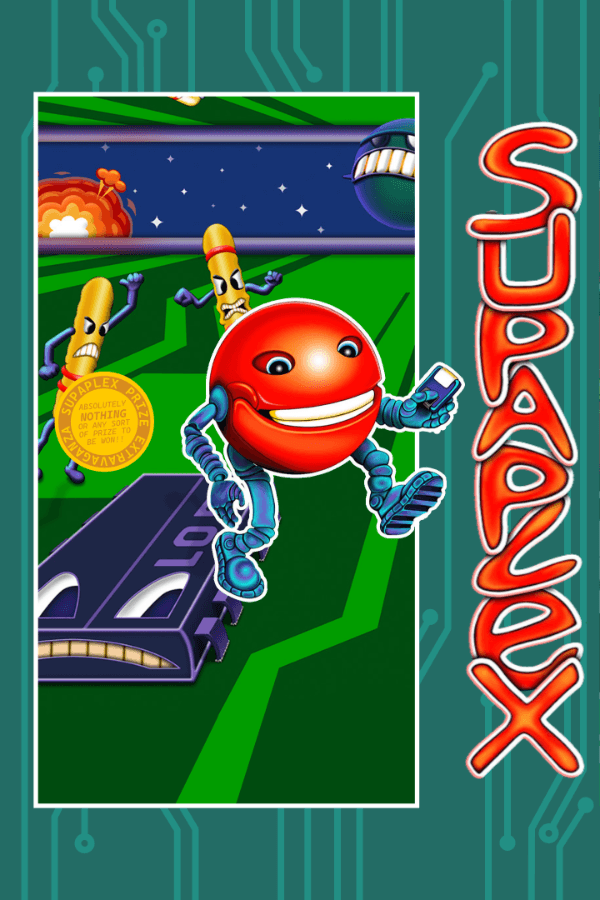

Supaplex takes the classic action-puzzle formula and rewires it into a punishing trial set inside a 1990s computer chassis. Playing as a round red creature named Murphy, you must chew through circuit boards and dodge falling boulders to gather data before finding the exit.
A circuit board built to punish small mistakes
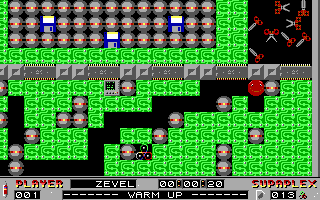
Most puzzle games give you time to think, but this one prefers to drop a rock on your head while you are mid-thought. You guide Murphy through a scrolling grid of green circuit board tiles, eating away soft RAM chips to clear paths while trying to gather a set number of Infotrons. These items look like a cross between an atom and a pretzel, and collecting enough of them opens the single exit tile marked with an exit symbol. Standing in your way are falling Zonks, moving scissor-like Snik Snaks, and volatile Electrons that explode into fresh Infotrons when touched by an explosion.
The mechanics look simple at first glance, but the interaction between objects creates a tight web of hazard. You deal with three distinct types of explosive utility disks throughout the 111 levels:
- Orange disks: behave like Zonks, falling straight down and detonating on impact with anything below them.
- Yellow disks: remain motionless until pushed into position and detonated remotely using a computer terminal tile.
- Red disks: stored in your inventory and placed on the board as timed landmines to clear away stubborn hardware walls.
What sets the game apart from typical grid puzzles is its subtle physics quirk. Objects do not hard-snap instantly to grid coordinates, allowing Murphy to catch half-step positions. If you tap the control keys with precise rhythm, you can cause a falling Zonk or an aggressive enemy to bounce harmlessly off Murphy while changing direction. That small window of physical leniency is often the only thing keeping you alive in dense level layouts like "Crazy Harry" or "Collector".
Why European gaming magazines completely split on Supaplex
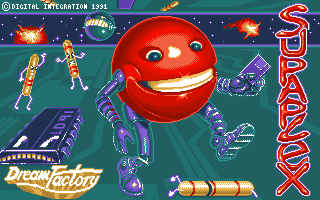
Created by Swiss student developers Philip Jespersen and Michael Stopp under the name Think!Ware Development, the project began on the Amiga before being ported line-by-line to MS-DOS. Publisher Digital Integration released the title under their Dream Factory imprint in 1991. The team had to squeeze the entire game into 512 kB of system memory so it could ship on a single floppy disk, relying on sharp Sound Blaster and AdLib audio drivers to deliver metallic crunch effects alongside crisp internal PC speaker bleeps.
When the game arrived at magazine review desks, critics could not agree on whether the design was brilliant or sadistic. Digital Integration Ltd. watched as Amiga Action awarded an 84% score, while Amiga Power slammed it with a dismal 29% review. The reviewer at Amiga Power pointed out that a single misstep or misplaced disk twenty minutes into a puzzle could render the entire stage uncompletable, forcing an immediate restart. Amiga Joker was similarly cool at 39%, while German publication Aktueller Software Markt landed in the middle with a 7/12 rating.
Despite the lukewarm press reviews, players on office networks and school computer labs fell in love with it. It became an underground hit across bulletin board systems, finding a massive, lasting fanbase in Israel during the early PC gaming boom. Players recognized that behind the harsh retry loop lay a deeply rewarding set of spatial problems that demanded careful spatial planning rather than quick reflexes.
Fixing the speed bug and skipping past impossible levels
The developers knew their levels were hard, so they built in an unusually generous safety valve for a 1991 release. If you hit a brick wall on a stage like "Easy Business", the menu allows you to skip up to three levels at a time. You can play forward through subsequent levels and return to solve the skipped puzzles later once your spatial timing improves. Without that system, most players would have abandoned the game before seeing even a third of its content.
As PC hardware accelerated throughout the nineties, a severe bug emerged. The game code tied its internal loop directly to CPU clock speeds rather than a fixed hardware timer, causing Murphy and hazards to move at twice their normal speed on faster machines. The game became practically unplayable until fan developer Herman Perk disassembled the code and released a custom "SpeedFix" patch that stabilized the frame rates across modern processors.
The original authors eventually released the game as freeware, allowing fan ports like Megaplex to flourish alongside modern conversions. Today, it fits right alongside classic releases in the puzzle genre because its strict logic design means every object on screen serves a clear purpose.
Fire up this Supaplex MS-DOS game directly in your browser
If you enjoy tight spatial logic where every move carries real consequences, this is still one of the sharpest challenges available from the MS-DOS era. The lack of mid-level saves forces you to map out every movement, but untangling a complex web of gravity switches, color-coded disks, and one-way ports remains immensely satisfying.
You can play Supaplex online for free in your browser right now, with no extra setup required. Launch the game, start on the early levels to get a feel for how Murphy handles momentum against falling Zonks, and see if you can clear the board without using up your three level skips.