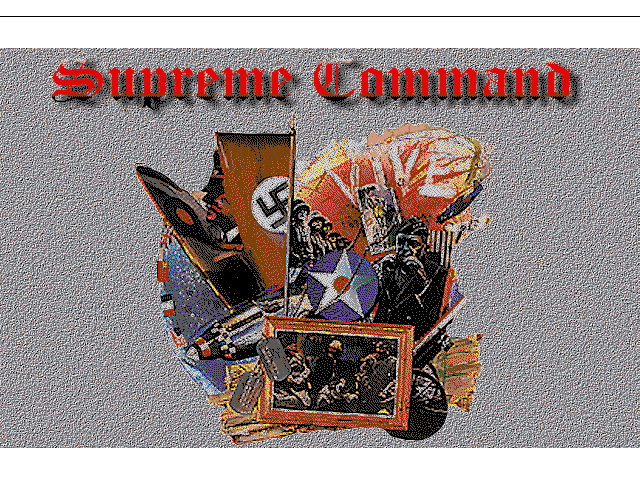
Supreme Command drops you into the Allied invasion of Europe using drop-down menus, turn-based counters, and static maps to win World War II.
Canadian developer Entrex Software built Supreme Command using the engine behind their historical strategy title Knights & Kings. Instead of medieval battlefields, this game asks you to organize armies and manage logistical shifts across the European theater in high-resolution VGA or standard EGA modes.
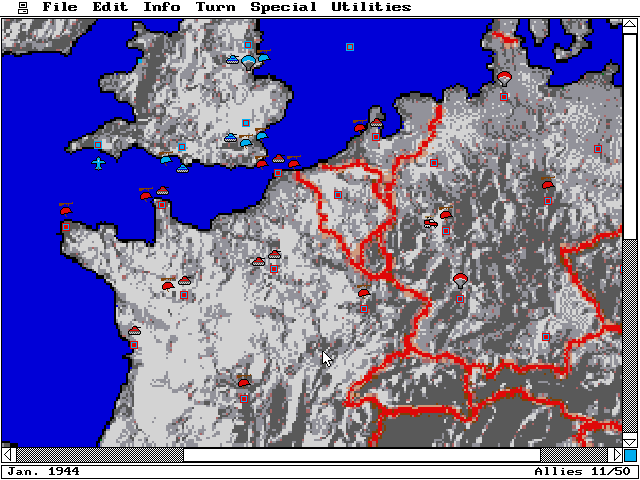
You interact with the theater entirely through top drop-down menus and mouse clicks. The display relies on traditional board-game counters laid out over region maps, giving you a top-down view of the western front.
Audio is minimal, relying on Sound Blaster support for the main title screen and basic combat sound effects. Outside of small digital pops during battle calculations, the war proceeds in absolute silence.
Entrex Software marketed this title as an educational program. It even appeared on the Entrex Home Education CD Library Volume 1 disc alongside other teaching tools. Anyone opening the game expecting detailed historical context will end up disappointed.
The game skips historical facts entirely. You will not find lists of historic generals, technical balance-of-power breakdowns, or dates for key battles. Instead, the game greets you with short introductory texts before tossing you right onto the strategic map.
That design choice leaves a strange empty space in the middle of the game loop. The simulation assumes you already know the chronology of the Allied push, doing very little to explain the broader historical context of your actions.
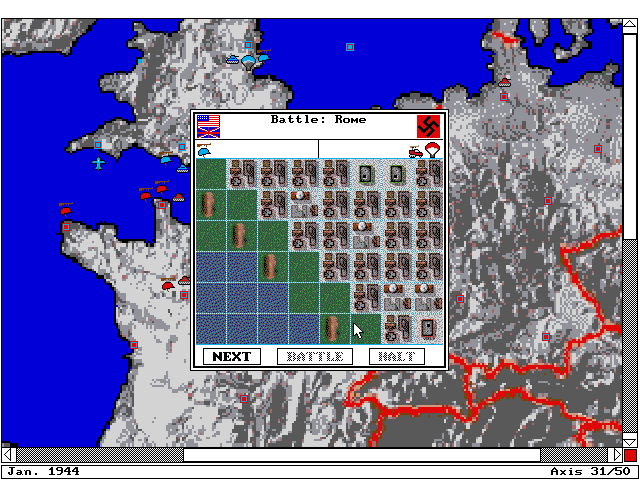
A typical turn involves checking your unit lines through the drop-down menus, adjusting force distributions, and sending divisions into adjacent territories. Because the interface relies entirely on nested menu picks, routine operations take far too many clicks.
The real issue comes from missing operational information. The game rarely clarifies how local terrain, supply line strength, or opposing force composition affect combat calculations. You send your counters forward and hope the numbers roll in your favor.
This lack of visible operational feedback makes planning a long-term campaign frustrating. When an attack fails, the game rarely tells you why. You are left guessing whether bad luck, supply shortages, or poor troop balance caused the loss.
By the time this game came out, players interested in strategy games had sophisticated options. The classic strategy market in 1995 offered deep economic systems, detailed tactical battle maps, and comprehensive civilopedia mechanics.
Next to its contemporaries, this release feels like a simplified desktop utility rather than a full wargame. It lacks cheat codes, hidden easter eggs, or deep operational settings to tweak. The experience remains strictly focused on shifting force numbers across static regions.
This title from Entrex Software sits in an obscure corner of MS-DOS wargaming history. Strategy completionists hunting down every strange take on the Western Front are the ones who will want to play it.
You can test your strategic skills right now. You can play Supreme Command online without downloading extra files or tweaking memory settings in MS-DOS.
The game launches directly in your web browser, allowing you to explore this rare 1995 strategy title in seconds. Jump straight into the drop-down menus, take control of the European theater, and see how your operational decisions hold up on the map.
Supreme Command drops you into the Allied invasion of Europe using drop-down menus, turn-based counters, and static maps to win World War II.
Canadian developer Entrex Software built Supreme Command using the engine behind their historical strategy title Knights & Kings. Instead of medieval battlefields, this game asks you to organize armies and manage logistical shifts across the European theater in high-resolution VGA or standard EGA modes.
You interact with the theater entirely through top drop-down menus and mouse clicks. The display relies on traditional board-game counters laid out over region maps, giving you a top-down view of the western front.
Audio is minimal, relying on Sound Blaster support for the main title screen and basic combat sound effects. Outside of small digital pops during battle calculations, the war proceeds in absolute silence.
Entrex Software marketed this title as an educational program. It even appeared on the Entrex Home Education CD Library Volume 1 disc alongside other teaching tools. Anyone opening the game expecting detailed historical context will end up disappointed.
The game skips historical facts entirely. You will not find lists of historic generals, technical balance-of-power breakdowns, or dates for key battles. Instead, the game greets you with short introductory texts before tossing you right onto the strategic map.
That design choice leaves a strange empty space in the middle of the game loop. The simulation assumes you already know the chronology of the Allied push, doing very little to explain the broader historical context of your actions.
A typical turn involves checking your unit lines through the drop-down menus, adjusting force distributions, and sending divisions into adjacent territories. Because the interface relies entirely on nested menu picks, routine operations take far too many clicks.
The real issue comes from missing operational information. The game rarely clarifies how local terrain, supply line strength, or opposing force composition affect combat calculations. You send your counters forward and hope the numbers roll in your favor.
This lack of visible operational feedback makes planning a long-term campaign frustrating. When an attack fails, the game rarely tells you why. You are left guessing whether bad luck, supply shortages, or poor troop balance caused the loss.
By the time this game came out, players interested in strategy games had sophisticated options. The classic strategy market in 1995 offered deep economic systems, detailed tactical battle maps, and comprehensive civilopedia mechanics.
Next to its contemporaries, this release feels like a simplified desktop utility rather than a full wargame. It lacks cheat codes, hidden easter eggs, or deep operational settings to tweak. The experience remains strictly focused on shifting force numbers across static regions.
This title from Entrex Software sits in an obscure corner of MS-DOS wargaming history. Strategy completionists hunting down every strange take on the Western Front are the ones who will want to play it.
You can test your strategic skills right now. You can play Supreme Command online without downloading extra files or tweaking memory settings in MS-DOS.
The game launches directly in your web browser, allowing you to explore this rare 1995 strategy title in seconds. Jump straight into the drop-down menus, take control of the European theater, and see how your operational decisions hold up on the map.
How Supreme Command is played — the keys the game listens to, grouped by what they do.
Highlighted keys are mapped — hover or tap one to see what it does.
The game operates primarily via mouse using top pull-down menus and interface buttons.
The on-screen keyboard and gamepad mapping the browser player uses on a phone, a tablet or a controller, as opposed to the real keys above. $PRO members make their own in the player and share them here; anyone can pick one to play with.
Cheat codes, console commands and memory pokes for Supreme Command — each one verified and attributed.
Sign in to submitHow Supreme Command is played — the keys the game listens to, grouped by what they do.
Highlighted keys are mapped — hover or tap one to see what it does.
The game operates primarily via mouse using top pull-down menus and interface buttons.
The on-screen keyboard and gamepad mapping the browser player uses on a phone, a tablet or a controller, as opposed to the real keys above. $PRO members make their own in the player and share them here; anyone can pick one to play with.
Cheat codes, console commands and memory pokes for Supreme Command — each one verified and attributed.
Sign in to submit