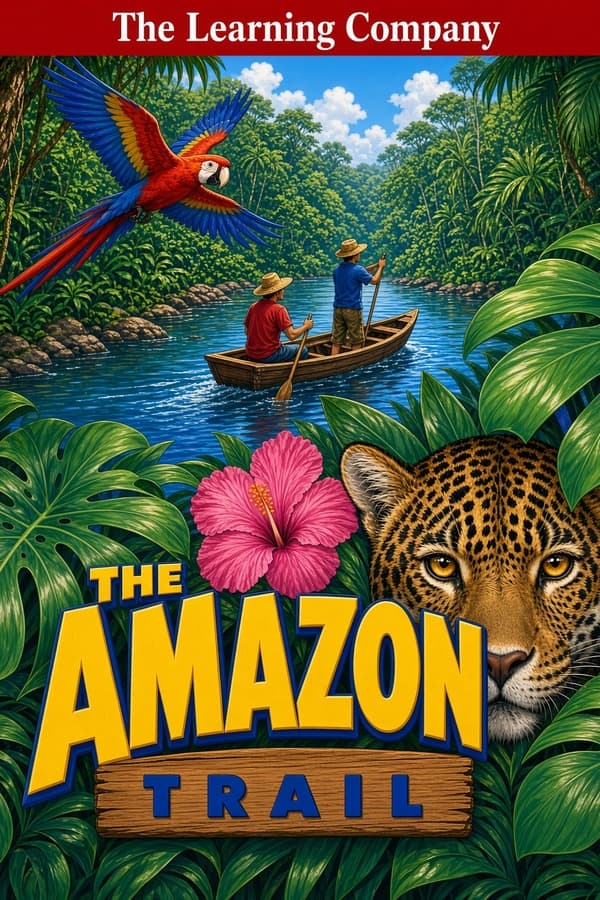
aka Expédition Amazone
The Amazon Trail swaps the dusty pioneer wagons of North America for a grueling canoe trip down South America's longest river, where one wrong turn leaves you lost in the jungle or dead from malaria.
By 1993, Minnesota Educational Computing Corporation had perfected a very specific formula: teach kids history by giving them dysentery and watching them starve in the wilderness. When MECC decided to build a follow-up set in South America, they traded covered wagons for canoes and high plains for dense rainforests. The goal was to tie geography, ecology, and native history into a single narrative quest. The result was The Amazon Trail, an educational title that proved vastly more stressful than its North American predecessor.
Your journey begins in Peru, Indiana, where a black jaguar appears in your dreams. The animal claims to serve the Inca King and tasks you with traveling back in time to deliver cinchona plant tissue (quinine) to save his people from malaria and European invasion. To complete the mission, you must navigate thousands of miles of tributaries to reach the hidden city of Vilcabamba. Along the way, you select a local guide, pack supplies, and manage your health while paddling through dangerous waters.
The core loop sounds straightforward on paper, but executing it requires agonizing patience. You steer your canoe down river paths, using maps and your guide's advice to pick the correct branches at each fork. Choosing the wrong tributary means getting lost, falling victim to headhunters, or running out of food far from your target. The historical element arrives via mysterious blue mist hovering over the water. Passing through this fog triggers encounters with historical figures, naturalists, and native inhabitants who talk about the region and trade vital supplies.
Surviving the trip relies on two action mini-games that generated endless frustration on school computer labs. Fishing is mandatory to keep your food stocks up, requiring you to aim a spear at fast-moving silhouettes beneath the surface. Many players found the fishing mechanics heavily reliant on sheer luck rather than skill. The canoe steering sections were equally punishing, demanding quick reactions to avoid sharp rocks and capsizing in the current.
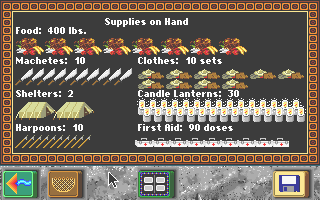
When you play The Amazon Trail online today, it is easy to forget how demanding the MS-DOS original was at launch. Period reviews in publications like Computer Gaming World noted its heavy system requirements, which brought mid-range 386 and early 486 PCs to their knees. The game made heavy use of digitized photographs of real rainforest flora and fauna alongside authentic audio recordings captured directly from the Amazon basin. Hearing jungle birds screech through a Sound Blaster card was impressive, but the high resolution assets meant frequent loading stutters on older hardware.
The presentation pulled players into its world, but the extreme difficulty wall often turned them away. You could contract yellow fever or malaria without warning, watching your health bar collapse before you even learned which supply cured it. Home of the Underdogs rightly pointed out that the linear nature of the river map made it far less forgiving than The Oregon Trail. One bad decision early on guaranteed a slow, inevitable death two hours downriver.
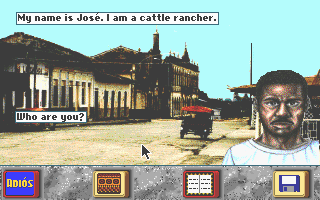
Despite the agonizing difficulty, The Amazon Trail became a massive commercial success, selling over a million copies across its original release and subsequent CD-ROM upgrades. Kids who played it in school still remember the distinctive voice lines that echoed across computer rooms. The voice actor shouting "Sinchooonaaaaa!" lives rent-free in the heads of an entire generation, right alongside the talking toucan and the ultimate reward screen declaring that the Inca King is pleased with your success.
The game rewarded genuine curiosity. Taking photos of obscure plants and identifying rare animals with your camera added points to your final score, encouraging you to pay attention to the environment rather than just rushing to the end. Few educational games in the 1990s aimed that high, even if its brutal arcade sequences pushed many players to rage-quit before reaching Vilcabamba.
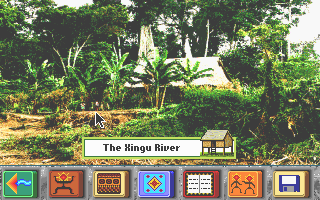
The spearfishing mechanics remain genuinely infuriating, and the sudden disease deaths feel just as unfair now as they did thirty years ago. Yet the digitized jungle atmosphere, detailed encyclopedia features, and sheer tension of river navigation hold up surprisingly well. If you want to experience a brutal chapter of retro PC gaming, you can play The Amazon Trail free in your browser right now. There is nothing to install and no setup required, so pack your medicine chest, watch out for the fog, and see if you can reach the King in one piece.
The Amazon Trail swaps the dusty pioneer wagons of North America for a grueling canoe trip down South America's longest river, where one wrong turn leaves you lost in the jungle or dead from malaria.
By 1993, Minnesota Educational Computing Corporation had perfected a very specific formula: teach kids history by giving them dysentery and watching them starve in the wilderness. When MECC decided to build a follow-up set in South America, they traded covered wagons for canoes and high plains for dense rainforests. The goal was to tie geography, ecology, and native history into a single narrative quest. The result was The Amazon Trail, an educational title that proved vastly more stressful than its North American predecessor.
Your journey begins in Peru, Indiana, where a black jaguar appears in your dreams. The animal claims to serve the Inca King and tasks you with traveling back in time to deliver cinchona plant tissue (quinine) to save his people from malaria and European invasion. To complete the mission, you must navigate thousands of miles of tributaries to reach the hidden city of Vilcabamba. Along the way, you select a local guide, pack supplies, and manage your health while paddling through dangerous waters.
The core loop sounds straightforward on paper, but executing it requires agonizing patience. You steer your canoe down river paths, using maps and your guide's advice to pick the correct branches at each fork. Choosing the wrong tributary means getting lost, falling victim to headhunters, or running out of food far from your target. The historical element arrives via mysterious blue mist hovering over the water. Passing through this fog triggers encounters with historical figures, naturalists, and native inhabitants who talk about the region and trade vital supplies.
Surviving the trip relies on two action mini-games that generated endless frustration on school computer labs. Fishing is mandatory to keep your food stocks up, requiring you to aim a spear at fast-moving silhouettes beneath the surface. Many players found the fishing mechanics heavily reliant on sheer luck rather than skill. The canoe steering sections were equally punishing, demanding quick reactions to avoid sharp rocks and capsizing in the current.

When you play The Amazon Trail online today, it is easy to forget how demanding the MS-DOS original was at launch. Period reviews in publications like Computer Gaming World noted its heavy system requirements, which brought mid-range 386 and early 486 PCs to their knees. The game made heavy use of digitized photographs of real rainforest flora and fauna alongside authentic audio recordings captured directly from the Amazon basin. Hearing jungle birds screech through a Sound Blaster card was impressive, but the high resolution assets meant frequent loading stutters on older hardware.
The presentation pulled players into its world, but the extreme difficulty wall often turned them away. You could contract yellow fever or malaria without warning, watching your health bar collapse before you even learned which supply cured it. Home of the Underdogs rightly pointed out that the linear nature of the river map made it far less forgiving than The Oregon Trail. One bad decision early on guaranteed a slow, inevitable death two hours downriver.

Despite the agonizing difficulty, The Amazon Trail became a massive commercial success, selling over a million copies across its original release and subsequent CD-ROM upgrades. Kids who played it in school still remember the distinctive voice lines that echoed across computer rooms. The voice actor shouting "Sinchooonaaaaa!" lives rent-free in the heads of an entire generation, right alongside the talking toucan and the ultimate reward screen declaring that the Inca King is pleased with your success.
The game rewarded genuine curiosity. Taking photos of obscure plants and identifying rare animals with your camera added points to your final score, encouraging you to pay attention to the environment rather than just rushing to the end. Few educational games in the 1990s aimed that high, even if its brutal arcade sequences pushed many players to rage-quit before reaching Vilcabamba.

The spearfishing mechanics remain genuinely infuriating, and the sudden disease deaths feel just as unfair now as they did thirty years ago. Yet the digitized jungle atmosphere, detailed encyclopedia features, and sheer tension of river navigation hold up surprisingly well. If you want to experience a brutal chapter of retro PC gaming, you can play The Amazon Trail free in your browser right now. There is nothing to install and no setup required, so pack your medicine chest, watch out for the fog, and see if you can reach the King in one piece.
How The Amazon Trail is played — the keys the game listens to, grouped by what they do.
Highlighted keys are mapped — hover or tap one to see what it does.
The game primarily relies on mouse input for navigation, selection, and mini-games, with keyboard input used for text entry and confirm/arrow actions.
The on-screen keyboard and gamepad mapping the browser player uses on a phone, a tablet or a controller, as opposed to the real keys above. $PRO members make their own in the player and share them here; anyone can pick one to play with.
Cheat codes, console commands and memory pokes for The Amazon Trail — each one verified and attributed.
Sign in to submitHow The Amazon Trail is played — the keys the game listens to, grouped by what they do.
Highlighted keys are mapped — hover or tap one to see what it does.
The game primarily relies on mouse input for navigation, selection, and mini-games, with keyboard input used for text entry and confirm/arrow actions.
The on-screen keyboard and gamepad mapping the browser player uses on a phone, a tablet or a controller, as opposed to the real keys above. $PRO members make their own in the player and share them here; anyone can pick one to play with.
Cheat codes, console commands and memory pokes for The Amazon Trail — each one verified and attributed.
Sign in to submit