
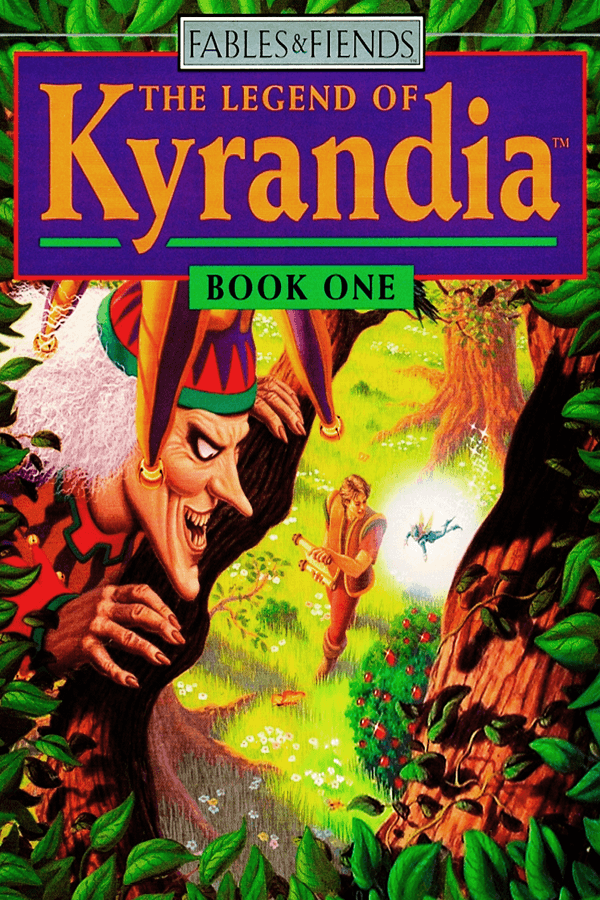

The Legend of Kyrandia: Book One abandons the wall of verb buttons used by its contemporaries in favor of a clean interface, but it offsets that friendliness with a brutal dark maze and a strict inventory limit.
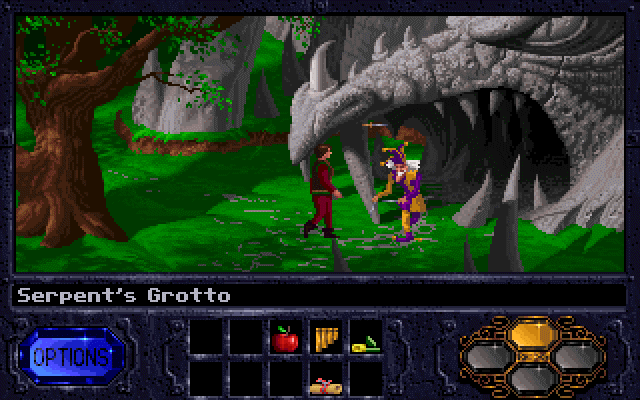
When you start The Legend of Kyrandia: Book One, the lack of an interface panel is the first detail you notice. Developed by Westwood Studios, Inc. and published by Virgin Interactive Entertainment, Inc., this 1992 release stripped away the standard verb grids seen in Sierra and LucasArts titles. Moving your mouse across the scene changes the cursor into a context-sensitive action automatically, letting you interact directly with objects without managing menus.
Your journey begins in the home of Kallak, a wizard turned to stone by the psychotic court jester Malcolm. Malcolm leaves Kallak with only his eyes intact so the old man can weep for the kingdom. As Brandon, Kallak's grandson, you pick up a saw and step into the Timbermist Woods. Items you grab match their exact visual scale whether sitting in the environment or stored in your inventory pouch at the bottom of the screen.
This minimalist point-and-click layout keeps the screen clear, allowing Rick Parks' high-resolution background art to take center stage. The audio design shines equally bright across period hardware. Frank Klepacki composed a soundtrack that takes full advantage of Roland MT-32 synth modules, while still delivering distinct tunes through standard Sound Blaster hardware or a basic PC speaker.
The gentle presentation hides design traps that punished uncareful players. Your inventory holds only ten items at a time. Because many quest puzzles require combining gems or brewing potions across different regions, you frequently have to leave vital quest items on the forest floor. You end up creating makeshift dump sites near key junctions, forcing constant backtracking when you realize a forgotten stone or flower was critical to a later puzzle.
The infamous Serpent's Cave maze is where the game gets brutally hard. This pitch-black labyrinth requires you to carry glowing fireflies room by room to light your path. If you step into a dark screen without a light source, monster eyes appear in the shadows and kill Brandon immediately. The fireflies drop off after a few transitions, meaning a wrong turn easily results in a sudden game over screen.
Soft-locks and dead-end scenarios pose a constant threat throughout the late game. If you waste critical potion ingredients or leave essential magic items behind before entering new areas, you can ruin a save file entirely. Dragon Magazine gave the game five out of five stars upon release, but retrospective articles rightly point out that its trial-and-error design forces heavy reliance on save management.
The original floppy release carried a famous easter egg in its early pressings. When attempting to cross an underground lava bridge without proper protection, Brandon would scream an uncensored line of profanity before perishing. Westwood altered this line in later printings to keep the tone safe for store shelves.
In 1993, Westwood released a CD-ROM talkie version that added full voice acting for every character. Joseph D. Kucan, who later gained fame playing Kane in Westwood's Command & Conquer series, provided the voice for Prince Brandon. Hearing the dialogue spoken aloud changed the dynamic of Brandon's interactions with magical figures like Zanthia the alchemist and Darm the wizard.
Despite its harsh puzzle traps, the core magic mechanics remain fun to experiment with. Brandon eventually fills a magical amulet with four distinct powers: turning into a floating wisp, healing damaged objects, casting invisibility, and summoning ice over flames. These spells offer clean solutions to regional obstacles, such as freezing lava channels or slipping past hostile guardians on Dark Island.
While the overall narrative follows standard high-fantasy tropes, the game succeeds because of its art direction, compact world, and experimental interface mechanics. It launched a memorable trilogy that continued through two direct sequels, solidifying Westwood's talent outside the real-time strategy genre. The pure adventure game structure tested how far developers could simplify point-and-click interactions without stripping away puzzle complexity.
You can experience this classic MS-DOS game directly in your browser. Navigating the Serpent's Cave and solving the jewel puzzles of Castle Kyrandia takes only a few moments to launch. You can play The Legend of Kyrandia: Book One online free in your browser right now, with no extra setup required, to see how Westwood reshaped MS-DOS quest design.
The Legend of Kyrandia: Book One abandons the wall of verb buttons used by its contemporaries in favor of a clean interface, but it offsets that friendliness with a brutal dark maze and a strict inventory limit.
When you start The Legend of Kyrandia: Book One, the lack of an interface panel is the first detail you notice. Developed by Westwood Studios, Inc. and published by Virgin Interactive Entertainment, Inc., this 1992 release stripped away the standard verb grids seen in Sierra and LucasArts titles. Moving your mouse across the scene changes the cursor into a context-sensitive action automatically, letting you interact directly with objects without managing menus.
Your journey begins in the home of Kallak, a wizard turned to stone by the psychotic court jester Malcolm. Malcolm leaves Kallak with only his eyes intact so the old man can weep for the kingdom. As Brandon, Kallak's grandson, you pick up a saw and step into the Timbermist Woods. Items you grab match their exact visual scale whether sitting in the environment or stored in your inventory pouch at the bottom of the screen.
This minimalist point-and-click layout keeps the screen clear, allowing Rick Parks' high-resolution background art to take center stage. The audio design shines equally bright across period hardware. Frank Klepacki composed a soundtrack that takes full advantage of Roland MT-32 synth modules, while still delivering distinct tunes through standard Sound Blaster hardware or a basic PC speaker.
The gentle presentation hides design traps that punished uncareful players. Your inventory holds only ten items at a time. Because many quest puzzles require combining gems or brewing potions across different regions, you frequently have to leave vital quest items on the forest floor. You end up creating makeshift dump sites near key junctions, forcing constant backtracking when you realize a forgotten stone or flower was critical to a later puzzle.
The infamous Serpent's Cave maze is where the game gets brutally hard. This pitch-black labyrinth requires you to carry glowing fireflies room by room to light your path. If you step into a dark screen without a light source, monster eyes appear in the shadows and kill Brandon immediately. The fireflies drop off after a few transitions, meaning a wrong turn easily results in a sudden game over screen.
Soft-locks and dead-end scenarios pose a constant threat throughout the late game. If you waste critical potion ingredients or leave essential magic items behind before entering new areas, you can ruin a save file entirely. Dragon Magazine gave the game five out of five stars upon release, but retrospective articles rightly point out that its trial-and-error design forces heavy reliance on save management.
The original floppy release carried a famous easter egg in its early pressings. When attempting to cross an underground lava bridge without proper protection, Brandon would scream an uncensored line of profanity before perishing. Westwood altered this line in later printings to keep the tone safe for store shelves.
In 1993, Westwood released a CD-ROM talkie version that added full voice acting for every character. Joseph D. Kucan, who later gained fame playing Kane in Westwood's Command & Conquer series, provided the voice for Prince Brandon. Hearing the dialogue spoken aloud changed the dynamic of Brandon's interactions with magical figures like Zanthia the alchemist and Darm the wizard.
Despite its harsh puzzle traps, the core magic mechanics remain fun to experiment with. Brandon eventually fills a magical amulet with four distinct powers: turning into a floating wisp, healing damaged objects, casting invisibility, and summoning ice over flames. These spells offer clean solutions to regional obstacles, such as freezing lava channels or slipping past hostile guardians on Dark Island.
While the overall narrative follows standard high-fantasy tropes, the game succeeds because of its art direction, compact world, and experimental interface mechanics. It launched a memorable trilogy that continued through two direct sequels, solidifying Westwood's talent outside the real-time strategy genre. The pure adventure game structure tested how far developers could simplify point-and-click interactions without stripping away puzzle complexity.
You can experience this classic MS-DOS game directly in your browser. Navigating the Serpent's Cave and solving the jewel puzzles of Castle Kyrandia takes only a few moments to launch. You can play The Legend of Kyrandia: Book One online free in your browser right now, with no extra setup required, to see how Westwood reshaped MS-DOS quest design.
How The Legend of Kyrandia: Book One is played — the keys the game listens to, grouped by what they do.
Highlighted keys are mapped — hover or tap one to see what it does.
The game is played primarily via point-and-click mouse controls. Keyboard shortcuts were not specified in the documentation.
Cheat codes, console commands and memory pokes for The Legend of Kyrandia: Book One — each one verified and attributed.
Sign in to submitHow The Legend of Kyrandia: Book One is played — the keys the game listens to, grouped by what they do.
Highlighted keys are mapped — hover or tap one to see what it does.
The game is played primarily via point-and-click mouse controls. Keyboard shortcuts were not specified in the documentation.
Cheat codes, console commands and memory pokes for The Legend of Kyrandia: Book One — each one verified and attributed.
Sign in to submit