


Long before modern digital storefronts and online lobbies, The Sierra Network brought dial-up PC gamers into a graphical virtual world filled with card tables, flight simulators, and dungeon crawlers.
Solving the Isolation of Early PC Gaming
In 1989, Sierra On-Line co-founder Ken Williams set out to solve a fundamental problem of early home computing: playing games on an MS-DOS machine was a solitary experience. Mainstream online services at the time relied almost entirely on text menus and slow command prompts, leaving little room for visual play. Designed as an accessible graphical platform, Sierra On-Line created an environment where players dialed directly into a central hub to chat and play together over standard telephone lines.
When the platform launched on May 6, 1991, it presented players with a full visual map rather than a list of text commands. Everything ran through a custom client that managed both the modem connections and the graphical interface, allowing users to move between rooms with a mouse click. It turned the solitary PC into a shared club, provided your phone line was free and your modem could keep up.
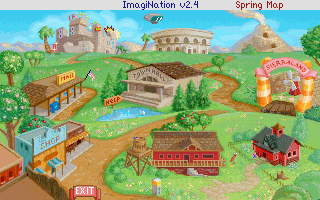
Exploring the Lands of The Sierra Network
Instead of burying content behind dense directory structures, the service organized its offerings into distinct graphical hubs. After connecting with a 2400 baud modem, you entered a virtual neighborhood containing destinations tailored to different interests and age groups.
- Town Hall handled account administration, customer support, and billing updates.
- The Post Office allowed members to compose and send internal email to fellow players.
- The Mall acted as a mail-order shop for physical Sierra titles and branded merchandise.
- The Clubhouse offered traditional board and card games like chess, checkers, bridge, backgammon, hearts, and cribbage.
- SierraLand gathered casual activities like miniature golf, a group drawing canvas called Graffiti, and a networked flight simulator.
- LarryLand catered to adults with virtual casino games such as Super Get Lucky Slots and a digital bar for socializing.
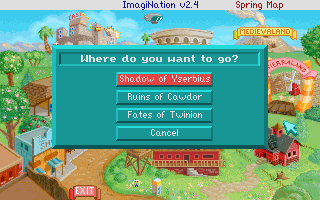
- MedievaLand housed the service's biggest attraction, the multiplayer first-person dungeon crawler The Shadow of Yserbius.
Avatars and Air Combat in The Sierra Network
Before jumping into a game of cards or stepping into a dungeon, you created a digital persona using the built-in "Facemaker" system. By mixing and matching hair styles, eyes, noses, and mouths, players could construct over 84 million unique avatar combinations. This graphic representation followed you into every room, allowing opponents across the country to see your face at the card table.
The individual games varied widely in technical ambition. When Sierra decided to include an online version of their hit flight simulator Red Baron, original creator Damon Slye declined to code it, arguing that dial-up latency was too unpredictable for fast-paced aerial dogfights. Sierra assigned the task to an internal team instead, building a customized dogfighting engine specifically for network play.
Meanwhile, simpler titles like miniature golf drew plenty of players. Computer Gaming World highlighted the mini-golf module for its inventive course layouts and the ability for players to comment or exchange light insults using the built-in chat function while waiting for an opponent to putt.
High Costs and Slow Speeds in MedievaLand
While casual card games kept the Clubhouse busy, The Shadow of Yserbius became the platform's runaway success, accounting for nearly half of all user traffic on the network. Up to six players could form a party to explore the deep corridors of Mount Yserbius, fighting monsters and hunting for loot in turn-based tactical combat. The social dynamic was so essential to the game that when Sierra later released a standalone offline version, reviewer Bernie Yee noted that removing the online interaction left behind a hollow shell of the original game.

Yet living inside this virtual world came with steep hardware and financial hurdles. Getting online required an IBM-compatible 286 or 386 PC with at least 580K of available conventional memory, VGA graphics, and a Hayes-compatible modem. To hear the MIDI soundtrack properly, you needed expensive sound hardware like a Sound Blaster card or a Roland MT-32 setup.
Worse than the hardware demands were the running costs. Hourly subscription fees during the early operating years could quickly accumulate huge bills. Connection speeds presented another harsh reality: players on 2400 or 9600 baud modems frequently complained about input delay, watching their moves register seconds late while players on faster lines dominated the games.
Revisiting a Dial-Up Classic Today
By November 1994, AT&T took full control of the service and rebranded it as the ImagiNation Network. The platform eventually struggled to compete as standard internet service providers and web browsers took over the market, but its mix of visual navigation, avatar customization, and real-time multiplayer showed early on what online lobbies could be.
The original dial-up servers are long turned off, but you can still explore this classic 1991 compilation directly in your browser. If you want to play The Sierra Network online, you can load The Sierra Network free in your browser today. The interface layout and avatar creation tools hold up as an intriguing window into early network design, making this landmark Sierra On-Line release worth exploring with no setup required.