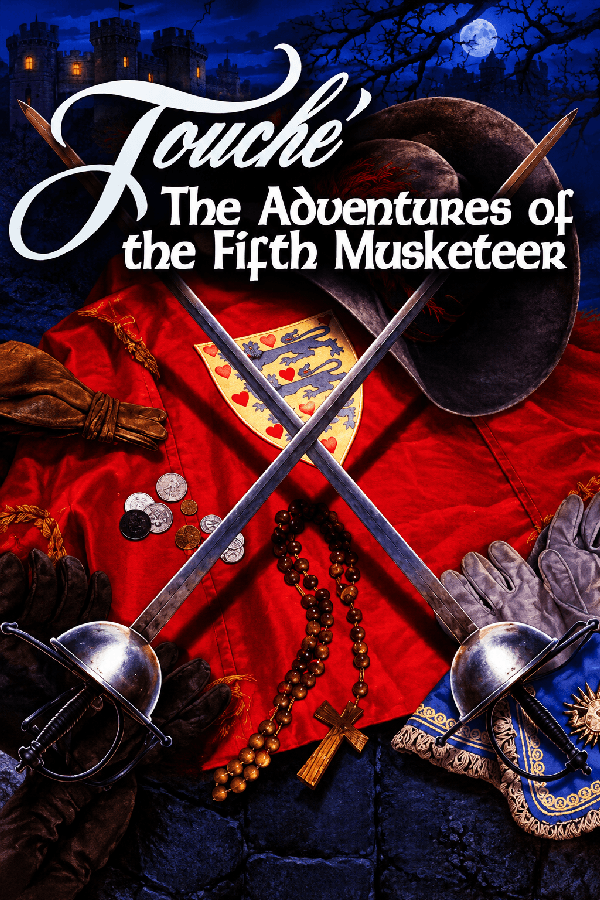
If you ever wanted to play a swashbuckling point-and-click comedy set in 16th-century France, Touché: The Adventures of the Fifth Musketeer hands you a rapier, a sarcastic manservant, and a murder mystery before you even reach the local tavern.
You play as Geoffroi Le Brun, a naive young man who rides into Rouen on a dark night with one goal: joining His Majesty's musketeers as an ensign. Things go sideways immediately. Before Geoffroi can even figure out where to report for duty, he witnesses the murder of William de Peuple, the Comte d'Itee. With his dying breath, the Comte begs Geoffroi to recover his stolen will from a band of killers and bring it safely to Paris. Naturally, Geoffroi agrees, setting off a continent-crossing wild goose chase.
British developer Clipper Software released the title in 1995 through publisher U.S. Gold, Inc., putting a slapstick spin on classic cloak-and-dagger fiction. Geoffroi does not travel alone. He recruits Henri, a former beggar and professional trickster who acts as his manservant and quick-witted foil. As you unlock new locations on the world map, your journey takes you from the docks of Le Havre to a cathedral in St. Quentin, a monastery in Amiens, and an innocent-looking florist shop in Le Mans that hides a secret underground gambling den.
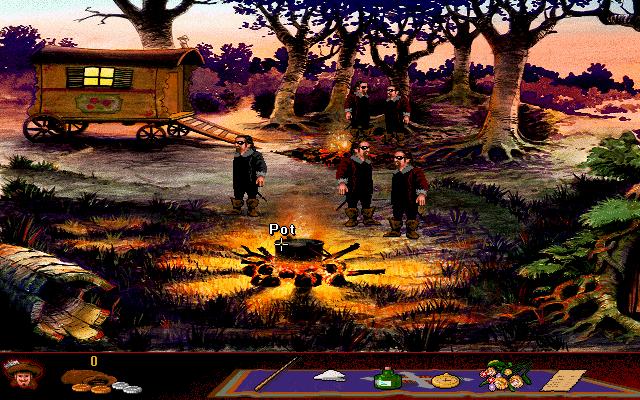
Mechanically, the experience stays firmly rooted in traditional point-and-click design, but it smooths out some of the era's clunkiest habits. Instead of locking you into a static action bar at the bottom of the display, right-clicking on an interactive object pops up a circular context menu showing only the actions that make sense for that target. It keeps the screen uncluttered and keeps your attention on the background artwork.
That streamlined interface does not mean the puzzles are a walk in the park. Progress relies heavily on collecting a massive array of items, trading them with locals, and combining oddities in your inventory. You spend a lot of time chatting up historical figures like Alexandre Dumas, dodging the schemes of Cardinal Guise, and trying to help a young woman named Juliette, who happens to be courted by D'Artagnan himself. The logic falls squarely into standard 90s adventure games territory, where you might need to figure out how to distract a guard using three completely unrelated objects you found three towns back.
The visual presentation had a small production line. The backdrops and animated figures were created entirely by a single artist, Teoman Irmak, over an eighteen-month period. He drew every screen in pencil, painted the scenery using traditional watercolors, and scanned the finished artwork into digital graphics. The result is a soft, painted aesthetic rendered in 256-color SVGA that gives every French town and dark alley a distinct look.
When the title hit store shelves, reactions were split down the middle. British television review service Digitiser handed it a sharp 65% rating, knocking it as a creaky mid-80s throwback filled with interminable conversations with innkeepers and uneven character scaling. Other critics were far more generous, pointing out that its Dumas-inspired narrative and witty banter between Geoffroi and Henri gave it a personality all its own. The full voice acting cast delivers their lines with full theatrical energy, turning what could have been dry exposition into lively back-and-forth comedy.
Where the design struggles is pacing. As the map opens up, you are forced to trek back and forth between towns to hand single inventory items to specific non-player characters. If you miss one small item in Amiens, you might find yourself stuck in Paris with no clear clue of what to do next. The writing also goes a bit wild in the final act, piling on sudden puzzle strings that demand bizarre lateral thinking just as you expect the story to wrap up.
The movement speed can also test your patience when backtracking through previously cleared streets. If you are playing the Touché: The Adventures of the Fifth Musketeer MS-DOS game under modern engine rewrites like ScummVM, keyboard shortcuts like Ctrl-F for fast mode or F9 and F10 to toggle fast walking become essential quality-of-life additions. Without them, watching Geoffroi slowly saunter across three full background screens just to check a lock can take the wind out of your sails.
If you enjoy classic LucasArts point-and-clickers, this French swashbuckler is well worth an evening. It does not reinvent the wheel, and its late-game travel back-and-forth will occasionally make you roll your eyes, but the comic chemistry between Geoffroi and Henri keeps things moving forward. The watercolor backdrops look great on high-resolution screens, and the voice work has plenty of heart.
You can play Touché: The Adventures of the Fifth Musketeer free in your browser right now, with no setup required. Just launch the browser window, remember to right-click on objects to bring up your action commands, and keep Henri close by whenever a French tavernkeeper starts giving you trouble.
If you ever wanted to play a swashbuckling point-and-click comedy set in 16th-century France, Touché: The Adventures of the Fifth Musketeer hands you a rapier, a sarcastic manservant, and a murder mystery before you even reach the local tavern.
You play as Geoffroi Le Brun, a naive young man who rides into Rouen on a dark night with one goal: joining His Majesty's musketeers as an ensign. Things go sideways immediately. Before Geoffroi can even figure out where to report for duty, he witnesses the murder of William de Peuple, the Comte d'Itee. With his dying breath, the Comte begs Geoffroi to recover his stolen will from a band of killers and bring it safely to Paris. Naturally, Geoffroi agrees, setting off a continent-crossing wild goose chase.
British developer Clipper Software released the title in 1995 through publisher U.S. Gold, Inc., putting a slapstick spin on classic cloak-and-dagger fiction. Geoffroi does not travel alone. He recruits Henri, a former beggar and professional trickster who acts as his manservant and quick-witted foil. As you unlock new locations on the world map, your journey takes you from the docks of Le Havre to a cathedral in St. Quentin, a monastery in Amiens, and an innocent-looking florist shop in Le Mans that hides a secret underground gambling den.
Mechanically, the experience stays firmly rooted in traditional point-and-click design, but it smooths out some of the era's clunkiest habits. Instead of locking you into a static action bar at the bottom of the display, right-clicking on an interactive object pops up a circular context menu showing only the actions that make sense for that target. It keeps the screen uncluttered and keeps your attention on the background artwork.
That streamlined interface does not mean the puzzles are a walk in the park. Progress relies heavily on collecting a massive array of items, trading them with locals, and combining oddities in your inventory. You spend a lot of time chatting up historical figures like Alexandre Dumas, dodging the schemes of Cardinal Guise, and trying to help a young woman named Juliette, who happens to be courted by D'Artagnan himself. The logic falls squarely into standard 90s adventure games territory, where you might need to figure out how to distract a guard using three completely unrelated objects you found three towns back.
The visual presentation had a small production line. The backdrops and animated figures were created entirely by a single artist, Teoman Irmak, over an eighteen-month period. He drew every screen in pencil, painted the scenery using traditional watercolors, and scanned the finished artwork into digital graphics. The result is a soft, painted aesthetic rendered in 256-color SVGA that gives every French town and dark alley a distinct look.
When the title hit store shelves, reactions were split down the middle. British television review service Digitiser handed it a sharp 65% rating, knocking it as a creaky mid-80s throwback filled with interminable conversations with innkeepers and uneven character scaling. Other critics were far more generous, pointing out that its Dumas-inspired narrative and witty banter between Geoffroi and Henri gave it a personality all its own. The full voice acting cast delivers their lines with full theatrical energy, turning what could have been dry exposition into lively back-and-forth comedy.
Where the design struggles is pacing. As the map opens up, you are forced to trek back and forth between towns to hand single inventory items to specific non-player characters. If you miss one small item in Amiens, you might find yourself stuck in Paris with no clear clue of what to do next. The writing also goes a bit wild in the final act, piling on sudden puzzle strings that demand bizarre lateral thinking just as you expect the story to wrap up.
The movement speed can also test your patience when backtracking through previously cleared streets. If you are playing the Touché: The Adventures of the Fifth Musketeer MS-DOS game under modern engine rewrites like ScummVM, keyboard shortcuts like Ctrl-F for fast mode or F9 and F10 to toggle fast walking become essential quality-of-life additions. Without them, watching Geoffroi slowly saunter across three full background screens just to check a lock can take the wind out of your sails.
If you enjoy classic LucasArts point-and-clickers, this French swashbuckler is well worth an evening. It does not reinvent the wheel, and its late-game travel back-and-forth will occasionally make you roll your eyes, but the comic chemistry between Geoffroi and Henri keeps things moving forward. The watercolor backdrops look great on high-resolution screens, and the voice work has plenty of heart.
You can play Touché: The Adventures of the Fifth Musketeer free in your browser right now, with no setup required. Just launch the browser window, remember to right-click on objects to bring up your action commands, and keep Henri close by whenever a French tavernkeeper starts giving you trouble.
How Touché: The Adventures of the Fifth Musketeer is played — the keys the game listens to, grouped by what they do.
Highlighted keys are mapped — hover or tap one to see what it does.
Key map reflects documented shortcut keys from ScummVM wiki and mouse mechanics from primary sources.
The on-screen keyboard and gamepad mapping the browser player uses on a phone, a tablet or a controller, as opposed to the real keys above. $PRO members make their own in the player and share them here; anyone can pick one to play with.
Cheat codes, console commands and memory pokes for Touché: The Adventures of the Fifth Musketeer — each one verified and attributed.
Sign in to submitHow Touché: The Adventures of the Fifth Musketeer is played — the keys the game listens to, grouped by what they do.
Highlighted keys are mapped — hover or tap one to see what it does.
Key map reflects documented shortcut keys from ScummVM wiki and mouse mechanics from primary sources.
The on-screen keyboard and gamepad mapping the browser player uses on a phone, a tablet or a controller, as opposed to the real keys above. $PRO members make their own in the player and share them here; anyone can pick one to play with.
Cheat codes, console commands and memory pokes for Touché: The Adventures of the Fifth Musketeer — each one verified and attributed.
Sign in to submit