Loading up Tremor for Quake feels like dumping a giant shoebox of 1990s CD-ROM add-ons onto your desktop, sorting through hundreds of forgotten deathmatch arenas and bizarre gameplay tweaks.
Sorting through the sheer noise of 500 custom maps
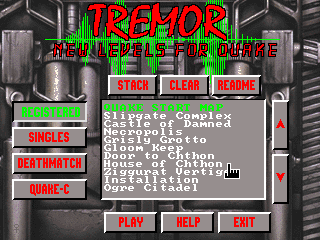
When you fire up this collection, you are greeted by a basic front-end launcher designed to inject user-made levels and code modifications straight into your installed copy of Quake. Released back in 1997 by Head Games Publishing, Inc., the disc served as a direct follow-up to their earlier commercial pack, Aftershock for Quake. Rather than offering a structured single-player campaign split into neat episodes with built-in story text, the CD dumps over 500 individual single-player and deathmatch maps directly onto your hard drive alongside more than a hundred QuakeC patches.
Booting into a random map selected through the utility launcher means stepping straight into the wild west of mid-nineties level construction. You might spawn in a pristine gothic arena with tight corridors made for quick shotgun duels, only to load the next entry and find yourself inside an oversized rectangular concrete box filled with dozens of Fiends and ogres dropped in without any layout logic. About a quarter of the included maps were original creations exclusive to this retail package, while the remainder were scoured directly from online FTP archives and early fan sites of the era.
The core movement and combat remain classic id Software design, carrying over the weightless strafe-jumping, sharp rocket launcher feedback, and heavy nailgun clatter that defined the original game. However, the experience of sifting through the disc is defined by extreme inconsistency. For every well-constructed map featuring clever secret rooms and thoughtful health placement, you will run across five draft levels where you fall through unclipped geometry or get trapped in dead-end pits with no exit elevator.
Why custom textures changed the look of Tremor for Quake
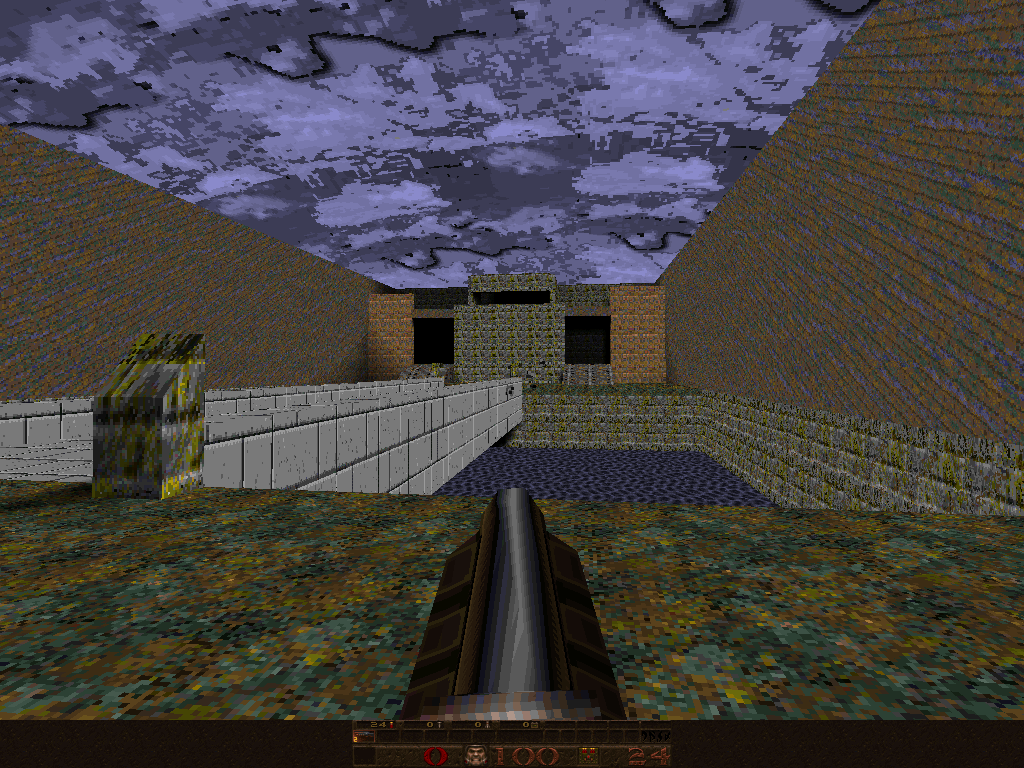
The most peculiar visual choice across this entire set is the texture work. To avoid potential copyright conflicts with id Software over distributing official art assets on a commercial disc, Head Games swapped out standard brick, metal, and slipgate textures across both the newly authored levels and the freely sourced internet downloads. Seeing familiar level geometry draped in alternative surface art gives the whole package an odd, parallel-universe atmosphere that sets it apart from typical commercial maps.
In practice, these replacement graphics yield mixed results during quiet exploration and intense firefights alike:
- Altered wall tiles: Ancient runes and rusted tech panels are replaced with raw stone patterns and earthy plaster designs.
- Modified liquid surfaces: Slime pits and lava rivers sport tweaked colors that look subtly off compared to standard brown slipgate sludge.
- Surprise atmospheric shifts: Medieval castle keeps take on a gritty, unpolished visual tone that feels more grounded and rustic.
- Inconsistent alignment: Net-harvested maps originally built for standard texture sets occasionally stretch or misalign the replacement art across angled walls.
Beyond the visual overhaul, the collection heavily features modified QuakeC gameplay scripts. Launching the game with these patches enabled alters weapon behavior, monster spawns, and physical rules. You might fire up a match where grenades bounce twice as far, or enter a modified deathmatch round where killed opponents drop custom power-ups. The menu utility lets you toggle these experiments on and off before launching the executable, letting you mix and match wild fan creations with traditional combat mechanics.
What works and what falls apart in the levels
Testing your skills against these levels highlights just how tricky budget commercial compilations could be to navigate. Because the disc was aimed squarely at players who had already cleared the original four episodes on Nightmare difficulty, many map authors cranked enemy density to absurd levels right at the start zone. Spawns frequently place you face-to-face with Shamblers or Vores before you even locate a super shotgun, turning your opening ten seconds into a frantic panic search for armor and shells.
The layout quality varies wildly across the board. In the single-player levels, keycard placement is a frequent pain point. Authors from the early mapping scene loved hiding small silver keys inside pitch-black alcoves without dynamic lighting, forcing you to hug every wall and shoot red barrels just to illuminate dark corners. Navigating these spaces without a built-in map overlay means spending significant time back-tracking through cleared halls just to find which door unlocked somewhere on the far side of the building.
Deathmatch maps fare somewhat better, especially when played in fast-paced LAN setups. The shorter, boxier environments work well for two to four players hunting each other down with super nailguns. Because these arenas skip complex key triggers and scripted monster doors, you can focus purely on item control, rocket jumping across low ledges, and learning timer spawns for quad damage power-ups scattered near central lava pits.
Commercial add-ons in the late nineties shovelware era
To understand why this CD existed, you have to look back at how PC gaming operated before high-speed broadband became universal. In 1997, downloading a single 5MB map file over a dial-up modem could take nearly an hour, assuming nobody in the house picked up the landline phone mid-transfer. Retail publishers capitalized on this bottleneck by burning hundreds of megabytes of publicly available internet files onto a single disc, slapping a loud box cover on it, and stocking it on store shelves for twenty dollars as a budget add-on.
Head Games built an entire business model around this strategy, producing multiple unofficial expansions for popular first-person shooters of the decade. The physical box highlighted flashy claims of carrying over a thousand levels and patches, though reaching that count meant treating every tiny code tweak, map variant, and test file as an individual feature. You were required to own the full, registered base game to play, as the disc provided no standalone engine files or core campaign graphics on its own.
The collection shows the creative energy of the early modding community. You get to see the exact moment level design shifted from simple geometric mazes toward complex multi-story structures with custom lighting tricks. These maps came from fans spending late nights writing code in Notepad and uploading logs to dial-up bulletin boards, long before polished development tools simplified the process.
Ready to play Tremor for Quake online without hunting down old discs?
If you enjoy exploring early community level design and want to see how third-party creators pushed early 3D engines, this collection offers a massive array of retro arenas to test out. The sheer volume of material means you will encounter plenty of broken geometry and unfair monster traps, but finding a genuinely clever deathmatch arena or weird QuakeC modification hidden inside the pile makes sifting through the disc a fun evening project.
You can play Tremor for Quake online free in your browser right now, with no need to install custom launchers, manage original CD-ROMs, or set up vintage MS-DOS directories. Jump straight into the action, load up the custom map collection, and start blasting through hundreds of user-created arenas instantly.