Virtual Chess
aka Virtua Chess
Streaming build
Checking storage…193 MB
Preload in background
JIT compiler
Rate this game
- Played
- Often
Getting crushed by Virtual Chess on a mid-90s PC usually meant watching a ray-traced knight slowly pivot in three dimensions right before its underlying engine trapped your king in twenty moves.
Beyond flat boards: the real pull of Virtual Chess
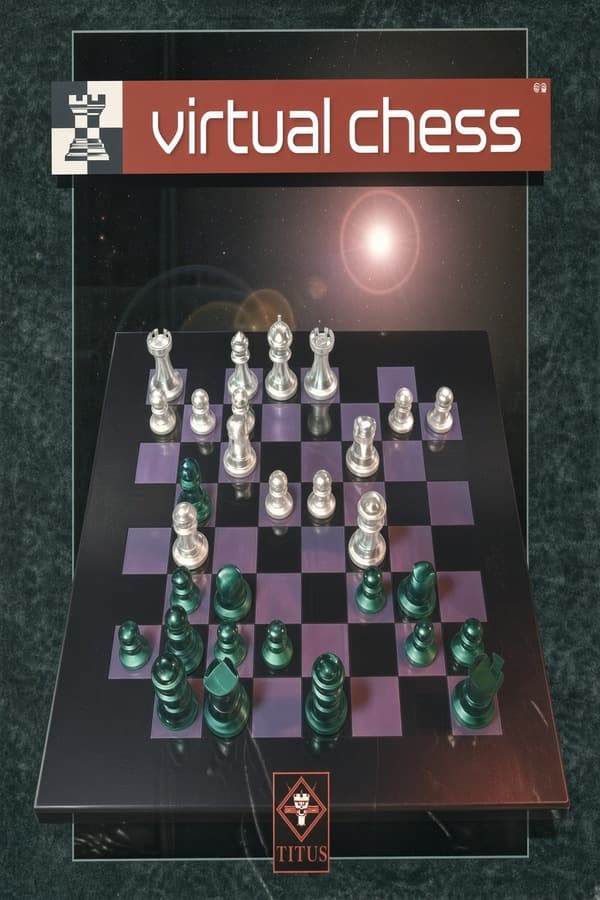
Most computer chess programs from the early nineties treated graphics as an afterthought. You got a flat 2D grid, functional sprites, and a black background. Titus France SA took a drastically different route with Virtual Chess, building a full 3D viewport rendered on Silicon Graphics workstations that you could rotate, tilt, and zoom directly on your screen alongside the classic flat view.
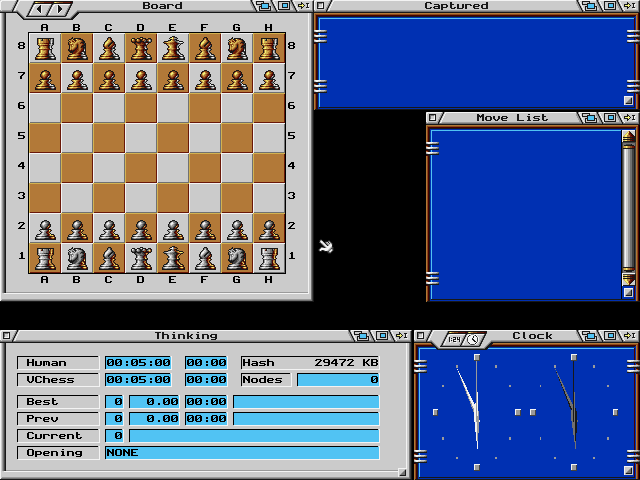
Having up to nine customizable windows open at once meant you could keep a top-down board visible for clear tactical planning while admiring the rotatable 3D board right next to it. For players used to flat monochrome grids, seeing a 3D board with basic directional lighting felt like stepping onto a high-end Unix workstation without leaving DOS.
The assembly engine behind the shiny polygon pieces
Strip away the glossy artwork, full-motion video introductions, and cutscenes, and you find a brute-force chess engine built by Jean-Christophe Weill and Marc-François Baudot. What started in 1989 as a university AI research project called Écume was rewritten straight into 32-bit assembly language to wring every drop of speed out of modern CPUs.
The code relied heavily on principal variation search, aggressive null-move pruning, and dynamic evaluation for king safety and pawn structure. On a Pentium 90, the engine could crunch roughly 20,000 nodes per second, backed up by complete built-in endgame knowledge for King-Pawn-King positions. It played fast, and it played hard. If you left a piece exposed to a tactical combination three turns deep, the machine found it instantly.
Tournament blunders and technical precision in Virtual Chess
Even elite code has its growing pains. Back during an early tournament entry in 1989, a pre-release version of the core engine finished near the absolute bottom of the pack because of a single, crippling bug in its en passant capture logic. Yet even with that flaw costing it points, the engine managed to hold the formidable Mephisto dedicated chess computer to a draw.
By the time Titus shipped the commercial package in 1995, those rule bugs were long gone. The engine even tracked opening books using the standard Encyclopedia of Chess Openings (ECO) classification system. It also packed diagnostic options like a dedicated "Search for Mate" function to solve mid-game puzzles. If you wanted to test your real-world setup, the package even supported hardware integration with Saitek magnetic auto-chessboards or local network matches over IPX.

Where the interface gets in its own way
The main frustration when playing the original 1995 release comes from its double-edged interface. While the real-time 3D board looks impressive, navigating piece placement in three dimensions with a mid-90s mouse can occasionally be awkward compared to clicking clean 2D tiles. You will occasionally grab the wrong piece or miss a subtle diagonal line of attack simply because the camera tilt obscured a distant bishop.
The reliance on early CD-ROM video clips and cutscenes also feels bloated if all you want is a quick match. If you ran this title on a modest 386SX CPU, the 3D rendering and deep analysis passes could drag the game down to a crawl during complex mid-game board states.
How to play Virtual Chess free in your browser today
If you enjoy classic strategy and tactics titles or want to see how high-end computer chess looked before modern engines conquered the world, this DOS release is well worth a match. The commercial engine code developed here was no gimmick; it was powerful enough to win the 1997 World Microcomputer Chess Championship Professional Category title just a couple of years later.
You can play Virtual Chess online right now, free in your browser, with no setup required. When you start your first match, try setting up the split layout with the flat 2D board on the left and the angled 3D camera on the right. It gives you the sharpest view of the board state while letting you appreciate the heavy-duty assembly engine working beneath the surface.
Players' controls
Touch and gamepad controls
The on-screen keyboard and gamepad mapping the browser player uses on a phone, a tablet or a controller, as opposed to the real keys above. $PRO members make their own in the player and share them here; anyone can pick one to play with.
Make your own touch controlsPRO
- 1Open the editorSign in below, then pick what to make. The game starts with the editor open over it.
- 2Place your keysAdd keys and drag them where your thumbs rest, or map a controller's buttons. Test plays the game with them; Save keeps them, and you play with them from then on.
- 3Share themShare them right after saving in the game, or name and share them here. Players vote, and the best become this game's controls for everyone.
Go PROSee how it worksSign in+20 XP for sharing · +50 XP if yours become the game's own
- The game's own controlsNone yet: played with a real keyboard only.In use
2 screenshots
From the archive
No gameplay video yet
No gameplay video for Virtual Chess yet. Sign in to add one.
No reviews yet
Tell the community what you think of Virtual Chess. Reviews are public and tied to your username.
No archived manuals for Virtual Chess yet
No manuals archived for this title yet. Sign in to upload the first scan.
Cheat codes, console commands and memory pokes for Virtual Chess — each one verified and attributed.
Sign in to submitNo cheats yet for this title
Know a working cheat, poke or trainer? Add it with the button above. Moderators check every entry before it goes live.
No archived soundtrack for Virtual Chess yet
No soundtrack archived for this title yet. Sign in to upload the first rip.
No save states for Virtual Chess yet
No save states for this title yet. Sign in to share one.
Discussions
Sign in to post- Threads0
- Total posts0
- Online now6
Community · Virtual Chess
Who's contributing, and what's new
- Reviews0
- Threads0
- Uploadsapproved0
- Contributors0
Recent activity
Nothing here yet
Reviews, discussion threads and approved uploads appear here as members add them.