Playing Warcraft: Orcs & Humans today reveals a strategy game where the real battle is fought against your own mouse cursor as much as the invading Orcish horde. Blizzard Entertainment introduced real-time tactical base-building to millions in 1994, but doing so meant inventing a control scheme that forced players to manage four units at a time while manually clicking every order.
Commanding an army four soldiers at a time
Every real-time strategy convention we take for granted had to be figured out somewhere, and this is where Blizzard drew its first line in the dirt. You start a mission with a town center, a handful of workers, and a patch of trees next to a gold mine. Your goal is simple enough: harvest gold, chop timber, build barracks, train troops, and crush the enemy camp on the other side of the map.
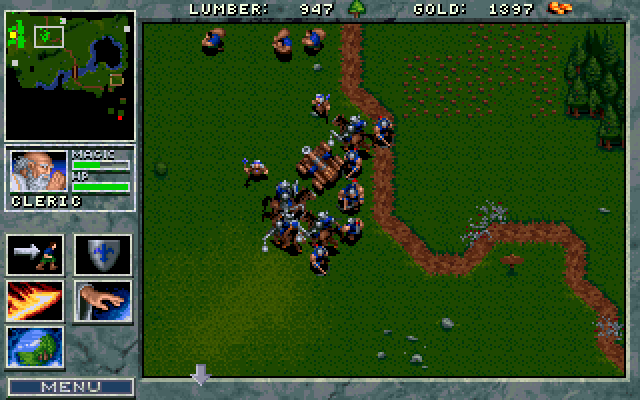
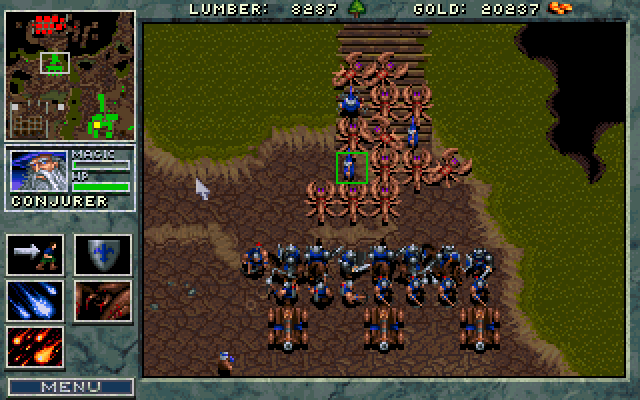
The friction begins the moment combat starts. You cannot click and drag a box around twenty Footmen to send them charging down a hill. You get four units per selection group. If you want eight Knights to attack an Orc encampment, you select four, command them to move, select the other four, command them to follow, and hope the first group did not already wander into a cluster of enemy Spearmen. Units do not even possess an automatic attack-move standard, meaning an unassigned guard will sit quietly while a dark wizard cooks him with lightning unless you explicitly tell him to defend himself.
That manual friction gives every skirmish a frantic, chaotic tempo. Modern players accustomed to unit production queues will find that every single Peasant or Archer requires an individual click the moment the previous unit finishes training. If you forget to check your Barracks for thirty seconds, your production halts entirely. It forces you to constantly watch your base and pay close attention to the layout of your choke points and walls.
Resource grinding and dungeon crawls in Warcraft: Orcs & Humans
The single-player campaign splits evenly between the Human defenders of Azeroth and the Orcish invaders across twelve scenario levels each. Early missions in places like the Forest of Elwynn or Goldshire teach you the core rhythm of balancing lumber yards and gold mines. You quickly learn that trees serve as a physical terrain wall on top of being a resource. Chopping down a forest can clear a defensive bottleneck, unintentionally opening a backdoor directly into your vulnerable farms.
Blizzard broke up the traditional base-building structure by inserting dungeon-style exploration maps throughout both campaigns. In levels like the Dead Mines, Northshire Abbey, and Medivh Tower, you receive a fixed contingent of troops without any workers or town centers. You spend these missions crawling through pitch-black corridors, dodging traps, and taking down Daemons or Necromancers who can raise fresh skeletons from the bodies of your fallen soldiers.
These dungeon crawls alter the pacing completely because lose a single Cleric or Warlock, and you might not have the firepower left to clear the final room. The game shifts from an economic race into a tense tactical puzzle where every hit point matters. For those looking for pure tactical combat, this strategy game collection demonstrates how varied early PC tactical design could be.
Sound Blaster noise and the secret keys of 1994
In 1994, audio presentation was a massive selling point for PC gaming, and this release delivered on every front. Sound hardware support was thorough, running smoothly on Sound Blaster, Sound Blaster Pro, Pro Audio Spectrum, and Gravis UltraSound. Playing through a Roland Sound Canvas SCC-1A gave the orchestral brass synth tracks a punchy, pompous atmosphere that fit the fantasy war theme perfectly.
Then there were the voice lines. Clicking on a unit repeatedly eventually caused them to break character and complain directly to the player, a humorous touch that became a signature studio tradition. Outside of the audio touches, players who found the four-unit selection cap too grueling often turned to built-in cheat codes entered via the chat console:
- Sally Shears reveals the entire map by disabling the fog of war.
- Pot of Gold immediately grants 10,000 units of gold and timber to your treasury.
- Hurry Up Guys dramatically accelerates construction speed and unit production times.
- Corwin of Amber activates master cheats, allowing There Can Be Only One for near-invincibility and Ides of March to jump directly to the campaign finale.
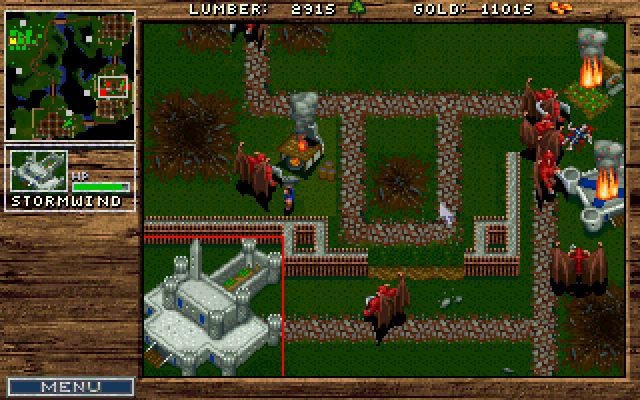
Without those codes, later levels like Blackrock Spire or Stormwind Keep demand strict resource optimization and brutal micro-management. The AI does not cheat as aggressively as in some rival titles of the period, but its sheer volume of heavy units will overrun a poorly fortified perimeter in seconds.
The final verdict on Blizzard's breakthrough
Looking back at Blizzard Entertainment's first real strategy hit, it is easy to focus on what missing convenience features make it stiff. The four-unit cap, manual unit orders, and lack of attack-move commands make high-level play feel like fighting your own keyboard layout. Yet behind that interface friction lies a deep, focused war game that rewards spatial planning and rapid tactical prioritization.
The game holds up best as a historical challenge for players who want to see where fantasy real-time strategy took root on MS-DOS. The campaign mission variety remains sharp, the unit balance between Human Clerics and Orcish Warlocks keeps matches interesting, and the head-to-head multiplayer maps showed off a formula that would dominate PC gaming for the next decade. If you can adapt to its manual demands, the tactical loop remains surprisingly rewarding.
You can play Warcraft: Orcs & Humans free in your browser right now with no setup needed. Start with the Human campaign, build two farms before you start training Footmen, and make sure you group your Archers behind your melee wall before sending them toward the nearest Orcish watchtower.