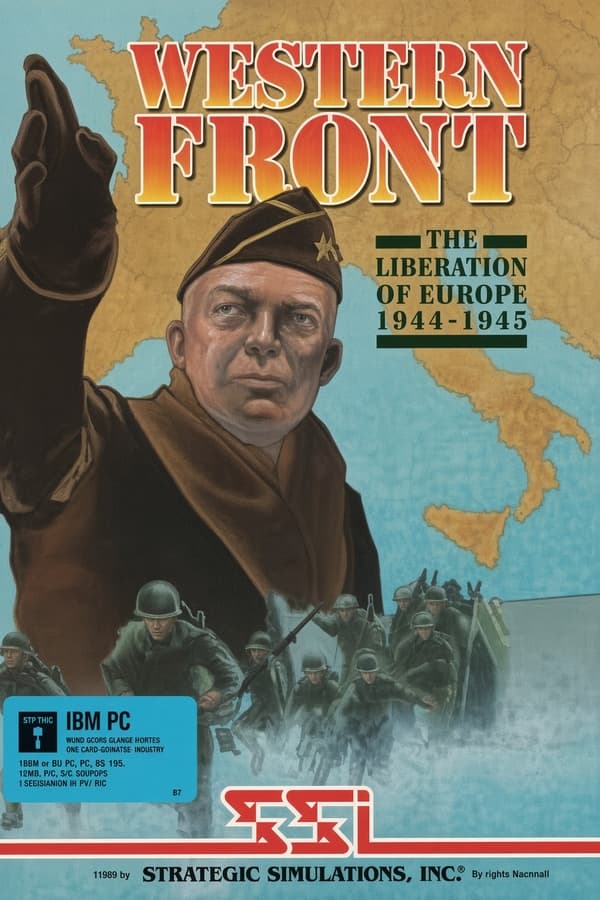
Setting up Western Front: The Liberation of Europe 1944-1945 drops you directly onto a crowded map of Western Europe, handed command of allied or axis divisions while the system secretly drains German reserves to feed the Eastern Front.
When you boot the 1991 strategy game, the first thing you encounter before giving a single order is the manual-based copy protection. The game prompts you to type a specific word from a given page and line of the printed guide. Pass that check, and you are greeted by an upgraded version of the engine designer Gary Grigsby used for Second Front: Germany Turns East a year prior. Unlike its predecessor, this release included full mouse support, letting you click unit stacks and select destination hexes without memorizing dozen-key keyboard chains.
You can choose individual historical operations or dive straight into the full theater campaign. The smaller scenarios narrow the focus considerably:
Selecting Overlord opens an immense board where every move carries logistical weight. Your units are tracked at division and brigade level, requiring you to monitor fuel reserves, unit fatigue, and ground readiness turn after turn.
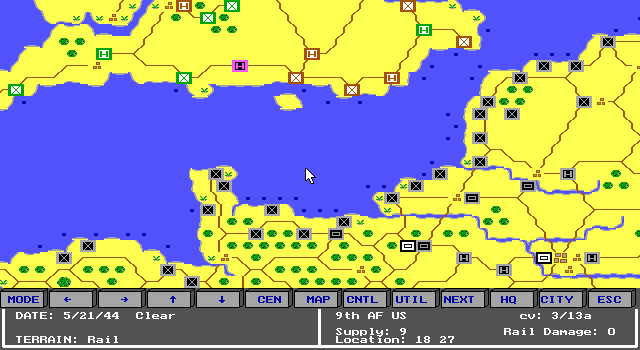
Commanding forces in this engine means balancing combat power with rail capacity and supply heads. Landing troops during Normandy amphibious operations or dropping airborne forces inland requires clear supply corridors. If your spearheads run out of fuel in front of the Siegfried Line or during the Siege of Bastogne, your armor turns into stationary targets for counter-attacks.
Playing as the Axis forces introduces an unavoidable background mechanic that continuously undermines your strength. As battle rages in the west, the engine automatically calculates troop losses on the simulated Eastern Front. When Soviet pressure rises, the game quietly transfers active German combat divisions off your map to reinforce the east, forcing you to stretch remaining units paper-thin across the Western and Italian fronts.
That background system makes holding defensive lines a nerve-wracking exercise. You might plan a counter-strike for next turn, only to find two essential panzer divisions pulled out of your reserve pool because fighting outside Warsaw went south. Victory requires managing structural attrition as much as winning localized firefights.
When published by Strategic Simulations, the game drew detailed analysis from wargame critics. Writing for Computer Gaming World in November 1991, Alan Emrich highlighted the title as an evolutionary advance in turn-based design. In Game Players PC Entertainment, William R. Trotter called it a must-have for historical wargamers, though he noted it sat slightly in the shadow of Second Front when it came to raw tactical scope.
Brian Walker raised a sharper critique in Computer Games Strategy Plus in December 1991. He lauded the underlying simulation while calling out obvious publisher cost-cutting, specifically pointing at thin printed documentation that left complex mechanical details unexplained. Players were expected to work out specific supply distribution formulas largely through trial and error.
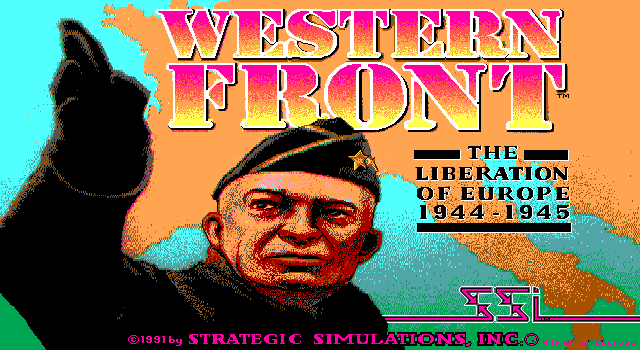
The time investment remains the largest barrier for modern players. Playing through the complete grand campaign from Normandy to the race to Berlin routinely takes over a hundred hours. Every turn demands checking dozens of unit stacks, reviewing rail movement capacity, and adjusting air support assignments, making it a heavy commitment even for seasoned grognards.
Grigsby used these systems as a foundation for his later titles, including Carrier Strike and Gary Grigsby's Pacific War. Dense statistics and missing manual charts can frustrate first-time players, but the core routine of managing a multi-front supply crisis still pulls you in.
You can play Western Front: The Liberation of Europe 1944-1945 free in your browser right here on this page. The Western Front: The Liberation of Europe 1944-1945 MS-DOS game runs directly inside your window with no software to install or setup required. Jump into the Breakout scenario first to get a handle on tank movements before attempting the full hundred-hour campaign to Berlin.
Setting up Western Front: The Liberation of Europe 1944-1945 drops you directly onto a crowded map of Western Europe, handed command of allied or axis divisions while the system secretly drains German reserves to feed the Eastern Front.
When you boot the 1991 strategy game, the first thing you encounter before giving a single order is the manual-based copy protection. The game prompts you to type a specific word from a given page and line of the printed guide. Pass that check, and you are greeted by an upgraded version of the engine designer Gary Grigsby used for Second Front: Germany Turns East a year prior. Unlike its predecessor, this release included full mouse support, letting you click unit stacks and select destination hexes without memorizing dozen-key keyboard chains.
You can choose individual historical operations or dive straight into the full theater campaign. The smaller scenarios narrow the focus considerably:
Selecting Overlord opens an immense board where every move carries logistical weight. Your units are tracked at division and brigade level, requiring you to monitor fuel reserves, unit fatigue, and ground readiness turn after turn.
Commanding forces in this engine means balancing combat power with rail capacity and supply heads. Landing troops during Normandy amphibious operations or dropping airborne forces inland requires clear supply corridors. If your spearheads run out of fuel in front of the Siegfried Line or during the Siege of Bastogne, your armor turns into stationary targets for counter-attacks.
Playing as the Axis forces introduces an unavoidable background mechanic that continuously undermines your strength. As battle rages in the west, the engine automatically calculates troop losses on the simulated Eastern Front. When Soviet pressure rises, the game quietly transfers active German combat divisions off your map to reinforce the east, forcing you to stretch remaining units paper-thin across the Western and Italian fronts.
That background system makes holding defensive lines a nerve-wracking exercise. You might plan a counter-strike for next turn, only to find two essential panzer divisions pulled out of your reserve pool because fighting outside Warsaw went south. Victory requires managing structural attrition as much as winning localized firefights.
When published by Strategic Simulations, the game drew detailed analysis from wargame critics. Writing for Computer Gaming World in November 1991, Alan Emrich highlighted the title as an evolutionary advance in turn-based design. In Game Players PC Entertainment, William R. Trotter called it a must-have for historical wargamers, though he noted it sat slightly in the shadow of Second Front when it came to raw tactical scope.
Brian Walker raised a sharper critique in Computer Games Strategy Plus in December 1991. He lauded the underlying simulation while calling out obvious publisher cost-cutting, specifically pointing at thin printed documentation that left complex mechanical details unexplained. Players were expected to work out specific supply distribution formulas largely through trial and error.
The time investment remains the largest barrier for modern players. Playing through the complete grand campaign from Normandy to the race to Berlin routinely takes over a hundred hours. Every turn demands checking dozens of unit stacks, reviewing rail movement capacity, and adjusting air support assignments, making it a heavy commitment even for seasoned grognards.
Grigsby used these systems as a foundation for his later titles, including Carrier Strike and Gary Grigsby's Pacific War. Dense statistics and missing manual charts can frustrate first-time players, but the core routine of managing a multi-front supply crisis still pulls you in.
You can play Western Front: The Liberation of Europe 1944-1945 free in your browser right here on this page. The Western Front: The Liberation of Europe 1944-1945 MS-DOS game runs directly inside your window with no software to install or setup required. Jump into the Breakout scenario first to get a handle on tank movements before attempting the full hundred-hour campaign to Berlin.
How Western Front: The Liberation of Europe 1944-1945 is played — the keys the game listens to, grouped by what they do.
Highlighted keys are mapped — hover or tap one to see what it does.
Ensure Num Lock and Caps Lock are off before playing on IBM PC.
The on-screen keyboard and gamepad mapping the browser player uses on a phone, a tablet or a controller, as opposed to the real keys above. $PRO members make their own in the player and share them here; anyone can pick one to play with.
Cheat codes, console commands and memory pokes for Western Front: The Liberation of Europe 1944-1945 — each one verified and attributed.
Sign in to submitHow Western Front: The Liberation of Europe 1944-1945 is played — the keys the game listens to, grouped by what they do.
Highlighted keys are mapped — hover or tap one to see what it does.
Ensure Num Lock and Caps Lock are off before playing on IBM PC.
The on-screen keyboard and gamepad mapping the browser player uses on a phone, a tablet or a controller, as opposed to the real keys above. $PRO members make their own in the player and share them here; anyone can pick one to play with.
Cheat codes, console commands and memory pokes for Western Front: The Liberation of Europe 1944-1945 — each one verified and attributed.
Sign in to submit