
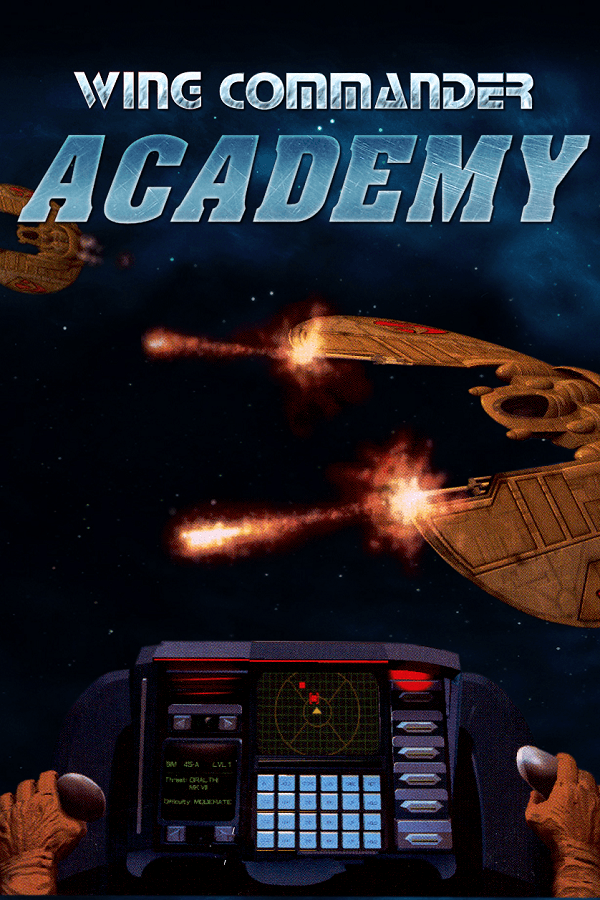

Launching Wing Commander Academy dumps you straight into a holographic simulator terminal, stripping away the cinematic talking heads of the main series to focus entirely on space combat.
You start at an academy computer terminal, picking targets and terrain before your cockpit hatch even closes. Instead of waiting through long debriefings or walking around carrier decks talking to flight crew, the simulator room asks what you want to fight and drops you into vacuum instantly. You can test your dogfighting skills immediately or assemble custom scenarios across 24 save slots in the Construct-a-Mission editor.
The mission builder gives you a radar interface to plot nav points and populate them with specific encounters. You can place friendly wingmen, hostile Kilrathi patrols, massive capital ships, space stations, and even drifting ejected pilots to rescue under fire. During the nineties, players saved these mission setups into small .WCA files, passing them around on local bulletin boards and shareware compilation CDs so everyone could try each other's custom gauntlets.
Programmers Jeff Everett and Brent Allen Thale built this space combat simulator on the core technical foundation and graphics engine of Wing Commander II: Vengeance of the Kilrathi. Producers Thomas Blom and Dallas Snell cut away the interactive story scenes entirely, leaving artists Whitney Ayres and Glen Johnson along with composers John Tipton and Kirk Winterrowd to deliver a streamlined combat package that fit on fewer floppy disks.
That trade-off divided players right from its 1993 release. Computer Gaming World praised the game as an absolute ball to play for anyone looking for quick action, while White Wolf Magazine applauded the choice to bypass time-wasting animated interludes. Yet as time went on, players who loved the main series for its dramatic branching campaigns felt this standalone release played more like a full-price expansion pack than a complete sequel.
While familiar starfighters like the light Ferret and agile Epee make a return from earlier missions, the fleet roster includes one special addition: the Wraith. This prototype super-fighter never appeared in the main Wing Commander II campaign, giving you access to extreme speed and heavy energy weaponry that can dissolve heavy Kilrathi Jalkehi fighters in seconds.
The true test of your flying comes in The Gauntlet mode, an arcade endurance run that throws 15 progressive waves of Kilrathi ships at your ship with zero pause for repairs. If you do not want to program your own waypoints or survive fifteen waves, a Quick Generator option constructs a random space battle with a single button press.
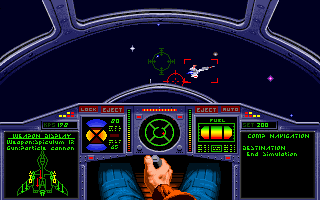
When you enter combat, the default interior cockpit view limits your field of vision with thick metal frames and console readouts. I always press F5 as soon as the screen loads to switch over to the chase camera view, which gives you an unobstructed sightline on trailing Kilrathi craft during tight turns. Without that cockpit frame blocking your lower visual field, tracking fast targets across full 360-degree space becomes far easier.
If you play space simulators primarily for branching character drama and military intrigue, this release will feel unusually bare. However, as an action-focused sandbox built by Origin Systems, it captures the mechanical punch of nineties space combat better than almost anything else from the era. The core concept even proved strong enough to inspire a 1996 animated television series of the same name starring Mark Hamill.
You can play Wing Commander Academy online free in your browser right now with no setup required. Jump into the mission editor, line up a fleet of Kilrathi capital ships against your lone Wraith super-fighter, and see if your shield management holds up under heavy turret fire.
Launching Wing Commander Academy dumps you straight into a holographic simulator terminal, stripping away the cinematic talking heads of the main series to focus entirely on space combat.
You start at an academy computer terminal, picking targets and terrain before your cockpit hatch even closes. Instead of waiting through long debriefings or walking around carrier decks talking to flight crew, the simulator room asks what you want to fight and drops you into vacuum instantly. You can test your dogfighting skills immediately or assemble custom scenarios across 24 save slots in the Construct-a-Mission editor.
The mission builder gives you a radar interface to plot nav points and populate them with specific encounters. You can place friendly wingmen, hostile Kilrathi patrols, massive capital ships, space stations, and even drifting ejected pilots to rescue under fire. During the nineties, players saved these mission setups into small .WCA files, passing them around on local bulletin boards and shareware compilation CDs so everyone could try each other's custom gauntlets.
Programmers Jeff Everett and Brent Allen Thale built this space combat simulator on the core technical foundation and graphics engine of Wing Commander II: Vengeance of the Kilrathi. Producers Thomas Blom and Dallas Snell cut away the interactive story scenes entirely, leaving artists Whitney Ayres and Glen Johnson along with composers John Tipton and Kirk Winterrowd to deliver a streamlined combat package that fit on fewer floppy disks.
That trade-off divided players right from its 1993 release. Computer Gaming World praised the game as an absolute ball to play for anyone looking for quick action, while White Wolf Magazine applauded the choice to bypass time-wasting animated interludes. Yet as time went on, players who loved the main series for its dramatic branching campaigns felt this standalone release played more like a full-price expansion pack than a complete sequel.
While familiar starfighters like the light Ferret and agile Epee make a return from earlier missions, the fleet roster includes one special addition: the Wraith. This prototype super-fighter never appeared in the main Wing Commander II campaign, giving you access to extreme speed and heavy energy weaponry that can dissolve heavy Kilrathi Jalkehi fighters in seconds.
The true test of your flying comes in The Gauntlet mode, an arcade endurance run that throws 15 progressive waves of Kilrathi ships at your ship with zero pause for repairs. If you do not want to program your own waypoints or survive fifteen waves, a Quick Generator option constructs a random space battle with a single button press.
When you enter combat, the default interior cockpit view limits your field of vision with thick metal frames and console readouts. I always press F5 as soon as the screen loads to switch over to the chase camera view, which gives you an unobstructed sightline on trailing Kilrathi craft during tight turns. Without that cockpit frame blocking your lower visual field, tracking fast targets across full 360-degree space becomes far easier.
If you play space simulators primarily for branching character drama and military intrigue, this release will feel unusually bare. However, as an action-focused sandbox built by Origin Systems, it captures the mechanical punch of nineties space combat better than almost anything else from the era. The core concept even proved strong enough to inspire a 1996 animated television series of the same name starring Mark Hamill.
You can play Wing Commander Academy online free in your browser right now with no setup required. Jump into the mission editor, line up a fleet of Kilrathi capital ships against your lone Wraith super-fighter, and see if your shield management holds up under heavy turret fire.
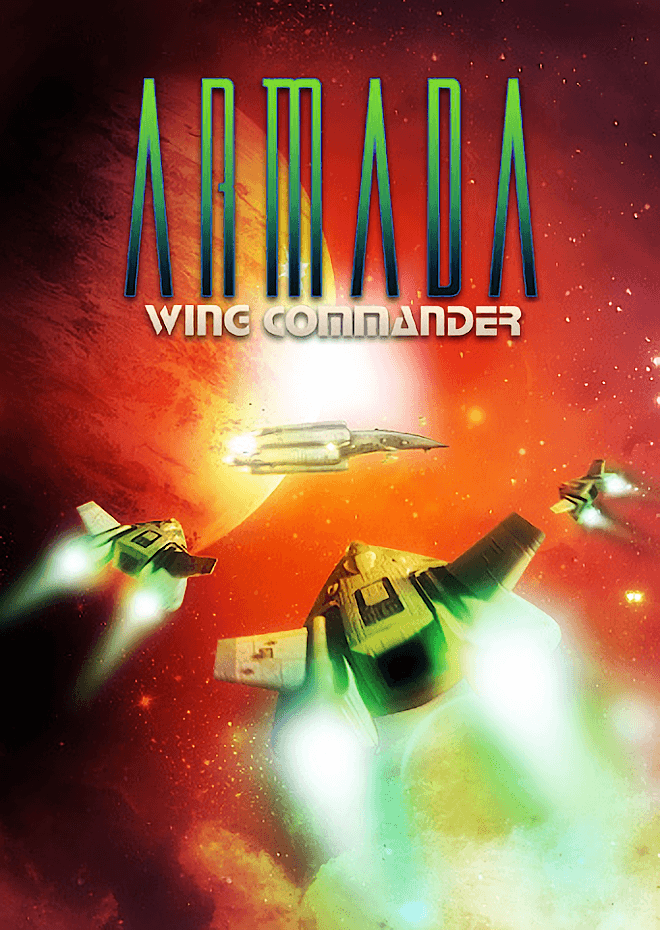
aka Wing Commander Academy: The Custom Mission Simulator
How Wing Commander Academy is played — the keys the game listens to, grouped by what they do.
Highlighted keys are mapped — hover or tap one to see what it does.
Key mapping for ship flight controls (pitch/yaw/roll/targeting) was omitted from manual text and listed on the separate physical Reference Card.
The on-screen keyboard and gamepad mapping the browser player uses on a phone, a tablet or a controller, as opposed to the real keys above. $PRO members make their own in the player and share them here; anyone can pick one to play with.
Cheat codes, console commands and memory pokes for Wing Commander Academy — each one verified and attributed.
Sign in to submit
Wing Commander1990
Wing Commander Academy1993 · this pageCheat codes, console commands and memory pokes for Wing Commander Academy — each one verified and attributed.
Sign in to submit
Wing Commander1990
Wing Commander Academy1993 · this page