
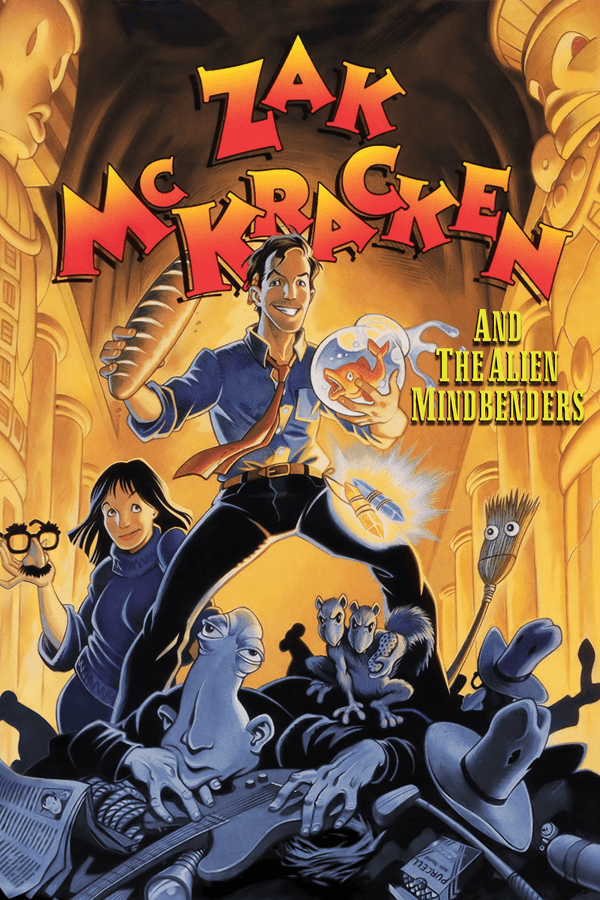
Zak McKracken and the Alien Mindbenders
aka Zak McCracken and the Alien Mindbenders
Rate this game
You start Zak McKracken and the Alien Mindbenders with a hangover, a goldfish bowl, and a cheap nose-and-glasses mask, only to discover that the telephone company is run by alien Caponians slowly dumbering down humanity with a 60 Hz hum.
A globe-trotting comedy built on the SCUMM engine
Following up on Maniac Mansion, project leader David Fox, along with Matthew Alan Kane and David Spangler, wanted to take the SCUMM interface out of a single spooky house and throw it across the entire planet. You play as Francis Zachary McKracken, a sensationalist reporter for the National Inquisitor tabloid, who teams up with freelance scientist Annie Larris and two Yale students, Melissa China and Leslie Bennett, who have somehow traveled to Mars in a modified van. Your goal is to defeat a conspiracy of extraterrestrials disguised as phone utility workers by assembling three pieces of an ancient Skolarian device driven by blue, yellow, and white crystals.
The game draws heavily from New Age ideas, UFO lore, and Fortean theories popular in the late eighties. The humour hits immediately through physical comedy and tabloid absurdities, like uncovering that Elvis Presley is actually an alien. The game box even shipped with a physical copy of the National Inquisitor, serving both as anti-piracy lookup codes and as a collection of puzzle hints disguised as outrageous news stories.
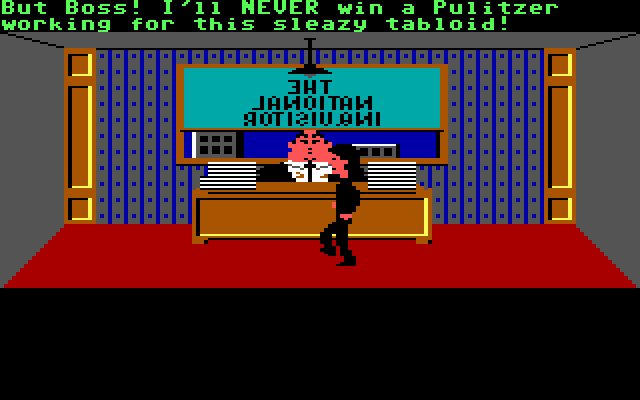
Four characters, ten cities, and the lethal threat of running out of cash in Zak McKracken and the Alien Mindbenders
Unlike its predecessor, which locked you into one setting, this campaign sends you hopping between San Francisco, Seattle, Miami, Cairo, Kinshasa, Katmandu, London, Lima, the Bermuda Triangle, and the surface of Mars. Managing four playable characters across two planets sounds fantastic on paper, but it introduces a level of inventory logistics that can drive you up the wall. You spend a lot of time passing cash, plane tickets, an egg, a bread wrapper, and essential tools between party members across thousands of miles.
The puzzles themselves range from genuinely funny visual gags to absolute brick walls of trial-and-error design. Bypassing a disguised Caponian using your fake nose disguise or distracting a guard with a two-headed squirrel feels great when it works. But the game constantly threatens to trap you in unwinnable states, a cruel feature that Lucasfilm Games LLC later famously abandoned in their design philosophy. The core player friction points come down to a few nasty traps:
- Running out of money: Air travel and bus rides cost actual in-game dollars, and if you waste your funds fly-hopping between cities before collecting necessary key items, you will end up stranded at an airport with no way to finish the game.
- Losing essential inventory items: Misplacing crucial tools or consuming items in the wrong location can silently break your playthrough hours before you realize it.
- Navigational mazes: Wandering through the repetitive corridors of the Sphinx or the Aztec pyramids without a map turns exploration into a chore.
- Micromanaging remote companions: Moving items between Earth and the two coeds on Mars demands precise, tedious steps that leave plenty of room for unrecoverable errors.
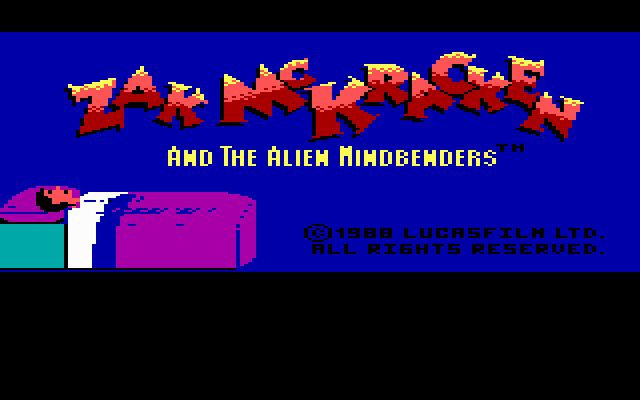
When SCUMM puzzle design goes too far into dead ends
If you look at adventure games released around 1988, the MS-DOS release of Zak McKracken pushed visual storytelling forward with its 2D scrolling background art and crisp side-view presentation. On an original PC setup, listening to the standard PC speaker beep out tunes made you crave a proper synthesizer card, but the graphics looked cleaner than Sierra's text-parser offerings at the time. Yet, where Sierra was notorious for dropping rocks on your head without warning, Zak McKracken achieved the same frustration through financial starvation and structural dead ends.
Retrospective reviews have been famously sharp about this side of the game. Critics at Rock Paper Shotgun tore into its nonsensical puzzles and impossible navigation logic, while Maximum Utmost noted that it fell into structural pitfalls that earlier releases avoided. It is a game where taking an egg into an airplane microwave or talking to a Shaman or a Guru can either reveal the path forward or subtly ruin your entire save file if done out of sequence. To enjoy it today, you have to accept that consultation with a walkthrough is not a failure of skill, but a necessary survival tool.
How to play Zak McKracken and the Alien Mindbenders today
Despite the punishing design flaws, the writing and sheer ambition of this cosmic farce make it worth playing. The dry jokes, the ridiculous disguises, and the grand multi-character setup show a studio stretching its wings, discovering what worked and what definitely needed to be thrown out before making The Secret of Monkey Island. If you approach it as 1980s conspiracy satire, saving early and saving often in different slots, you can appreciate the jokes while dodging the dead ends.
You can play Zak McKracken and the Alien Mindbenders online, free, right here in your browser, with nothing to install and no setup. Jump straight into Zak's apartment, grab the fish bowl, equip your fake glasses, and see if you have what it takes to save human intelligence before the Caponians turn everyone's brain to mush.
How Zak McKracken and the Alien Mindbenders is played — the keys the game listens to, grouped by what they do.
- Action
- Interface
- Right click / Esc — Bypass or skip a cutscene
Highlighted keys are mapped — hover or tap one to see what it does.
Mainly uses the mouse as the primary control method, but all verbs and inventory slots can be accessed via keyboard shortcuts. No remapping support.
Players' controls
Touch and gamepad controls
The on-screen keyboard and gamepad mapping the browser player uses on a phone, a tablet or a controller, as opposed to the real keys above. $PRO members make their own in the player and share them here; anyone can pick one to play with.
Make your own touch controlsPRO
- 1Open the editorSign in below, then pick what to make. The game starts with the editor open over it.
- 2Place your keysAdd keys and drag them where your thumbs rest, or map a controller's buttons. Test plays the game with them; Save keeps them, and you play with them from then on.
- 3Share themShare them right after saving in the game, or name and share them here. Players vote, and the best become this game's controls for everyone.
Go PROSee how it worksSign in+20 XP for sharing · +50 XP if yours become the game's own
- The game's own controlsKeyboardGamepadWhat every player starts with.In use
2 screenshots
From the archive
No gameplay video yet
No gameplay video for Zak McKracken and the Alien Mindbenders yet. Sign in to add one.
No reviews yet
Tell the community what you think of Zak McKracken and the Alien Mindbenders. Reviews are public and tied to your username.
No archived manuals for Zak McKracken and the Alien Mindbenders yet
No manuals archived for this title yet. Sign in to upload the first scan.
Cheat codes, console commands and memory pokes for Zak McKracken and the Alien Mindbenders — each one verified and attributed.
Sign in to submitNo cheats yet for this title
Know a working cheat, poke or trainer? Add it with the button above. Moderators check every entry before it goes live.
No archived soundtrack for Zak McKracken and the Alien Mindbenders yet
No soundtrack archived for this title yet. Sign in to upload the first rip.
No save states for Zak McKracken and the Alien Mindbenders yet
No save states for this title yet. Sign in to share one.
Discussions
Sign in to post- Threads0
- Total posts0
- Online now6
Community · Zak McKracken and the Alien Mindbenders
Who's contributing, and what's new
- Reviews0
- Threads0
- Uploadsapproved0
- Contributors0
Recent activity