
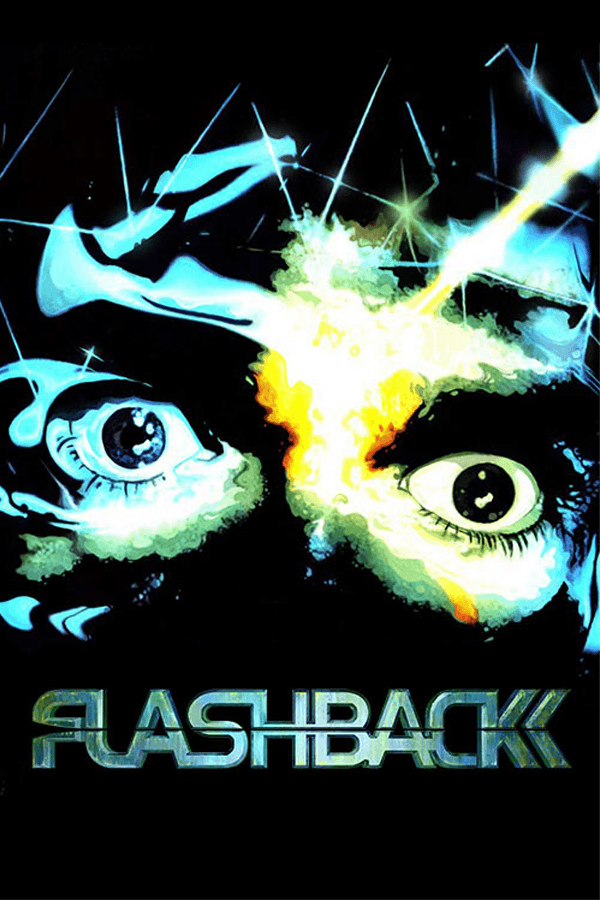

In Flashback: The Quest for Identity, you wake up in an alien jungle with an empty memory, a sidearm that never runs out of lead, and a body that moves only as fast as frame-by-frame animation allows.
Every single step in this 1993 action game requires commitment. Designer Paul Cuisset built the character system by recording real actors on video and tracing their motions onto transparencies, a technique that gives protagonist Conrad B. Hart realistic physical momentum. Because Conrad must finish his current animation frame before he can change direction or pull out his handgun, combat is less about quick reflexes and more about positioning.
If you sprint blindly across a flip-screen panel and run headlong into a mutant cop, you cannot simply stop on a dime and shoot. You have to wait for Conrad to skid to a stop, turn around, and draw his weapon. That deliberate speed completely changes how you approach an enemy encounter. You learn to stop one screen early, crouch behind a ledge, throw a stone onto a pressure pad to draw a patrol away, and draw your gun before stepping into the line of fire.
The gunplay relies on heavy spatial awareness. Conrad carries a pistol with infinite ammunition, but his survival hinges on a personal shield that absorbs incoming hits. Once those shield charges drain, a single stray laser bolt drops you. Recharging requires finding designated energy booths scattered across the levels, turning resource management into a spatial puzzle where you weigh pushing forward against backtracking to safety.
The campaign begins on Planet Titan in 2142, where Conrad crashes after escaping a group of shape-shifting aliens called Morphs. What follows is a globe-trotting sci-fi story that spans six distinct environments, ranging from dense alien vegetation to sprawling underground cities. To piece together his identity and warn Earth of an impending Morph invasion, Conrad must earn credits through odd jobs, navigate bureaucratic corridors, and secure keycards.
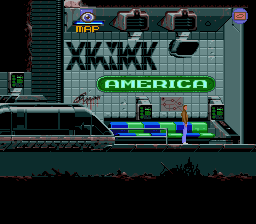
The structure shifts dramatically once you reach the underground city of New Washington. Instead of dodging alien wildlife, you take on work assignments to buy a global transit ticket, executing tasks like running errands or clearing out rogue security units. It plays like a light graphic adventure embedded inside a platformer, forcing you to talk to locals, manage inventory items, and use computer terminals.
That urban leg leads straight into the Death Tower, a broadcast gladiatorial contest where Conrad fights through room after room of heavily armed mercenaries and auto-defense sentinels. Surviving the game show grants passage to Earth, where the plot shifts from personal survival to uncovering a hidden Morph infiltration inside the highest levels of human government.
The engine uses a rigid, tile-based grid similar to the original Prince of Persia. A single step forward covers a fixed distance, meaning a running jump off a cliff edge will fail if you initiate the leap one pixel too early or too late. Missing a ledge means dropping into a pit, hitting a force field, or falling directly into the line of sight of a security turret.
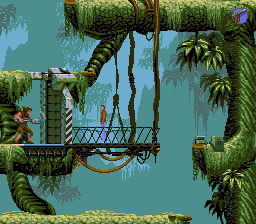
Modern players often clash with the save system. The game does not offer mid-level quicksaving; instead, you rely on rare, specific save terminals in the terrain and alphanumeric passwords granted at the start of new levels. Dying near the end of a long, switch-heavy puzzle panel often resets ten to fifteen minutes of methodical progress, forcing you to retrace steps and hit every elevator toggle all over again.
Backtracking is the primary penalty for mistakes. When you need to retrieve a keycard across three flip-screen rooms, a single misplaced drop off an air vent sends Conrad crashing to the floor below, requiring another circuit around the map. The game demands precise memory of guard routines and switch layouts rather than fast button mashing.
When Delphine Software International created the game, they built narrative cutscenes out of flat-shaded vector polygons. Computer Gaming World praised the introductory sequence in October 1993, highlighting its cinematic direction while noting that skilled players could push through the overall adventure quickly. Those vector sequences give pickup items, elevator rides, and narrative reveals a crisp graphical look that stood apart from traditional sprite animations.
Published on PC by Strategic Simulations, Inc. in 1993, the floppy disk release takes full advantage of period audio hardware. On an AdLib or Sound Blaster card, short synth cues punctuate moments of tension, while Roland MT-32 setups deliver richer MIDI brass and pads. The sound design stays quiet during standard exploration, letting footfalls, elevator hums, and draw-weapon clicks dominate the atmosphere until an alien drops from the ceiling.
The game went on to sell over 1.25 million copies across its various releases, entering records as a massive commercial success for a French studio. Regional differences popped up across ports; for instance, console editions toned down themes by renaming the Death Tower game show to Cyber Tower. Early design drafts were vastly different too, originally starting as a licensed space-mob concept described pitch-wise as a sci-fi Godfather before evolving into Conrad's alien conspiracy saga.
This cinematic platformer earns its reputation through tight environmental design and deliberate pacing. While the strict input buffering and password-only save points will frustrate anyone expecting loose control, mastering Conrad's leap-and-roll cadence pays off. Its atmospheric sci-fi world rewards patience over panicked firing.
If you want to play Flashback: The Quest for Identity MS-DOS game files without hunting down vintage computer hardware, you can launch the complete experience right now. You can play Flashback: The Quest for Identity online free in your browser right here, with no setup required. Just remember to holster your gun before talking to civil servants in New Washington, or the local police units will gun you down before you even accept your first contract job.
In Flashback: The Quest for Identity, you wake up in an alien jungle with an empty memory, a sidearm that never runs out of lead, and a body that moves only as fast as frame-by-frame animation allows.
Every single step in this 1993 action game requires commitment. Designer Paul Cuisset built the character system by recording real actors on video and tracing their motions onto transparencies, a technique that gives protagonist Conrad B. Hart realistic physical momentum. Because Conrad must finish his current animation frame before he can change direction or pull out his handgun, combat is less about quick reflexes and more about positioning.
If you sprint blindly across a flip-screen panel and run headlong into a mutant cop, you cannot simply stop on a dime and shoot. You have to wait for Conrad to skid to a stop, turn around, and draw his weapon. That deliberate speed completely changes how you approach an enemy encounter. You learn to stop one screen early, crouch behind a ledge, throw a stone onto a pressure pad to draw a patrol away, and draw your gun before stepping into the line of fire.
The gunplay relies on heavy spatial awareness. Conrad carries a pistol with infinite ammunition, but his survival hinges on a personal shield that absorbs incoming hits. Once those shield charges drain, a single stray laser bolt drops you. Recharging requires finding designated energy booths scattered across the levels, turning resource management into a spatial puzzle where you weigh pushing forward against backtracking to safety.
The campaign begins on Planet Titan in 2142, where Conrad crashes after escaping a group of shape-shifting aliens called Morphs. What follows is a globe-trotting sci-fi story that spans six distinct environments, ranging from dense alien vegetation to sprawling underground cities. To piece together his identity and warn Earth of an impending Morph invasion, Conrad must earn credits through odd jobs, navigate bureaucratic corridors, and secure keycards.
The structure shifts dramatically once you reach the underground city of New Washington. Instead of dodging alien wildlife, you take on work assignments to buy a global transit ticket, executing tasks like running errands or clearing out rogue security units. It plays like a light graphic adventure embedded inside a platformer, forcing you to talk to locals, manage inventory items, and use computer terminals.
That urban leg leads straight into the Death Tower, a broadcast gladiatorial contest where Conrad fights through room after room of heavily armed mercenaries and auto-defense sentinels. Surviving the game show grants passage to Earth, where the plot shifts from personal survival to uncovering a hidden Morph infiltration inside the highest levels of human government.
The engine uses a rigid, tile-based grid similar to the original Prince of Persia. A single step forward covers a fixed distance, meaning a running jump off a cliff edge will fail if you initiate the leap one pixel too early or too late. Missing a ledge means dropping into a pit, hitting a force field, or falling directly into the line of sight of a security turret.
Modern players often clash with the save system. The game does not offer mid-level quicksaving; instead, you rely on rare, specific save terminals in the terrain and alphanumeric passwords granted at the start of new levels. Dying near the end of a long, switch-heavy puzzle panel often resets ten to fifteen minutes of methodical progress, forcing you to retrace steps and hit every elevator toggle all over again.
Backtracking is the primary penalty for mistakes. When you need to retrieve a keycard across three flip-screen rooms, a single misplaced drop off an air vent sends Conrad crashing to the floor below, requiring another circuit around the map. The game demands precise memory of guard routines and switch layouts rather than fast button mashing.
When Delphine Software International created the game, they built narrative cutscenes out of flat-shaded vector polygons. Computer Gaming World praised the introductory sequence in October 1993, highlighting its cinematic direction while noting that skilled players could push through the overall adventure quickly. Those vector sequences give pickup items, elevator rides, and narrative reveals a crisp graphical look that stood apart from traditional sprite animations.
Published on PC by Strategic Simulations, Inc. in 1993, the floppy disk release takes full advantage of period audio hardware. On an AdLib or Sound Blaster card, short synth cues punctuate moments of tension, while Roland MT-32 setups deliver richer MIDI brass and pads. The sound design stays quiet during standard exploration, letting footfalls, elevator hums, and draw-weapon clicks dominate the atmosphere until an alien drops from the ceiling.
The game went on to sell over 1.25 million copies across its various releases, entering records as a massive commercial success for a French studio. Regional differences popped up across ports; for instance, console editions toned down themes by renaming the Death Tower game show to Cyber Tower. Early design drafts were vastly different too, originally starting as a licensed space-mob concept described pitch-wise as a sci-fi Godfather before evolving into Conrad's alien conspiracy saga.
This cinematic platformer earns its reputation through tight environmental design and deliberate pacing. While the strict input buffering and password-only save points will frustrate anyone expecting loose control, mastering Conrad's leap-and-roll cadence pays off. Its atmospheric sci-fi world rewards patience over panicked firing.
If you want to play Flashback: The Quest for Identity MS-DOS game files without hunting down vintage computer hardware, you can launch the complete experience right now. You can play Flashback: The Quest for Identity online free in your browser right here, with no setup required. Just remember to holster your gun before talking to civil servants in New Washington, or the local police units will gun you down before you even accept your first contract job.
How Flashback: The Quest for Identity is played — the keys the game listens to, grouped by what they do.
Highlighted keys are mapped — hover or tap one to see what it does.
The on-screen keyboard and gamepad mapping the browser player uses on a phone, a tablet or a controller, as opposed to the real keys above. $PRO members make their own in the player and share them here; anyone can pick one to play with.
Cheat codes, console commands and memory pokes for Flashback: The Quest for Identity — each one verified and attributed.
Sign in to submitaka Flashback · Flashback (Enhanced CD-ROM)
How Flashback: The Quest for Identity is played — the keys the game listens to, grouped by what they do.
Highlighted keys are mapped — hover or tap one to see what it does.
The on-screen keyboard and gamepad mapping the browser player uses on a phone, a tablet or a controller, as opposed to the real keys above. $PRO members make their own in the player and share them here; anyone can pick one to play with.
Cheat codes, console commands and memory pokes for Flashback: The Quest for Identity — each one verified and attributed.
Sign in to submit