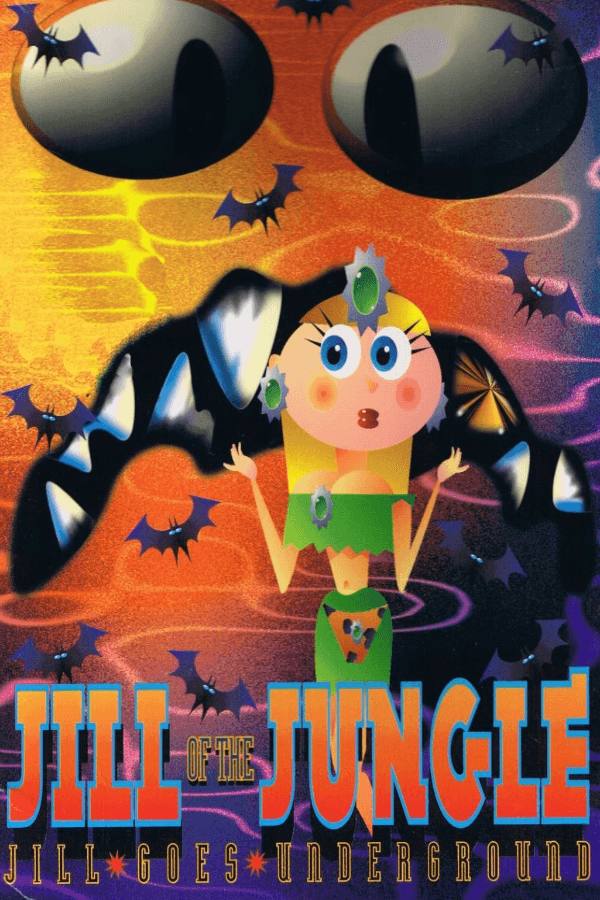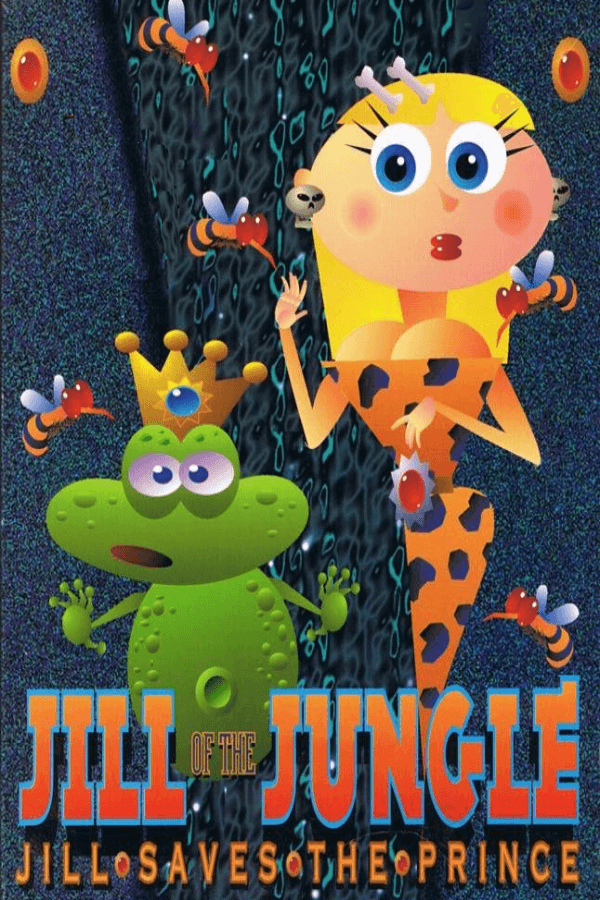


Jill of the Jungle
Rate this game
- Played often
Long before PC hardware had dedicated graphics chips to handle fluid action, Jill of the Jungle brought fast, smooth-scrolling platforming to VGA displays straight out of Columbia, Maryland. Designed and coded almost entirely by Epic MegaGames founder Tim Sweeney, it gave computer owners a sharp, colorful alternative to console platformers without requiring a dedicated gaming rig.
Getting smooth 2D scrolling onto PC monitors was a messy business
In the early nineties, IBM-compatible PCs were built for spreadsheets and database management, not for tracking fast-moving sprites across a scrolling background. Console systems had hardware custom-built for tile-based scrolling, but an MS-DOS machine forced programmers to handle every pixel swap directly in software. When Sweeney set out to build a side-scrolling action game in 1992, the biggest hurdle was preventing screen tearing while keeping the framerate from chugging whenever more than two enemies shared the screen.
His solution was a custom 2D engine built around 256-color VGA graphics. The code managed display buffers so efficiently that a standard 386 processor could glide through levels at a steady pace. That same underlying technology was refined a year later for Xargon, but here it made its debut powering the adventures of an Amazon warrior in a green outfit who spent her afternoons clearing monsters out of overgrown ruins.
The game was distributed using Apogee's shareware model. The first episode circulated for free on bulletin board systems and cheap floppy disks, while the remaining two episodes were ordered directly from Epic by mail or phone. In the early weeks, order forms trickled in at a rate of twenty to thirty sales a day, generating the initial capital that established Epic MegaGames as a major force in PC software.
Transformations and precision platforming in Jill of the Jungle
When you start a level in Jill of the Jungle, the primary goal is finding the right matching keys and colored gems to clear gates that block the exit door. You jump between floating ledges, toggle elevators, pull switches, and dodge environmental hazards like falling boulders and bed-of-nails spike pits. Jill defends herself using a throwing knife that behaves like a boomerang, returning to her hand after each toss, along with a high-damage spinning blade weapon.
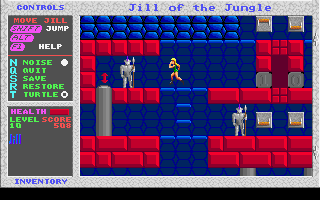
What sets the level design apart is Jill's ability to touch magical icons and transform into different creatures to solve specific terrain puzzles. Walking onto a transformation tile can turn her into one of three shapes:
- A flying phoenix that lets you rise straight over high walls and dodge ground-bound enemies.
- A jumping frog that can vault across massive gaps and fit into tight vertical shafts.
- A shooting fish capable of swimming through underwater currents while firing projectiles at piranhas and stingrays.
The level slate moves beyond standard jungle themes quickly. You drop into stages like "The Aqueduct", "The Dam", "The Ship of the Giant Green Lizard Men", and mind-bending challenge maps like "The Mega Puzzle" and "Knight's Puzzle". The final episode flips the standard save-the-princess narrative by sending Jill into "The Castle" to rescue an endangered prince. Conspicuously absent are traditional end-of-level boss fights; progress is governed entirely by stage navigation, hazard evasion, and puzzle layout.
Sound chips, shareware checks, and secret engine codes
The audiovisual presentation was a clear talking point for anyone who owned an AdLib or Sound Blaster card at the time. Composer Dan Froelich wrote the soundtrack using AdLib Visual Composer, authoring tracks in the native .ROL format before translating them into .CMF files for the game's audio driver. Played back through Yamaha's OPL2 FM synthesis chip, the soundtrack delivered rich FM synthesizer leads that stood far above the tiny blips of a standard PC Speaker.
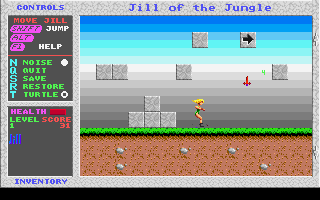
That sound code wasn't without its quirks on real hardware. Sound Blaster setups frequently suffered from digital audio glitches where digitized sound effects became muffled or dropped in volume altogether while the FM music kept rolling. If your audio started acting up, tapping specific key combinations could clear memory buffers or surface internal diagnostic data. Pressing 'Z' three times in rapid succession brings up a live free memory display, while tapping 'W' three times outputs scancode debug values.
Artists Joe Hitchens and John Pallett-Plowright crafted bright graphics that looked stunning on high-end CRTs, even if the individual tiles sometimes looked more like abstract geometric shapes than real foliage. Sweeney also left a fully functional, hidden level editor built right into the main executable, allowing players who knew the correct key combinations to tweak layout data or build custom stages from scratch.
Where the controls fall flat and why it still demands your attention
For all its technical ingenuity, this 1992 release carries control quirks that will test your patience. Jill's jumps carry an unusual floatiness with heavy inertia. Once you commit to a direction in mid-air, redirecting her path is difficult, which turns tight platform sequences into nerve-wracking calculation jumps. A single misjudged leap on late-game stages like "The Pyramid Puzzle" sends you tumbling into a bed of spikes, forcing a full level restart.
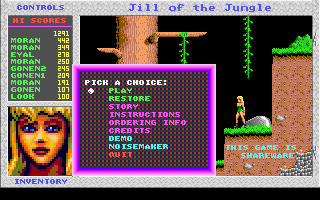
Enemies do not telegraph their movements with modern finesse either. Giant ants, scorpions, bees, and green lizard men move on rigid patrol tracks or jitter erratically across floors. Because collision boxes are generous, climbing down a ladder into an unseen enemy patrol often means taking unavoidable damage. The option to save your game state at any moment compensates for these sudden difficulty spikes, letting you save right before attempting a risky maneuver.
Plans for an official sequel called Jill of the Jungle II were eventually restructured into a separate standalone release named Vinyl Goddess from Mars in 1995. Yet the original trilogy remains the definitive template for Epic's early platforming era, striking a memorable balance between action, exploration, and weird animal transformations.
You can play this classic directly in your browser window
You can run this MS-DOS classic right here on this page without fiddling with custom mounts or executable files. Launching the game directly through your browser preserves every frame of the original 256-color VGA graphics, giving you instant access to all three shareware episodes.
If you have never experienced this piece of PC history, running the Jill of the Jungle MS-DOS game online gives you an immediate feel for how early nineties platformers handled momentum and level structure. The floaty jump mechanics and sharp FM tunes come across instantly the moment you step into the first stage, making it easy to see how a simple shareware title launched one of the biggest studios in modern software development.
How Jill of the Jungle is played — the keys the game listens to, grouped by what they do.
- Movement
- Action
- Interface
- Other
Highlighted keys are mapped — hover or tap one to see what it does.
Controls can be remapped or configured using SETUP.EXE. Joysticks are supported but require proper calibration.
Players' controls
Touch and gamepad controls
The on-screen keyboard and gamepad mapping the browser player uses on a phone, a tablet or a controller, as opposed to the real keys above. $PRO members make their own in the player and share them here; anyone can pick one to play with.
Make your own touch controlsPRO
- 1Open the editorSign in below, then pick what to make. The game starts with the editor open over it.
- 2Place your keysAdd keys and drag them where your thumbs rest, or map a controller's buttons. Test plays the game with them; Save keeps them, and you play with them from then on.
- 3Share themShare them right after saving in the game, or name and share them here. Players vote, and the best become this game's controls for everyone.
Go PROSee how it worksSign in+20 XP for sharing · +50 XP if yours become the game's own
- The game's own controlsKeyboardGamepadWhat every player starts with.In use
3 screenshots
From the archive
No gameplay video yet
No gameplay video for Jill of the Jungle yet. Sign in to add one.
No reviews yet
Tell the community what you think of Jill of the Jungle. Reviews are public and tied to your username.
No archived manuals for Jill of the Jungle yet
No manuals archived for this title yet. Sign in to upload the first scan.
Cheat codes, console commands and memory pokes for Jill of the Jungle — each one verified and attributed.
Sign in to submitNo cheats yet for this title
Know a working cheat, poke or trainer? Add it with the button above. Moderators check every entry before it goes live.
No archived soundtrack for Jill of the Jungle yet
No soundtrack archived for this title yet. Sign in to upload the first rip.
No save states for Jill of the Jungle yet
No save states for this title yet. Sign in to share one.
Discussions
Sign in to post- Threads0
- Total posts0
- Online now6
Community · Jill of the Jungle
Who's contributing, and what's new
- Reviews0
- Threads0
- Uploadsapproved0
- Contributors0
Recent activity