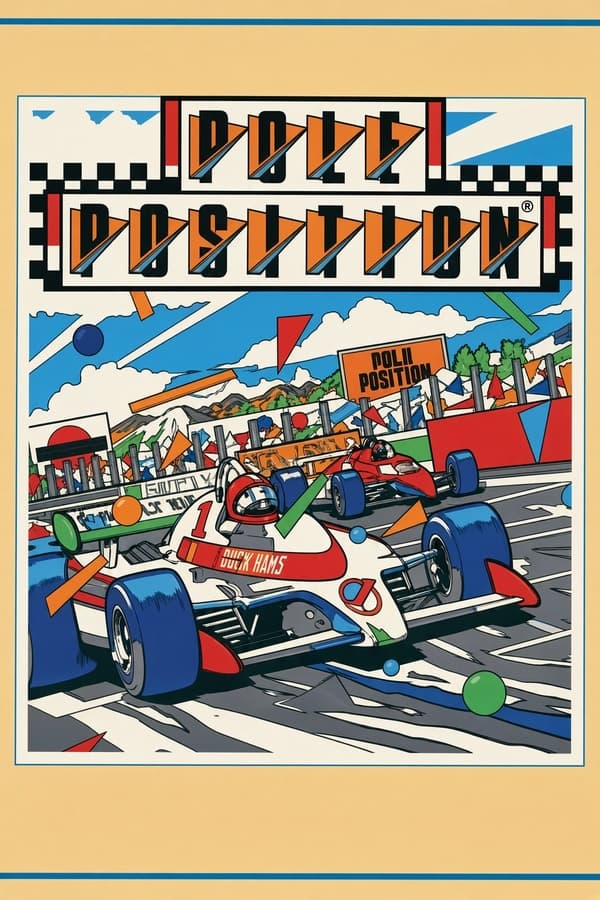
Pole Position
aka Arcade Archives POLE POSITION · Rekor Arabaları
In 1988, bringing Pole Position to home PCs meant taking the arcade racer that ate quarters in 1983 and shrinking it down to fit the hardware of the IBM XT era.
Arcade racing scaled down to fit an IBM XT
Arcade cabinets in the early eighties relied on custom chips to push scaling sprites and crisp audio, but translating that experience to early DOS machines required compromises. The 1988 release of Pole Position on PC from Thunder Mountain attempt to capture the arcade thrill on an 8088 processor with four-color CGA graphics. While the visual downgrade was stark, the basic driving loop survived intact, delivering a fast-paced game of precise steering and split-second dodging.
You sit behind the wheel of a Formula 1 car viewed from a classic behind-car perspective. There are no weapon pickups, engine upgrades, or alternate tracks to select. Everything depends on how cleanly you can thread your car through tight curves while navigating around slower opponents scattered across the track.
Qualifying for the Grand Prix demands tight timing
Before you get to line up against the main field of cars, the game forces you to prove your skills in a high-stakes qualifying run. You get one single lap to beat a target time of 73 seconds. If you fail to break that threshold, your run simply transitions into a timed exercise where you drive until the overall 90-second clock runs out, leaving you with a game over and no spot in the main race.
Making the grid depends on squeezing every millisecond out of the layout:
- Crossing the finish line under 58.50 seconds earns you the coveted pole position in the front starting spot along with a massive point bonus.
- Times between 58.50 and 73.00 seconds place you progressively further back across eight available starting grid slots.
- Passing rivals along the track grants 50 extra points per car passed.
- Distance covered adds 50 points for every 5 meters traveled, while unused time converts into 200 bonus points per remaining second.
When you secure a spot on the grid, the real challenge begins. The Grand Prix race sets you against a strict countdown timer for each lap alongside a track crowded with competitor cars. Running out of time on any individual lap ends the entire run instantly, putting immense pressure on every turn you take.
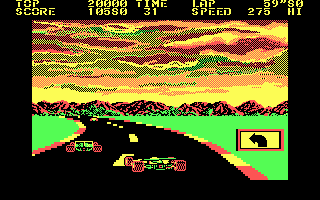
CGA visuals and silent engines mark the PC port
The visual presentation of this 1988 PC edition relies on low-resolution CGA graphics, which renders the environment using cyan, magenta, black, and white. The track scenery is repetitive, with simple billboards and green borders lining the asphalt. While the scaling on approaching rival cars feels surprisingly fast for an 8088 CPU, the blocky visuals make it difficult to judge exact distances until an enemy racer is right on top of you.
The audio side suffers an even harsher fate. While the arcade original made great use of engine roars and tire screeches, the PC Speaker in this racing game stays entirely silent during actual driving. The lack of engine sounds or collision crashes leaves the racing feeling detached, meaning you have to rely purely on visual cues to gauge your speed and position.
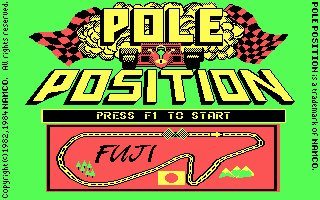
Keyboard controls keep the racing responsive
Despite the visual flaws and silence, the control scheme for this Namco Limited design works well on a standard keyboard. Steering feels direct, which you need for quick adjustments through long turns. There are no complicated keys to learn, letting you focus on keeping top speed without clipping the grass or slamming into rivals.
The core friction point for modern players is the unforgiving timer and collision penalty. Brushing against another car or sliding into a roadside sign causes an immediate, dramatic crash that wipes away precious seconds. In a game where losing two seconds means failing to qualify or running out of Grand Prix time, a single mistake usually ruins the entire run. I found that mastering the subtle art of letting off the accelerator just before a tight bend is the only way to avoid catastrophic wipeouts.
Why trying this arcade classic is worth your time today
The original arcade release of Pole Position was designed by arcade legends including Kazunori Sawano and Sho Osugi, going on to become the highest-grossing arcade cabinet globally in 1983. While this DOS conversion strips away the original soundscape and color palette, it retains the core tension of driving on the edge of control against a merciless clock.
It shows how late-eighties developers squeezed high-speed arcade racing out of limited PC hardware. Anyone interested in early motorsport games or arcade conversions will find a tough, twitch-reflex test here.
You can play Pole Position free in your browser right now with no setup required. Jump straight onto the grid, test your reflexes against the 73-second qualifying timer, and see if you have what it takes to take first place in this early PC port.