
Test Drive
aka 试验驾驶
Rate this game
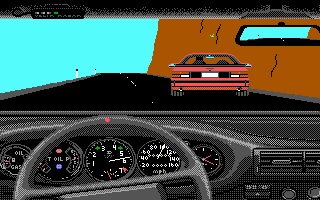
Playing Test Drive meant staring through a simulated windshield at a two-lane mountain highway, constantly balancing speed against the threat of a shattered glass life-loss animation.
Five supercars and a single cliffside road
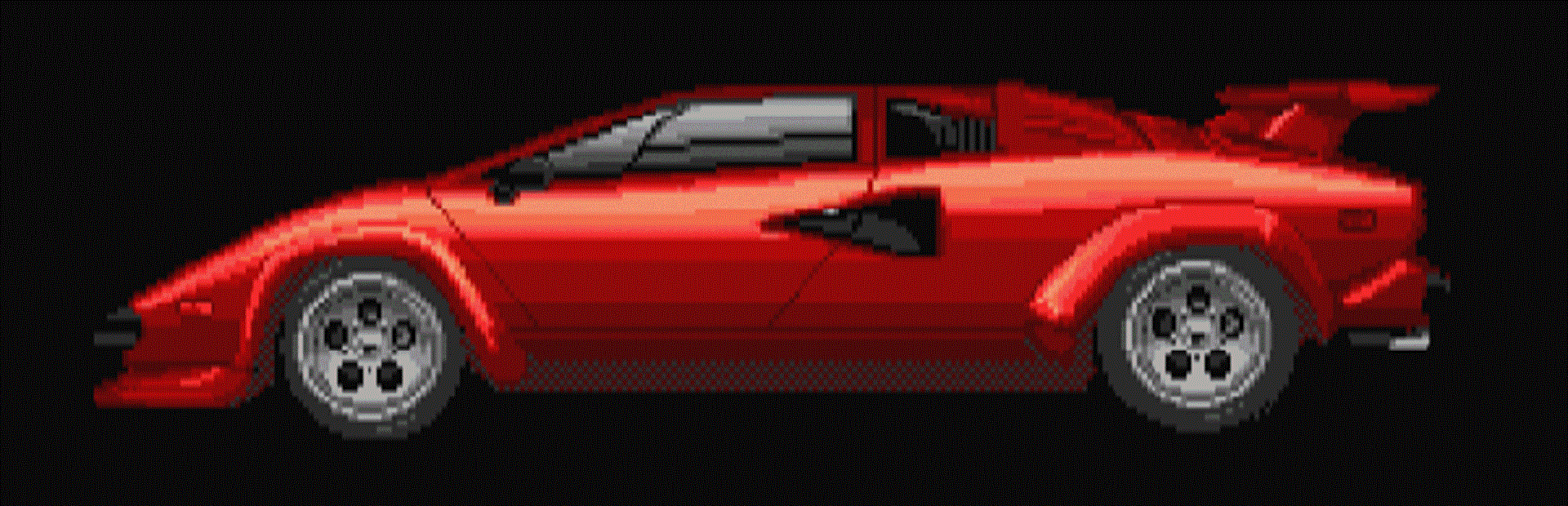
The core design of Test Drive strips away traditional lap-based circuits in favor of a straightforward premise: select one of five exotic supercars and survive five stretches of a narrow, winding mountain road. Your lineup includes the Lamborghini Countach, Lotus Esprit Turbo, Chevrolet Corvette C4, Porsche 911 Turbo, and Ferrari Testarossa. Once you make your pick from the showroom menu, the view shifts directly inside the cockpit, complete with a functional steering wheel, a side rear-view mirror, and an analog dashboard. On MS-DOS, playing in 16-color EGA mode gave those interior dashboards distinct personality, even if the road ahead was drawn with minimal roadside scenery.
Every vehicle forces you to shift gears manually. If you ignore the tachometer and redline the needle for too long, your engine instantly blows up, ending your run on the spot. Traffic constantly comes straight at you in the left lane, forcing you to time passes around slower-moving haulers. To make matters worse, oncoming road hazards like fallen rocks sit in your path, and sharper bends in the later mountain stretches will fling your car straight over the edge of the drop-off if you take them too fast.
Outrunning the cops in Test Drive
The primary mechanic that separates this title from pure arcade racers is the constant threat of police speed traps. Mounted on your windshield is a functional radar detector that starts beeping as you approach a speed trap. Once the alarm sounds, you have a split-second decision to make: slam on the brakes to get under the limit, or drop down a gear, floor it, and try to outrun the squad car that pulls out behind you. If the cop manages to pass you, you get pulled over, handed a ticket, and lose valuable time off your overall score.
The real trouble starts when you try to juggle a police chase alongside the game's traffic. Passing a truck on a blind curve while a patrol car is tailing you usually ends in a head-on collision. A crash shatters your windshield, costs a life, drops your score, and resets your vehicle from a complete standstill on the shoulder. Because reaching the highest possible speed is required to score well, taking zero risks means placing low on the leaderboard, but taking one risk too many leaves you staring at spiderwebbed glass.
How Distinctive Software designed around hardware limits
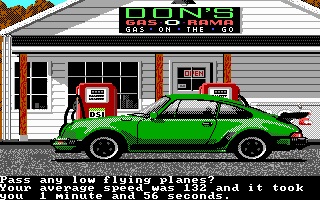
Developed by Distinctive Software, Inc. and published by Accolade, Inc., the game became a massive commercial success, selling over 400,000 copies. The development team included programmers and designers like Don Mattrick, Kevin Pickell, and Bruce Dawson, many of whom would later take the driving concepts pioneered here to assist in creating the original Need for Speed series. To make the game accessible across a wide range of late-80s PCs, the developers built support for multiple display adapters, ranging from monochrome Hercules and 4-color CGA graphics up to standard 16-color EGA displays.
While magazines like Computer Gaming World lauded the title for its detailed visual perspective and the thrill of outrunning highway patrolmen, contemporary outlets like Compute! rightly pointed out its major design weakness: the game features only one single course divided by gas station refueling stops. Furthermore, PC magazine reviews at the time frequently complained about the constant disk reads when transitioning between segments. If you played it off floppy drives back in 1987, you spent a noticeable portion of your session waiting for the next segment to load from the drive bay.
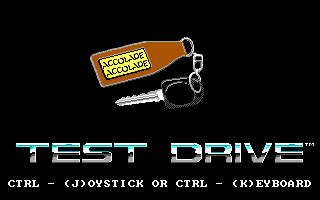
A mechanical model that heavily punished small mistakes
As a 1st-person driving simulation, the game is uncompromising about mechanical details. It abstracts away complex physics, but it holds you strictly accountable for engine management and stickshift timing. Misjudging a clutch shift or pushing past the redline snaps your engine in half instantly. Early players found that severity infuriating; one minor slip of the keyboard while passing a sedan ruins an attempt across all five mountain stages.
Interestingly, porting quirks slipped into other platforms as well. On the Commodore 64 version, the in-game manual lists the Chevrolet Corvette with four standard gears plus an overdrive, but due to a coding error in that specific build, players could only ever shift through three gears plus overdrive. Despite these rough edges across different home ports, the MS-DOS release established the template for first-person supercar games across the entire industry.
How to play Test Drive free in your browser today
If you want to experience where the franchise started, you can play Test Drive online right now. Modern players often expect full analog steering drift or forgiving wall-bounces, but this game will correct those habits on your very first turn. The key to keeping your car intact is respecting the tachometer: keep your eyes on the radar detector, shift down early when taking sharp mountain curves, and never try to pass a car unless you can clearly see the horizon ahead in the left lane.
You can run this full Test Drive MS-DOS game free in your browser directly on this page, complete with authentic EGA colors and original PC speaker audio, with no installation needed. Select the Lotus Esprit for a slightly easier handle on the corners, or pick the Lamborghini Countach if you want to test your raw reaction times against the mountain speed traps.
How Test Drive is played — the keys the game listens to, grouped by what they do.
- Movement
- Action
- Interface
Highlighted keys are mapped — hover or tap one to see what it does.
If using a physical joystick, calibrate it properly to avoid severe steering drift.
Players' controls
Touch and gamepad controls
The on-screen keyboard and gamepad mapping the browser player uses on a phone, a tablet or a controller, as opposed to the real keys above. $PRO members make their own in the player and share them here; anyone can pick one to play with.
Make your own touch controlsPRO
- 1Open the editorSign in below, then pick what to make. The game starts with the editor open over it.
- 2Place your keysAdd keys and drag them where your thumbs rest, or map a controller's buttons. Test plays the game with them; Save keeps them, and you play with them from then on.
- 3Share themShare them right after saving in the game, or name and share them here. Players vote, and the best become this game's controls for everyone.
Go PROSee how it worksSign in+20 XP for sharing · +50 XP if yours become the game's own
- The game's own controlsKeyboardGamepadWhat every player starts with.In use
3 screenshots
From the archive
No reviews yet
Tell the community what you think of Test Drive. Reviews are public and tied to your username.
No archived manuals for Test Drive yet
No manuals archived for this title yet. Sign in to upload the first scan.
Cheat codes, console commands and memory pokes for Test Drive — each one verified and attributed.
Sign in to submitNo cheats yet for this title
Know a working cheat, poke or trainer? Add it with the button above. Moderators check every entry before it goes live.
No archived soundtrack for Test Drive yet
No soundtrack archived for this title yet. Sign in to upload the first rip.
No save states for Test Drive yet
No save states for this title yet. Sign in to share one.
Discussions
Sign in to post- Threads0
- Total posts0
- Online now6
Community · Test Drive
Who's contributing, and what's new
- Reviews0
- Threads0
- Uploadsapproved0
- Contributors0
Recent activity
Nothing here yet
Reviews, discussion threads and approved uploads appear here as members add them.