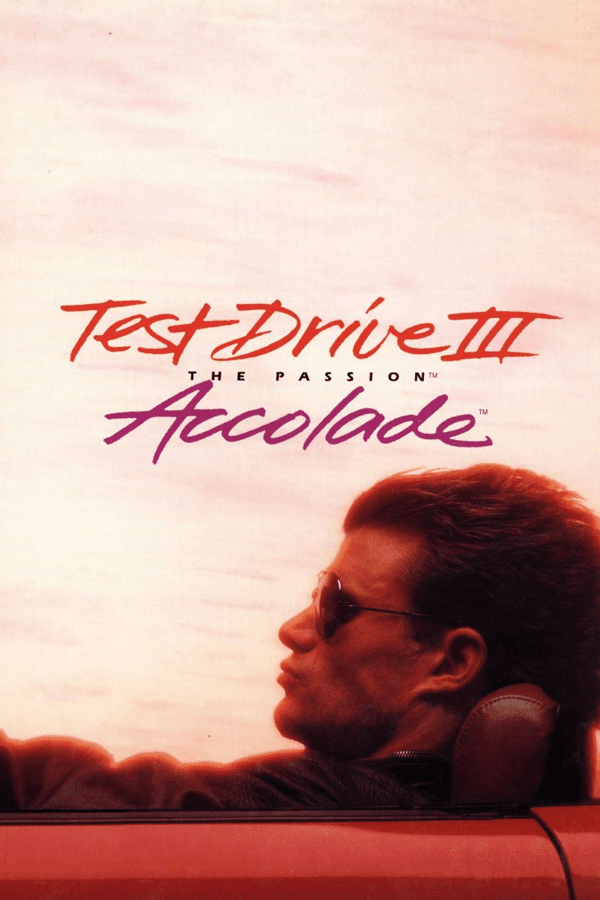

Test Drive III: The Passion took the series off the strictly paved, ribbon-like tracks of its past and dumped players directly into a fully three-dimensional Northern California landscape full of traffic, train tracks, and sudden off-road shortcuts.
By 1990, sprite-based driving games were hitting a ceiling. Stacking 2D trees and road signs alongside a flat bitmap track created a convincing illusion of speed, but you could never turn off the designated road. Developer and publisher Accolade shifted the third entry in their flagship driving franchise to a polygon-mesh engine, changing how players approached every mile of the journey.
Instead of staying trapped between invisible barriers, Test Drive III: The Passion lets you cut across grassy fields, steer over rolling hills, and drive straight through farmland to shave seconds off your time. The trade-off for this freedom was visual complexity. On the hardware of its day, rendering whole 3D environments required serious compromise in frame rate, but it gave the MS-DOS platformer and simulation crowd something rare: a legitimate open route where choosing an unconventional path was a viable strategy rather than an instant crash.
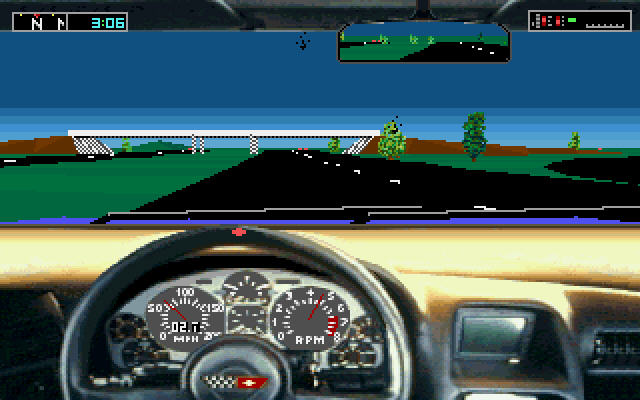
The car lineup leaned heavily into high-concept performance. Players select between three distinct vehicles: the production Lamborghini Diablo, the sleek Ferrari Mythos Pininfarina Concept, and the experimental Chevrolet Corvette CERV III Concept. Each vehicle features a fully digitized dashboard complete with functional gauges, gear shifts, and interactive interior controls.
Those interior controls were more than decorative touches. The game introduced small operational details that demanded your attention while navigating traffic:
The primary route runs through a five-section stretch of Northern California, moving from the Scenic Coast into the Coast Hills, down through Valley Farms, across the Foothills, and finally into Sierra Vista toward Yosemite. Along the way, dynamic hazards constantly threaten your run. A train might cut off a railroad crossing just as you approach at top speed, wandering cows in pasture sections can bring your exotic car to an abrupt halt, and radar-equipped police officers will pull you over and hand out fines if you blow past them above the limit.
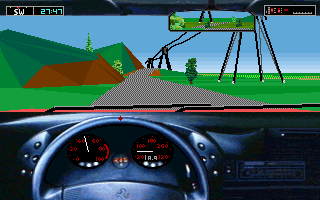
When magazines reviewed the game at release, the reception was split between genuine awe at the engine and frustration with the hardware requirements. Compute! awarded it four out of five stars, praising the unmatched detail, realism, and sound, while pointing out that shipping with only one main course felt light on content. Computer Gaming World highlighted the weather effects, interactive wipers, flexible terrain handling, and the F10 instant replay key, which let players rewatch their runs with full camera control.
Playing the 1990 original today reveals clear flaws that period praise sometimes glossed over. The most severe issue is the handling. Steering via keyboard or standard analog joystick feels sluggish and heavy, turning sharp corners into a guessing game of input delay. Furthermore, the engine code is notoriously tied to CPU speed. Run this title on anything faster than an era-appropriate 386 or mid-range 486 processor without severe throttling, and the game accelerates into an unplayable frenzy where your car hits a wall before you can register a single keypress.
Despite the steep control learning curve and the limits of early 3D rendering, this release captures a shift in the racing and driving genre. Accolade took a massive gamble by abandoning safe 2D sprites in favor of spatial freedom, laying ground rules for open-world routes that would take another decade to become standard industry practice.
If you want to experience this piece of PC history without fighting autoexec files, CPU slow-down utilities, or sound card IRQ conflicts, you can play Test Drive III: The Passion free in your browser right now. The interactive dashboard gadgets, working wipers, and open-ended California countryside still hold plenty of charm, provided you stay on the lookout for roaming cattle and keep your eyes peeled for the highway patrol.
Test Drive III: The Passion took the series off the strictly paved, ribbon-like tracks of its past and dumped players directly into a fully three-dimensional Northern California landscape full of traffic, train tracks, and sudden off-road shortcuts.
By 1990, sprite-based driving games were hitting a ceiling. Stacking 2D trees and road signs alongside a flat bitmap track created a convincing illusion of speed, but you could never turn off the designated road. Developer and publisher Accolade shifted the third entry in their flagship driving franchise to a polygon-mesh engine, changing how players approached every mile of the journey.
Instead of staying trapped between invisible barriers, Test Drive III: The Passion lets you cut across grassy fields, steer over rolling hills, and drive straight through farmland to shave seconds off your time. The trade-off for this freedom was visual complexity. On the hardware of its day, rendering whole 3D environments required serious compromise in frame rate, but it gave the MS-DOS platformer and simulation crowd something rare: a legitimate open route where choosing an unconventional path was a viable strategy rather than an instant crash.

The car lineup leaned heavily into high-concept performance. Players select between three distinct vehicles: the production Lamborghini Diablo, the sleek Ferrari Mythos Pininfarina Concept, and the experimental Chevrolet Corvette CERV III Concept. Each vehicle features a fully digitized dashboard complete with functional gauges, gear shifts, and interactive interior controls.
Those interior controls were more than decorative touches. The game introduced small operational details that demanded your attention while navigating traffic:
The primary route runs through a five-section stretch of Northern California, moving from the Scenic Coast into the Coast Hills, down through Valley Farms, across the Foothills, and finally into Sierra Vista toward Yosemite. Along the way, dynamic hazards constantly threaten your run. A train might cut off a railroad crossing just as you approach at top speed, wandering cows in pasture sections can bring your exotic car to an abrupt halt, and radar-equipped police officers will pull you over and hand out fines if you blow past them above the limit.

When magazines reviewed the game at release, the reception was split between genuine awe at the engine and frustration with the hardware requirements. Compute! awarded it four out of five stars, praising the unmatched detail, realism, and sound, while pointing out that shipping with only one main course felt light on content. Computer Gaming World highlighted the weather effects, interactive wipers, flexible terrain handling, and the F10 instant replay key, which let players rewatch their runs with full camera control.
Playing the 1990 original today reveals clear flaws that period praise sometimes glossed over. The most severe issue is the handling. Steering via keyboard or standard analog joystick feels sluggish and heavy, turning sharp corners into a guessing game of input delay. Furthermore, the engine code is notoriously tied to CPU speed. Run this title on anything faster than an era-appropriate 386 or mid-range 486 processor without severe throttling, and the game accelerates into an unplayable frenzy where your car hits a wall before you can register a single keypress.

Despite the steep control learning curve and the limits of early 3D rendering, this release captures a shift in the racing and driving genre. Accolade took a massive gamble by abandoning safe 2D sprites in favor of spatial freedom, laying ground rules for open-world routes that would take another decade to become standard industry practice.
If you want to experience this piece of PC history without fighting autoexec files, CPU slow-down utilities, or sound card IRQ conflicts, you can play Test Drive III: The Passion free in your browser right now. The interactive dashboard gadgets, working wipers, and open-ended California countryside still hold plenty of charm, provided you stay on the lookout for roaming cattle and keep your eyes peeled for the highway patrol.
How Test Drive III: The Passion is played — the keys the game listens to, grouped by what they do.
Highlighted keys are mapped — hover or tap one to see what it does.
Graphics and joystick settings are configured using SETUP.EXE in the game directory.
The on-screen keyboard and gamepad mapping the browser player uses on a phone, a tablet or a controller, as opposed to the real keys above. $PRO members make their own in the player and share them here; anyone can pick one to play with.
Cheat codes, console commands and memory pokes for Test Drive III: The Passion — each one verified and attributed.
Sign in to submit
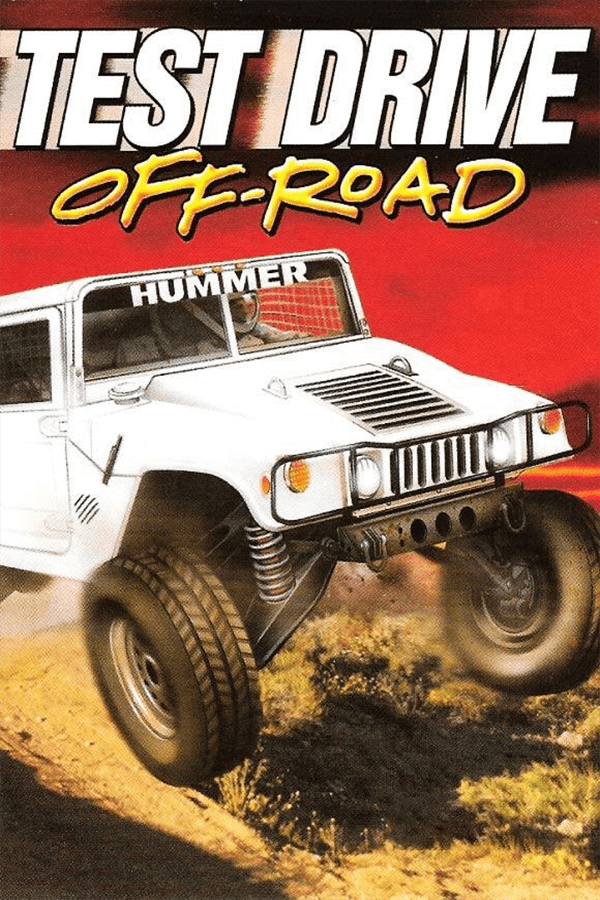
Test Drive: Off-Road1997Cheat codes, console commands and memory pokes for Test Drive III: The Passion — each one verified and attributed.
Sign in to submit
Test Drive: Off-Road1997